
Teens Engage More with Fewer Photos: Unmasking the "Popularity Engine" of Adolescent Instagram Use
Teens Engage More with Fewer Photos: Temporal and Comparative Analysis on Behaviors in Instagram
This paper presents a large-scale computational and comparative analysis of Instagram behaviors between teens (13-19) and adults (25-39). Using a dataset of over 26,000 users and longitudinal tracking, it reveals that while teens are often viewed as more "active," they actually post fewer photos than adults but engage significantly more through interactive features like Likes, comments, and tagging.
TL;DR
Is the common trope that teens are "addicted" to social media accurate? This large-scale study finds that while teens are indeed more interactive, they are surprisingly more selective and "stingy" with their permanent content compared to adults. By analyzing 26,885 users, researchers found that teens curate their profiles like a high-stakes popularity contest, deleting photos that don't perform well and using comments as a hyper-fast chat room.
Problem & Motivation: Beyond the Survey
For years, we've relied on what teens say they do on social media. However, self-reporting is notoriously biased. We know teens are "digital natives," but does that mean they post more? Or just that they use the tools differently? The challenge has always been the data: Instagram doesn't give you a user's birthdate. This study bridges that gap by using AI to identify ages and then tracking their behavior over time to see what’s actually happening behind the screen.
Methodology: The Hybrid Detection Lens
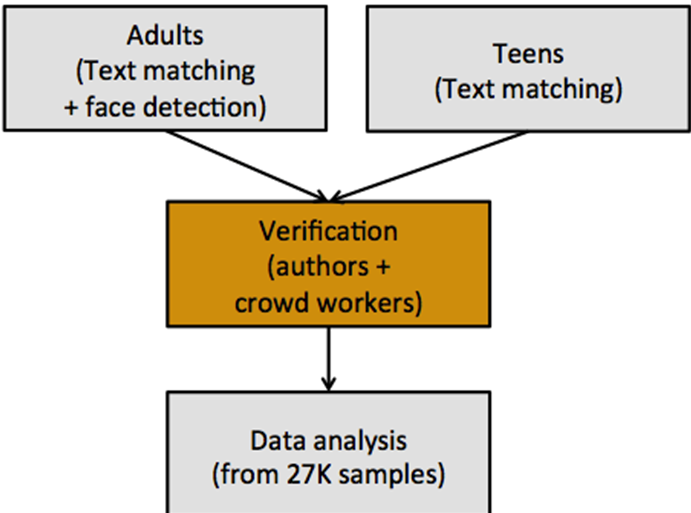
The researchers didn't just guess ages. They used a sophisticated two-step process:
- Textual Pattern Matching: Searching bios for strings like "I'm 17."
- Facial Recognition: Using the Face++ API to estimate age from profile pictures.
- Human Verification: Double-checking results via Amazon Mechanical Turk.
With this verified cohort, they tracked 12 days of temporal data to see not just what users shared, but what they deleted.
Methodology Detail: Why the Difference?
The study used LDA (Latent Dirichlet Allocation) to categorize photo topics and LIWC (Linguistic Inquiry and Word Count) to analyze the emotional tone of comments. They weren't just looking at counts; they were looking at the psychology of the interaction.
Key Insights: Selective Posting and the "Like" Filter
1. The Curation Paradox
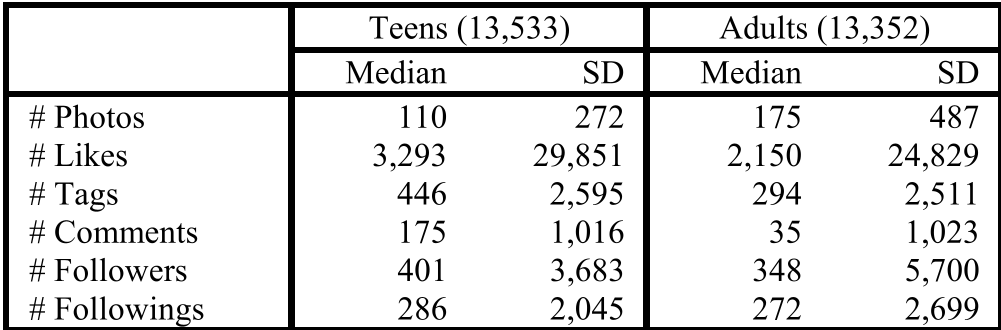
Counter-intuitively, adults (25-39) post more photos than teens. Teens, however, are ruthless curators. They remove photos at a much higher rate. Why? Social Validation.
- The "Like" Threshold: Teens are significantly more likely to delete a post if it doesn't hit a certain number of Likes. Their removed photos had 51.4% fewer Likes than their kept photos.
- Topic Narrowness: While adults post about travel, art, and nature, teen content is heavily skewed toward "Mood/Emotion" and "Follow/Like" tags.
2. High-Speed Interaction
Teens treat Instagram as a synchronous communication tool.
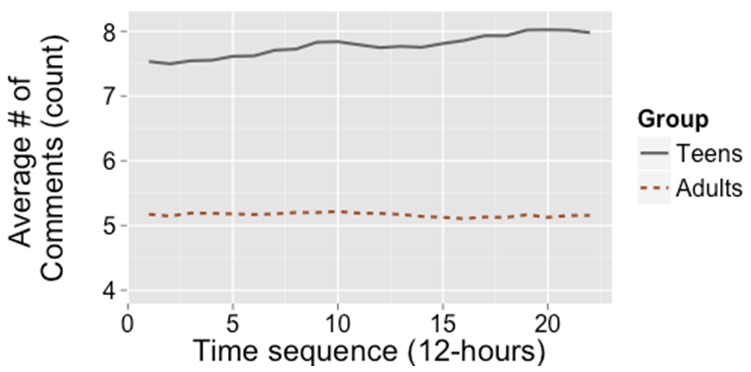
- Latency: Teens reply to comments in an average of 7.2 minutes, whereas adults take 30 minutes.
- Social Interests: Using LIWC, researchers found that teen comments are shorter but significantly more emotional and social-interest oriented.
Deep Insight: The Self-Representation Strategy
This study confirms that for teens, social media is a "Conversation Space." Their use of the @tag feature is far more communal; they often use comments on one person's post to talk to a third party, effectively turning the comment section into a group chat.
Adults, by contrast, use Instagram as a "Archive/Identity Space," focusing on interpersonal one-on-one interactions and preserving content regardless of its "popularity."
Critical Analysis & Conclusion
Takeaway
The value of this paper lies in its quantitative proof of the "Popularity Self" theory. It proves that teens' technological fluency isn't used to create more content, but to manage their online reputation with surgical precision.
Limitations
- Age Estimation: Even with AI and human checks, age estimation from photos can be skewed by filters or "young-looking" adults.
- Platform Specificity: These behaviors might look different on TikTok or Snapchat, where "ephemerality" (disappearing content) is a built-in feature rather than a manual behavior (deleting posts).
Future Outlook
As social media moves more toward algorithmic feeds, understand that teens are already "gaming" the system by removing low-performing content to maintain a high-engagement profile. Design opportunities lie in creating "summary" features that help users find peers based on these specific interaction styles rather than just shared interests.