
Telebeads: Reifying the Social Network through Tangible Mnemonics
Telebeads: social network mnemonics for teenagers
This paper introduces Telebeads, a mixed-reality communication system featuring mnemonic wearable artifacts (digital jewelry) designed for teenagers. By combining electronic beads with a mobile interface, it facilitates the management of massified social networks through tangible, symbolic interaction.
TL;DR
Telebeads moves social networking from the abstract glass of a smartphone into the physical world of wearable crafts. By using Bluetooth-enabled rings and beads as mnemonic anchors, teenagers can manage their vast social circles through "Mixed Reality" interactions, turning jewelry into shortcuts for digital communication and memory.
Background Positioning
Published in 2006, this work stands as a visionary bridge between Constructionist learning (learning through making) and Ubiquitous Computing. It moves beyond the laptop-centric social web of its time to predict a future where our accessories are the primary interfaces for our digital "Experience Networks."
Problem & Motivation: The Paradox of Massification
As social networks expand, they face the problem of massification. For a teenager with 200+ contacts across blogs, IM, and email, a simple list of names is no longer sufficient.
- The Cognitive Burden: Traditional UI (node-link graphs) fails on small screens.
- The Social Burden: High-tech devices often isolate users from their immediate physical peers.
- The Insight: Authors Labrune and Mackay realized that teens already use "analog" mnemonics—like friendship bracelets—to symbolize relationships. Telebeads digitizes this existing social protocol.
Methodology: From Participatory Design to Prototyping
The researchers didn't just build a gadget; they codesigned it with the target demographic (10-14 year olds).
1. The Power of "Electronic Sewing"
In the first workshop, the team discovered that even "destroyable" objects like umbrellas and bags could be socialized. For instance, a luminous bag allowed a teen to control their "extimacy"—choosing exactly when and how to be seen by friends.
2. Architecture of the Telebead
The system consists of two primary components:
- The Tangible Artifact: A Bluetooth-enabled ring or bead equipped with LEDs and micro-switches.
- The Magic Lens (PDA/Mobile): A mobile device that uses its camera or wireless sensors to "interrogate" the bead.
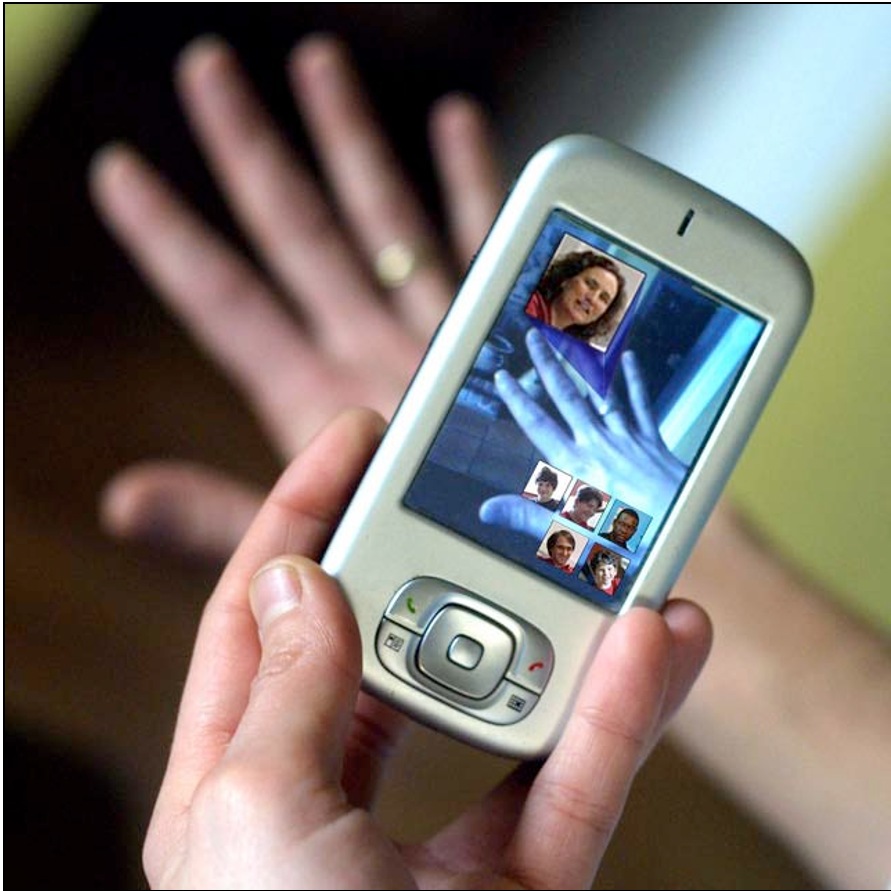 Figure: The Bluetooth telebead ring prototype used to establish a wireless link for social signaling.
3. "IntiMates" vs. "ExtiMates"
A key finding was the social requirement for privacy.
- IntiMates: Discreet interactions (like a vibrating ring) for secret "single-bit" communication between close friends.
- ExtiMates: Public displays (luminous patterns) used for group awareness and social signaling.
Experiments & Results: The Mixed-Reality Palette
The prototype proved that a bead could act as a physical pointer. By positioning a ring (emitting unique light pulses) in front of a mobile camera, the device could superimpose a friend's photo or their latest blog update on the screen.
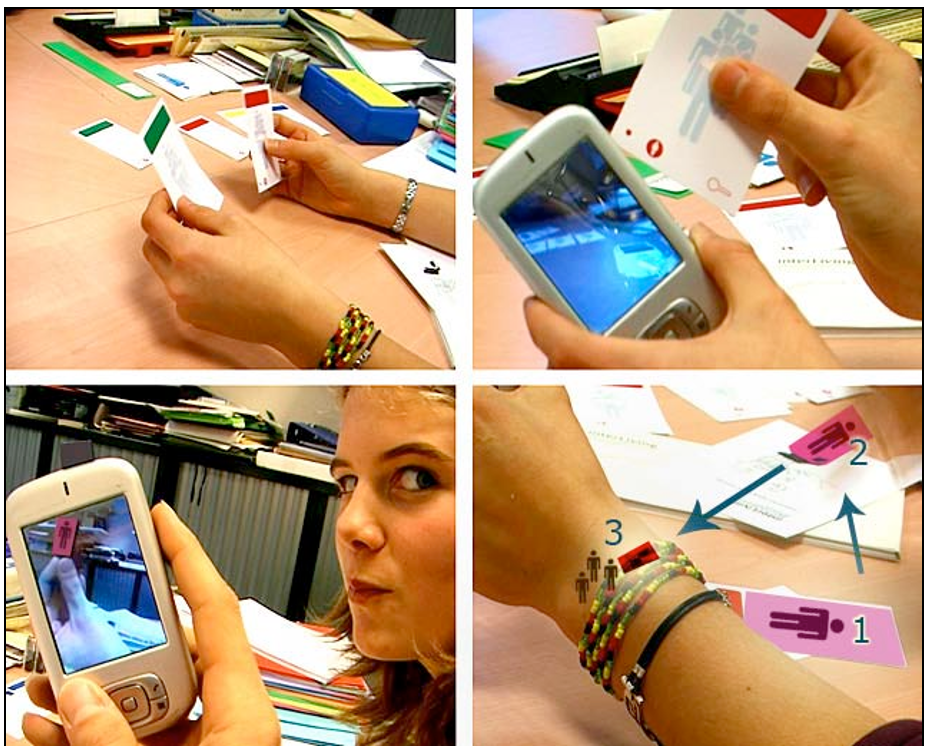 Figure: Concept sketches showing the evolution from FamilyNet cards to wearable "nanobeads" on a bracelet.
SOTA Comparison & Insight
Unlike the Nokia Medallion (a contemporary device of the era) which relied on asynchronous infrared, Telebeads proposed a real-time, bi-directional link. The most significant "performance" metric here was the reduction in friction for context-switching between different social groups.
Critical Analysis & Conclusion
Takeaway: Telebeads isn't just a wearable; it’s a creativity analysis tool. It allows users to reflect on their "Experience Networks" by reifying digital ties into physical mementos.
Limitations:
- Miniaturization: The 2006 prototype was "bulky," requiring a battery pack and a separate Bluetooth headset circuit.
- Cost: The electronics required for 200+ beads (to match a teen’s contact list) were cost-prohibitive at the time.
Future Outlook: In today’s world of Apple AirTags and ubiquitous NFC, the Telebeads vision is more achievable than ever. The paper’s true legacy is the concept of Interperception—the idea that devices should facilitate a peripheral, subliminal awareness of our social circle, rather than demanding our constant, narrow-focused attention.