
WeChat and Well-being: Why Trust in Institutions Matters More Than Your Friend List
Telematics and informatics
This study investigates the joint effects of trust and WeChat use on life satisfaction using Structural Equation Modeling (SEM). It identifies that trust in institutions and the Intensity of WeChat Use (IWU) significantly impact life satisfaction, primarily through the mediator of Perceived Usefulness (PU).
TL;DR
Does spending hours on WeChat make you happier? Not necessarily by itself. This research reveals that Intensity of WeChat Use (IWU) only boosts life satisfaction if you find the platform useful. Furthermore, for Chinese undergraduates, trust in institutions (government, courts) is a far more potent predictor of life satisfaction than trust in individuals.
Background Positioning
In the landscape of social network research, we often see a "happiness paradox": some studies claim SNS use causes depression, while others claim it builds social capital. This paper acts as a structural mediator study, moving beyond "what" happens to "how" it happens by integrating the Technology Acceptance Model (TAM) into social psychology.
Problem & Motivation: The Missing Link in Social Capital
Most research treats social media usage as a direct cause of well-being. However, the authors argue that this overlooks the cognitive evaluation of the tool. Why do some users feel drained while others feel empowered? The authors hypothesized that "Trust"—both in people and systems—dictates how we perceive the usefulness of our digital tools, which in turn dictates our happiness.
Methodology: The Structural Model
The researchers surveyed 463 students, measuring their trust levels, how intensely they used WeChat (friends, time, frequency), and their perceived usefulness of the app.
The Hypothesized Model
The core of the study rests on a mediation path: Trust Intensity of Use Perceived Usefulness Life Satisfaction.
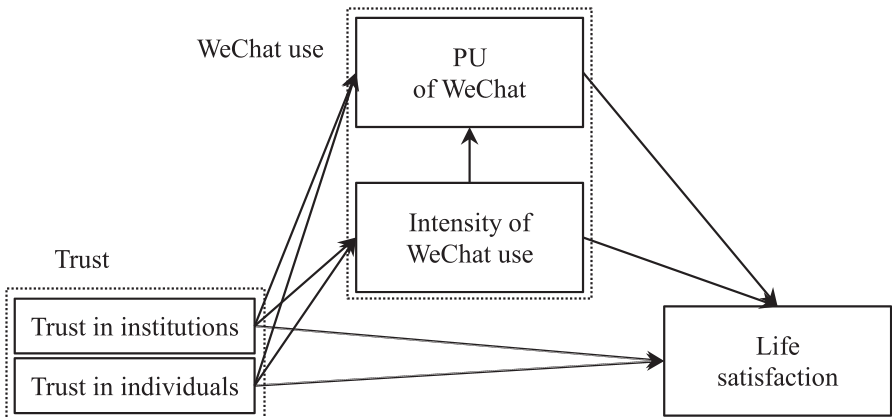
Experiments & Results: The Death of Individual Trust?
The results from the Structural Equation Modeling (SEM) provided some counter-intuitive insights:
- Trust in Individuals Failed: Surprisingly, trusting your friends and neighbors did not significantly correlate with life satisfaction or WeChat's perceived usefulness in this model.
- The Power of Institutions: Trust in the fairness of courts and government was a direct and indirect driver of well-being.
- Usefulness is the Gateway: Intensity of WeChat use had zero direct effect on life satisfaction. It only mattered if the user felt WeChat helped them acquire information or maintain social standing.
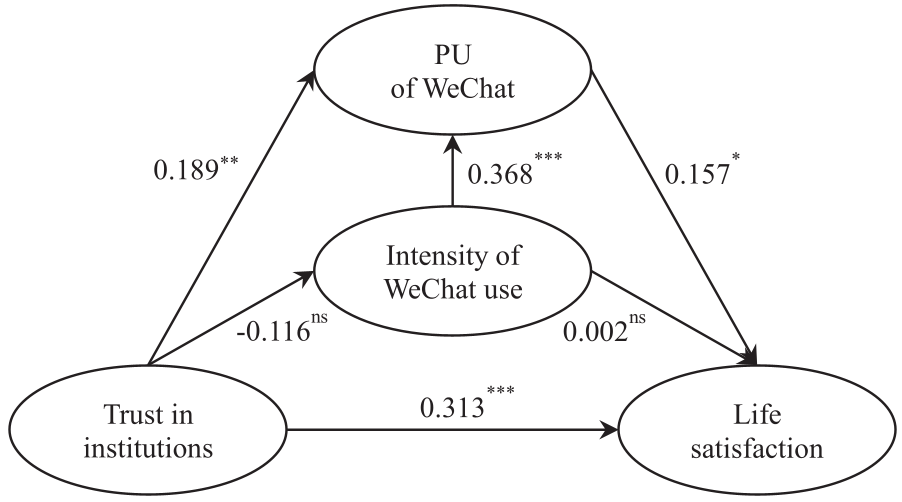
Detailed Path Coefficients
| Path | Coefficient (β) | Result |
|---|---|---|
| Trust in Institutions Life Satisfaction | 0.313*** | Supported |
| IWU Perceived Usefulness (PU) | 0.368*** | Supported |
| IWU Life Satisfaction | 0.002 | Rejected |
Deep Insights & Conclusion
Why does IWU need PU?
This suggests that "doomscrolling" or mindless usage (high intensity, low usefulness) provides no psychological benefit. Success on WeChat comes from utilitarian engagement—solidifying real-world ties and gaining knowledge.
The Institutional Shift
The finding that institutional trust outweighs interpersonal trust reflects a specific socio-economic trend among Chinese youth, where formal systems are increasingly relied upon for stability and problem-solving over traditional informal networks.
Limitations
- Context Specific: The data is from undergraduate students; results might differ for older professionals or retirees.
- Directionality: As a cross-sectional study, it's hard to prove if trust leads to life satisfaction or if happy people simply trust more.
Takeaway for Designers: Social platforms should focus on features that enhance the "Perceived Usefulness" (e.g., productivity, meaningful info) rather than just "Time Spent," as the former is what actually correlates with long-term user well-being.