
Unmasking the Digital Natives: Why 11-Year-Olds Flock to Social Networks
Telematics and informatics
2005-01-01
Summary
Problem
Method
Results
Takeaways
Abstract
This study utilizes a modified GoToFB scale and cluster analysis to investigate the motivations for Social Network Site (SNS) usage among 401 sixth-grade pupils in Taiwan. The research identifies "Connecting" as the primary driver and segments the young users into four distinct behavioral archetypes: Highly Motivated, Less Motivated, Relaxed-Oriented, and Socially-Oriented.
## TL;DR
While most social media platforms require a minimum age of 13, the reality is that sixth graders are already deeply embedded in these ecosystems. This study by Sua et al. breaks down the "Why" and "How" for Taiwanese pupils, revealing that while **Connecting** is the universal magnet, gender and regional digital development create vastly different user profiles—ranging from the hyper-active "Highly Motivated" to the passive "Less Motivated" groups.
## The Research Gap: Beyond the "Teens Only" Myth
For years, academic interest in Social Network Sites (SNS) focused on college students and teenagers. However, statistics increasingly show that nearly 95% of fifth and sixth graders in Taiwan have active Facebook accounts. These children are at a critical developmental crossroads—moving from family-centric lives to peer-driven identities. The authors argue that we cannot understand the risks and rewards of this transition without first mapping the underlying psychological motives.
## Methodology: Mapping the Motives
The research utilized the **GoToFB scale**, testing eight distinct dimensions of motivation:
* **Social-centric**: Connecting, Sharing, Monitoring.
* **Self-centric**: Branding, Expressing, Learning.
* **Functional/Affective**: Organizing, Relaxing.
Through a rigorous Confirmatory Factor Analysis (CFA), the researchers validated that these eight factors explain approximately **72.6% of the variance** in how pupils use SNS.
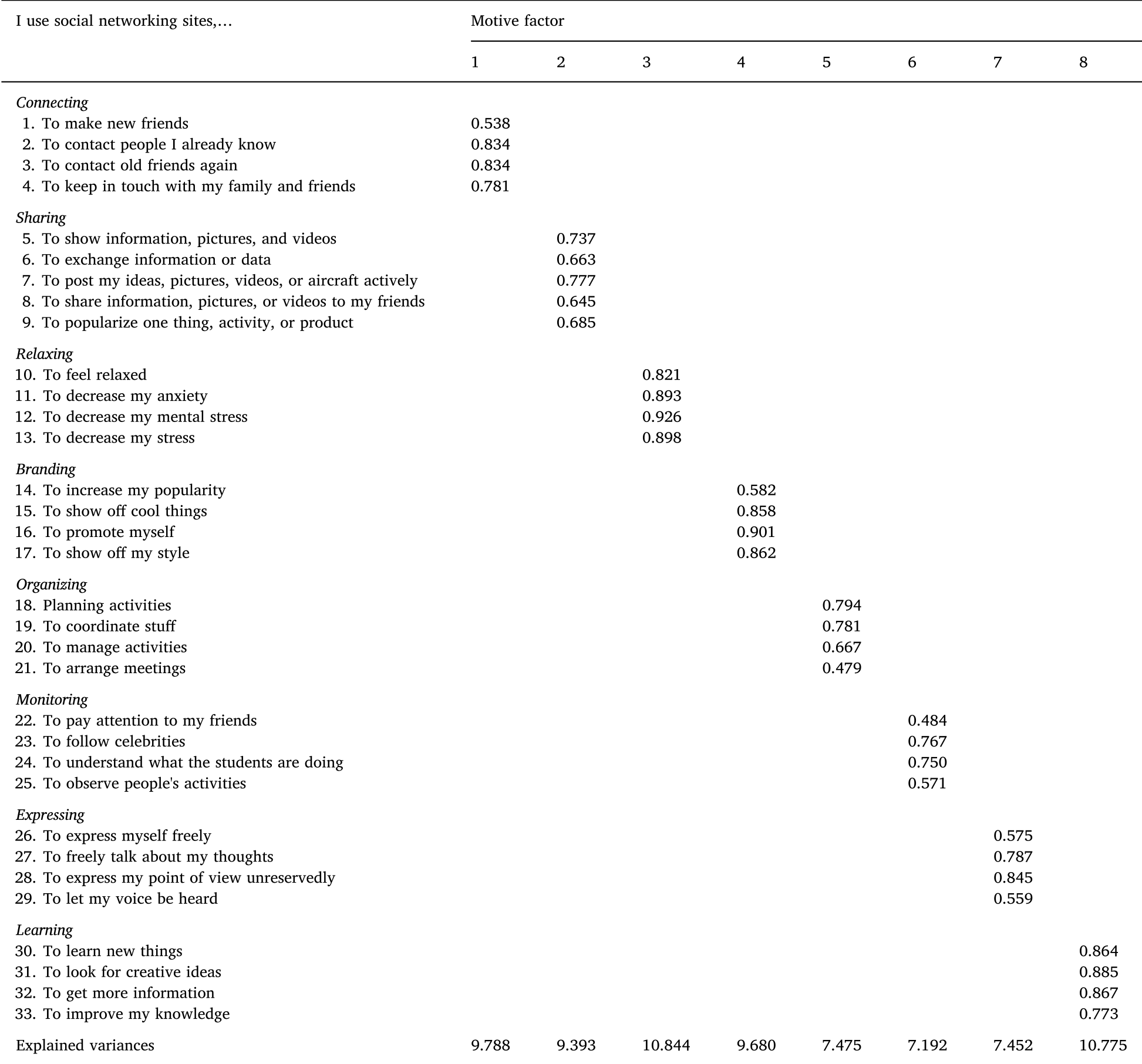
*Table 1: The validated 8-factor model showing how specific activities (like "Showing off cool things" for Branding) map to psychological motives.*
## Four Archetypes of the Young SNS User
One of the paper’s most compelling contributions is the segmentation of pupils into four clusters via K-means analysis:
1. **Highly Motivated (32.2%)**: The "Power Users." They score high across all eight factors. They don't just chat; they brand themselves, organize events, and use the platform for learning.
2. **Less Motivated (25.2%)**: Primarily boys from regions with lower digital opportunities. They use the internet but find SNS less compelling than, say, offline activities or pure gaming.
3. **Relaxed-Oriented (24.7%)**: Dominated by girls. Their primary motive is stress relief. They bypass "Branding" or "Organizing" in favor of the emotional comfort provided by the scroll.
4. **Socially-Oriented (18.0%)**: They focus strictly on the "Social" in social media—Connecting and Monitoring (staying in the loop)—while ignoring the self-expressive or organizational features.
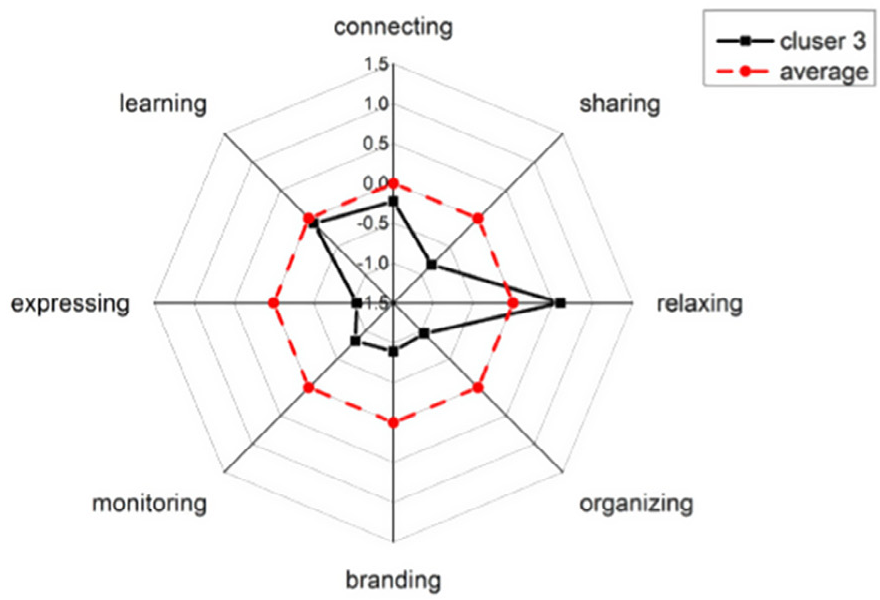
*Fig 1: The Radar Chart illustrates the dramatic variance in motive intensity between "Highly Motivated" (bold) and "Relaxed-Oriented" (dots).*
## Key Insights: Gender and Geography
The study highlights a significant **Internal Influence (Gender)**:
* **Girls** are significantly more likely to use SNS for *Monitoring* (observing peers) and *Sharing*.
* **Boys** show a higher (though still low) inclination for *Organizing*.
More importantly, it identifies an **External Influence (Digital Opportunity)**. Pupils in "High-level" digital regions (cities like Taipei) show much higher Branding and Expressing motives. However, the "Dounan" group—a middle-level region given government assistance (e-book projects)—rivaled the high-level schools in motivation. This suggests that **infrastructure interventions can directly stimulate social and digital literacy.**
## Critical Analysis & Conclusion
The takeaway is clear: we cannot treat "SNS use" as a monolithic behavior. A "Highly Motivated" pupil perceives the digital world very differently than a "Relaxed-Oriented" peer.
**Limitations**: The study is a cross-sectional snapshot of Taiwan in 2018; it doesn't account for the rise of short-video platforms like TikTok, which likely emphasize "Branding" and "Expressing" even more heavily than the Facebook-era tools studied here.
**Future Outlook**: For educators and parents, the goal shouldn't necessarily be screen-time reduction, but rather shifting "Less Motivated" or "Relaxed-Oriented" users toward "Learning" motives, leveraging the infrastructure to turn social browsing into a cognitive asset.