
The Stealth Filter: How Social Networks Shape Body Dissatisfaction in the Digital Age
Telematics and informatics
This study investigates the unnoticed influence of social networks and advertising on body image and eating disorder risks among Spanish university students. Using a multi-phase approach involving API-based social media analysis, expert surveys, and student self-assessments, the research highlights a significant gender disparity in how digital beauty standards affect self-perception.
TL;DR
A study of Spanish university students reveals that while social media connection frequency is high across genders, it disproportionately damages the body image of women. While men pursue an "athletic" ideal and feel unaffected by ads, women are heavily influenced by the "extreme thinness" promoted in fashion advertising, leading to higher dissatisfaction and a significant inclination toward surgical interventions.
The Invisible Influence: Why Digital Context Matters
We live in an age where "addictive" social media use is the norm. We check Instagram, TikTok, and Twitter multiple times a day, often believing we are immune to the perfectly curated images scrolling past our eyes. However, the research by Aparicio-Martínez et al. suggests that this influence is unnoticed but potent.
The core problem isn't just the existence of "thin-ideals," but the frequency and speed of their distribution. Unlike high-fashion magazines of the past, social media provides a constant, peer-reinforced stream of "ideal" bodies, creating a distorted reality that users often fail to recognize as artificial.
Methodology: A Multi-Dimensional Analysis
The researchers didn't just ask students how they felt; they looked at the problem from three distinct angles:
- The Digital View: Using APIs (Application Programming Interfaces) to track how fashion videos spread across platforms like Facebook and YouTube.
- The Clinical View: Surveying mental health experts to quantify social media as a risk factor for eating disorders.
- The Human View: Assessing 328 students using the Body Shape Questionnaire (BSQ) to find correlations between their digital habits and their self-image.
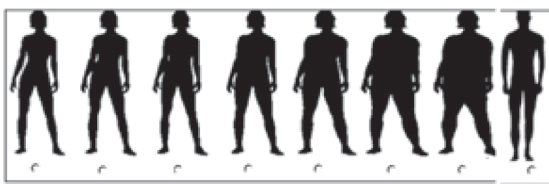 Figure 1: Visual body-type scales used to assess current vs. desired body image.
Key Findings: The Gender Divide
The study highlights a stark contrast in how men and women process digital social influence:
Women: The "Thinness" Trap
For women, there is a clear statistical dependence between the frequency of social media connections and body dissatisfaction.
- The Target: Women gravitate toward an "extreme thinness" standard (rated at 1.55 on a 7-point scale).
- The Consequence: A significant 24.8% of female students expressed willingness to undergo surgery to achieve their "ideal" body.
- The Driver: There is a high correlation between perceived "Effect of Advertising" and actual body dissatisfaction.
Men: The "Muscular" Resilience
Interestingly, while men connected to social networks more frequently than women (10.47 vs. 9.93 times per week), their self-esteem remained largely intact.
- The Ideal: Men seek a more "athletic" or muscular figure.
- The Perception: Most men believed advertising had little to no effect on them (2.17/7), suggesting a higher level of psychological resilience or a different relationship with visual content.
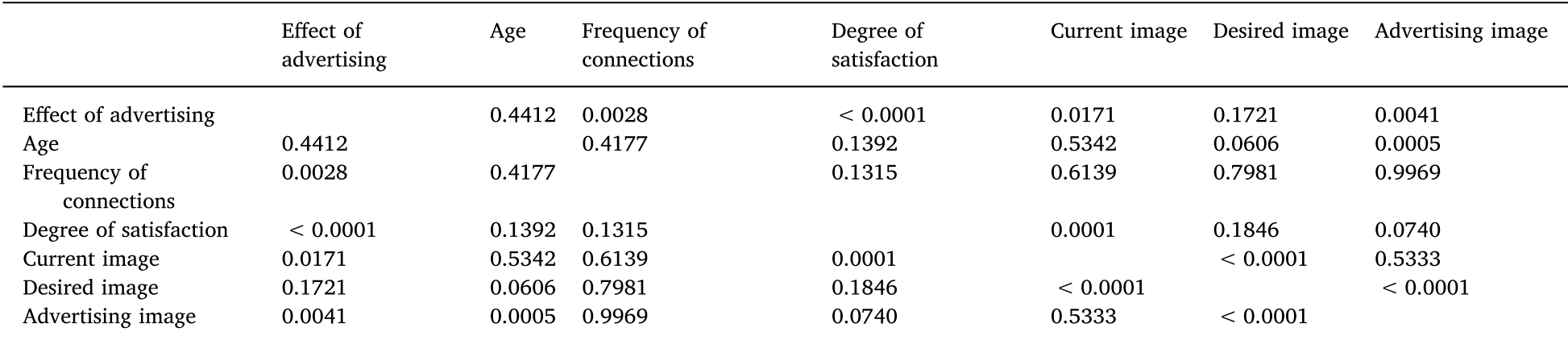 Table 1: Pairwise significance showing strong links between connection frequency, advertising, and satisfaction for women.
Experts' Warning
Health professionals are sounding the alarm. They rated advertising as a risk factor at 4.6 out of 5. They noted that while students are "well-educated" and generally avoid unhealthy weight-loss practices (like extreme fasting), the desire for an unrealistic body remains dangerously high due to the constant "worship" of thinness on digital platforms.
Critical Insight: The "Social Network Disorder"
The study concludes that as the frequency of connections increases, the internal "poor body image" worsens for women. This suggests that the habitual nature of social media—the "check-in" every few minutes—functions as a repetitive reinforcement of inadequacy.
Future Outlook & Limitations
While this study provides a robust look at Spanish university life, it relies on self-reported survey data. The authors suggest that future research should dive deeper into Specific Platforms like Instagram or TikTok, where image-centric algorithms might exert even more pressure than the broader networks studied here.
Conclusion (Takeaway)
The digital mirror is warped. For young women, social media is not just a tool for communication; it is a significant environmental stressor that dictates self-worth through the lens of advertising. For educators and health professionals, the focus must shift from "internet safety" to "digital body literacy"—helping users recognize the manufactured nature of the images they consume.