
Bridging Social Presence and Navigation: A Dual-Factor Approach to Robot Teleoperation
A Teleoperation Approach for Mobile Social Robots Incorporating Automatic Gaze Control and Three-Dimensional Spatial Visualization
This paper presents a teleoperation system for mobile social robots that integrates automatic gaze control with a 3-D spatial visualization interface. Evaluated in a simulated watch shop scenario, the system demonstrates that combining shared autonomy (gaze) with enhanced situational awareness significantly improves human-robot interaction quality.
TL;DR
Teleoperating a mobile social robot is a "cognitive juggling act." Operators must manage conversation, watch for nonverbal cues, and navigate physical space—all through a limited camera feed. This paper introduces a system that automates the robot's gaze while providing a 3-D spatial "God's eye view," proving that these two features must work in tandem to create interactions that feel natural to the end-user rather than clumsy or reactive.
The Problem: The "Social vs. Navigation" Conflict
In the world of Human-Robot Interaction (HRI), mobile social robots (like those used in malls or museums) present a unique challenge. Unlike search-and-rescue robots where navigation is the sole mission, a social robot's primary goal is engagement.
However, current teleoperation often fails because:
- Workload Overload: Manually panning a camera to keep a walking customer in frame is exhausting.
- Situational Blindness: When the camera is focused on a user's face for social rapport, the operator loses track of the robot's position relative to the room, leading to "weird" behaviors like spinning in place to regain orientation.
Methodology: Decoupling Visual Awareness
The researchers proposed a system with two key pillars designed to remove the operator from the "micro-management loop":
1. Automatic Gaze Control
Using a network of environmental Laser Range Finders (LRFs), the system tracks the customer's 2D position and orientation. It calculated the necessary 3-DOF head movements to keep the customer's face centered in the video feed. This allows the operator to focus on what the customer is saying and feeling rather than how to point the camera.
2. 3-D Spatial Visualization
To solve the disorientation caused by the automatic camera movement, the authors created a 3-D GUI. As shown in the architecture below, it fuses video with a third-person representation of the environment.
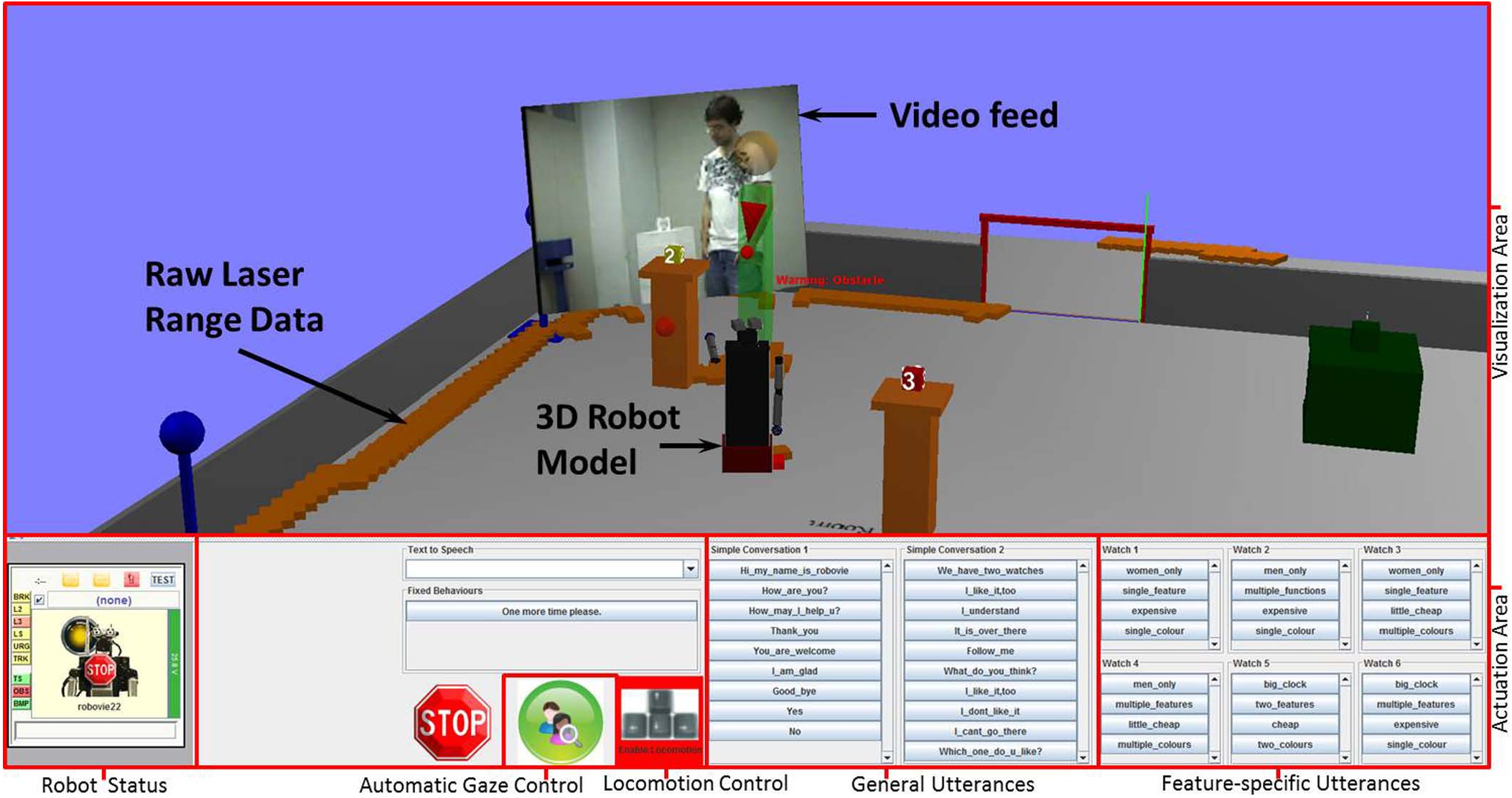 The GUI integrates a 3D model of the Robovie II, static shop objects, and laser sweep data (yellow/red dots) to provide context.
Experimental Insights: Why One Feature is Not Enough
The study utilized a "Watch Shop" scenario where the robot acted as a salesperson. The results revealed a fascinating interaction between the variables:
- The Workload Paradox: Surprisingly, automatic gaze control did not reduce the operator's perceived workload on its own. In fact, it was sometimes disorienting.
- Efficiency Gains: Spatial visualization was the real hero for navigation, significantly reducing interaction length by helping the operator "lead" the customer to products more naturally.
- The Synergy of Satisfaction: The most critical finding was that Customer Satisfaction only saw a significant boost when both features were active.
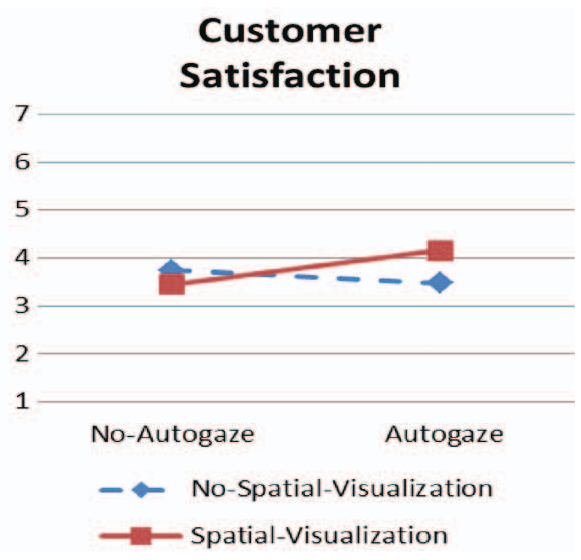 Graphs showing (Left) NASA-TLX Workload, (Center) Interaction Length, and (Right) Customer Satisfaction. Higher satisfaction is clearly visible in the V+A (Visualization + Autogaze) condition.
Case Study: Proactive vs. Reactive Behavior
The qualitative analysis of the trials highlighted why the "V+A" condition worked.
- Proactive Leading: With spatial awareness, the operator could say, "Follow me to this watch," and start moving immediately.
- Avoiding "The Wait": In the "No Visualization" condition, customers often became bored or "took the initiative" because the operator was busy rotating the robot just to find out where they were.
Critical Analysis & Conclusion
This paper highlights an essential truth in robotics: Shared autonomy changes the operator's role, but it doesn't automatically make it easier. When you automate a robot's gaze, you remove a feedback loop the operator previously used for orientation. You must replace that feedback with another modality—in this case, the 3-D visualization.
Future Outlook: While the study used external environmental sensors (SICK LRFs), the next logical step is moving this spatial awareness entirely "on-board" using SLAM and computer vision. As we move toward 5G-enabled remote "Avatar" robots for retail, the design principles established here—decoupling social gaze from navigational context—will be the blueprint for professional-grade telepresence interfaces.