
Decoding Social Influence: Why Timing is Everything in User Adoption
Temporal Analysis of Influence to Predict Users’ Adoption in Online Social Networks
This paper introduces a temporal framework for social influence prediction using two novel time constraints: Susceptible Span () and Forgettable Span (). Applied to a massive Twitter dataset, the method significantly improves the predictive accuracy of user adoption across 10 different social influence measures.
TL;DR
Predicting when a user will adopt a new behavior (like retweeting a hashtag) is a holy grail for social media analytics. This paper reveals that standard metrics are significantly more powerful when filtered through two temporal lenses: Susceptible Span (how long we listen to someone) and Forgettable Span (how long we remember what they did). By applying these constraints, researchers achieved massive gains in prediction accuracy (F1 score up to 0.755) and provided quantifiable evidence of the "attention decay" in online social networks.
The Problem: The Myth of the Static Social Graph
Most social influence research treats your "friends list" as a permanent, active pipeline of influence. However, human sociology suggests otherwise. We are not influenced by everyone we follow at all times. Prior work often overlooks two critical human limitations:
- Selective Attention: We stop monitoring connections that haven't provided value recently.
- Memory Decay: Even if a friend adopts a behavior, the "pressure" for us to follow suit fades as the event recedes into the past.
Without accounting for these, models become cluttered with "stale" social signals, drowning out the high-intent triggers that actually lead to adoption.
Methodology: The Dual-Span Framework
The authors formalize a framework that shifts influence measurement from static counts to dynamic intervals. They introduce two parameters:
- Susceptible Span (): The interval during which a user is considered "open" to influence from a neighbor . If hasn't interacted with within this window, the link is effectively "blind."
- Forgettable Span (): The shelf-life of a specific action. If your friend retweets a hashtag today, it might influence you for the next 24 hours, but its power drops to near zero after a week.
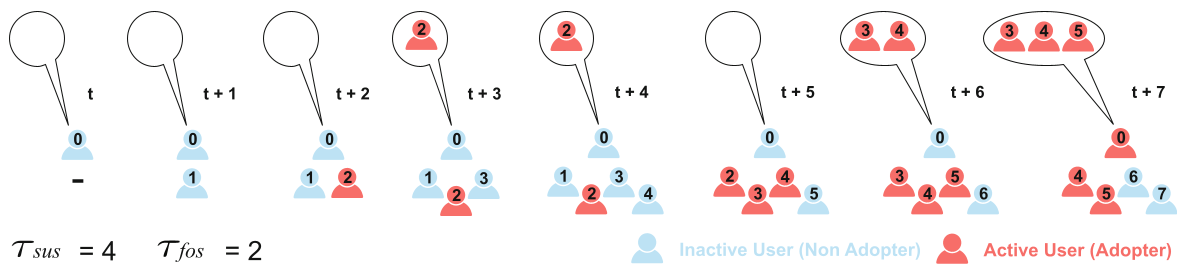 The image illustrates how effective neighborhoods () shrink and evolve based on these time constraints.
The study tests these spans across 10 different social measures, including Connectivity (NAN, PNE), Temporal decay (CDI), and Structural Diversity (ACC, ACR).
Experiments and Results: The 2-Day/2-Week Rule
The researchers utilized a Twitter dataset of 1.6 million retweets to find the "sweet spot" for these constraints. Using Heat Maps to visualize correlation gains, they identified a consistent pattern: Influence is best measured when is relatively high and is relatively low.
Key Quantitative Wins:
- Correlation Boost: Simply counting "Active Neighbors" (NAN) more accurately predicted adoption with a 92.31% gain in correlation when temporal constraints were applied.
- Classification Performance: Using a Random Forest classifier, the combined model ("All") reached an F1 score of 0.755, outperforming existing SOTA baselines like LRC-Q and CPM.
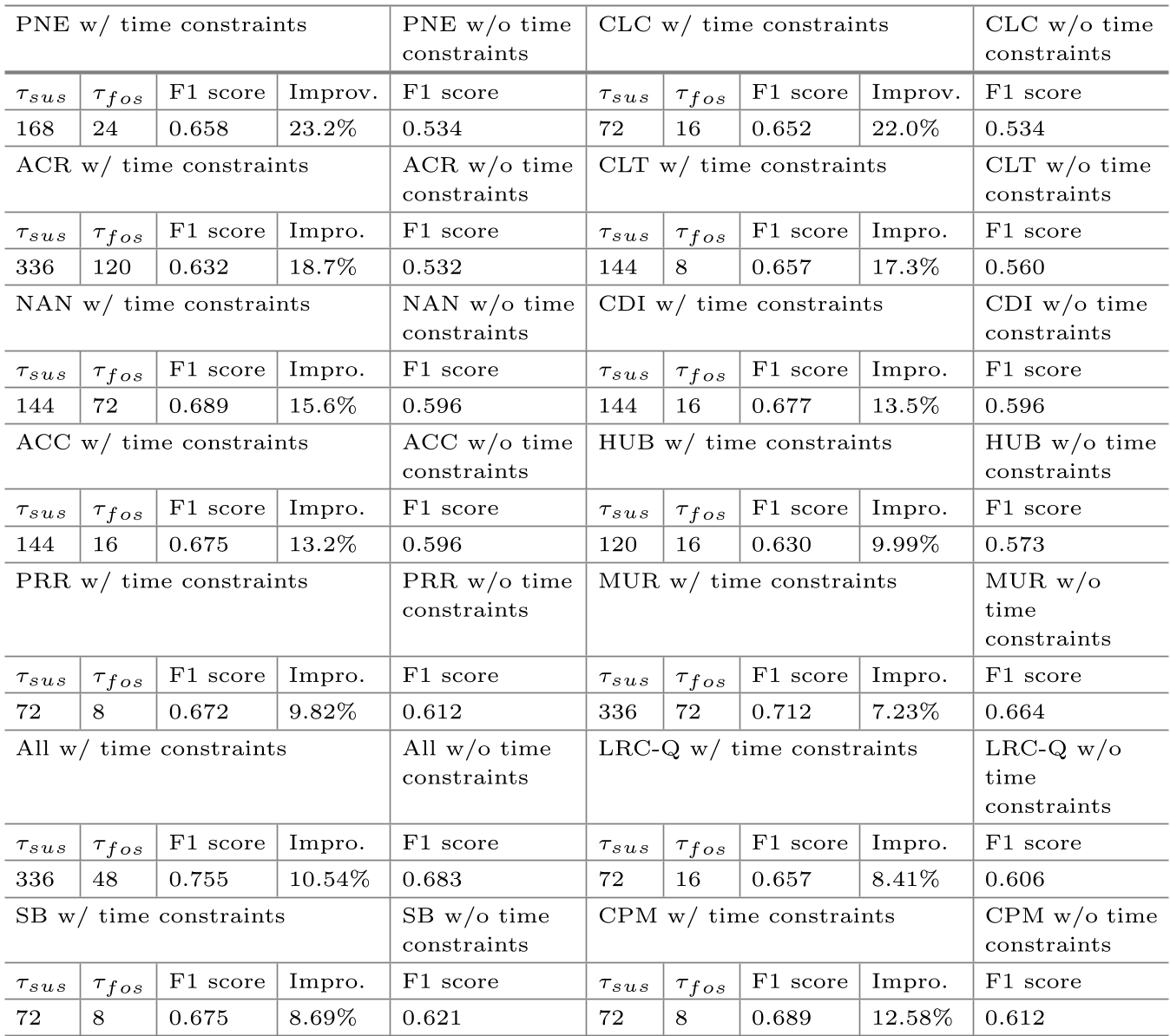 Table 2 demonstrates how adding and consistently boosts the F1 score across every single influence metric tested.
The Theoretical Insight
The data suggests a fascinating insight into human digital behavior:
- The 2-Week Attention Window (): Users generally stop being susceptible to a neighbor's influence if that neighbor has been inactive for more than 14 days.
- The 2-Day Memory Window (): The specific "social signal" of an adoption typically effectively vanishes from a user's conscious decision-making process after about 48 hours.
Critical Analysis & Conclusion
Takeaway
This paper proves that time isn't just a feature; it's a fundamental filter for social network topology. By acknowledging that social ties "fade" and "forget," we move closer to a realistic model of human behavior. For practitioners in viral marketing or public health messaging, the message is clear: the density of actions within a 48-hour window is far more influential than the total number of actions over a month.
Limitations & Future Work
While the study is robust, the "Optimal Spans" found (2 days/2 weeks) are likely specific to the fast-paced nature of Twitter. Platforms like LinkedIn or Instagram might exhibit different temporal constants. Future research should investigate whether these spans vary by topic—for example, does the "Forgettable Span" for a breaking news hashtag differ from that of a political movement?
Overall, this work provides a solid mathematical foundation for "Temporal Social Influence," turning a complex psychological phenomenon into a tunable, high-performance engineering parameter.