
Beyond Semantics: Capturing the Pulse of Cultural Events through Temporal Embeddings
Exploring Temporal Analysis of Tweet Content from Cultural Events
This paper explores the integration of temporal information into word embeddings for analyzing social media content during cultural events. It compares a traditional Word2Vec model with a proposed "Temporal Embedding" approach, which captures word occurrence patterns over weeks or months, demonstrating superior performance in identifying event-related word associations.
TL;DR
Researchers from the University of Avignon have demonstrated that while standard models like Word2Vec are masters of semantic similarity, they are "time-blind." By proposing a Temporal Embedding approach based on word occurrence frequencies over time, the authors show we can uncover hidden connections—like linking a city to a specific brand during a festival—that traditional NLP models overlook.
The "Time-Blind" Problem in NLP
Most Word Embedding models operate on the Distributional Hypothesis: words appearing in similar contexts have similar meanings. While powerful, this approach aggregates all data into a single snapshot.
In the context of Cultural Events (like the Cannes Film Festival or the Apple Music Festival), the meaning of a conversation is inextricably linked to when it happens. A global model tends to reveal only high-frequency, "general purpose" language patterns, effectively filtering out the specific, time-bound associations that define an event.
Methodology: Mapping Time to Vector Space
The study compares two distinct philosophies:
- Word2Vec (CBOW): Predicts a word based on its local context window. It builds a static semantic space.
- Temporal Embedding:
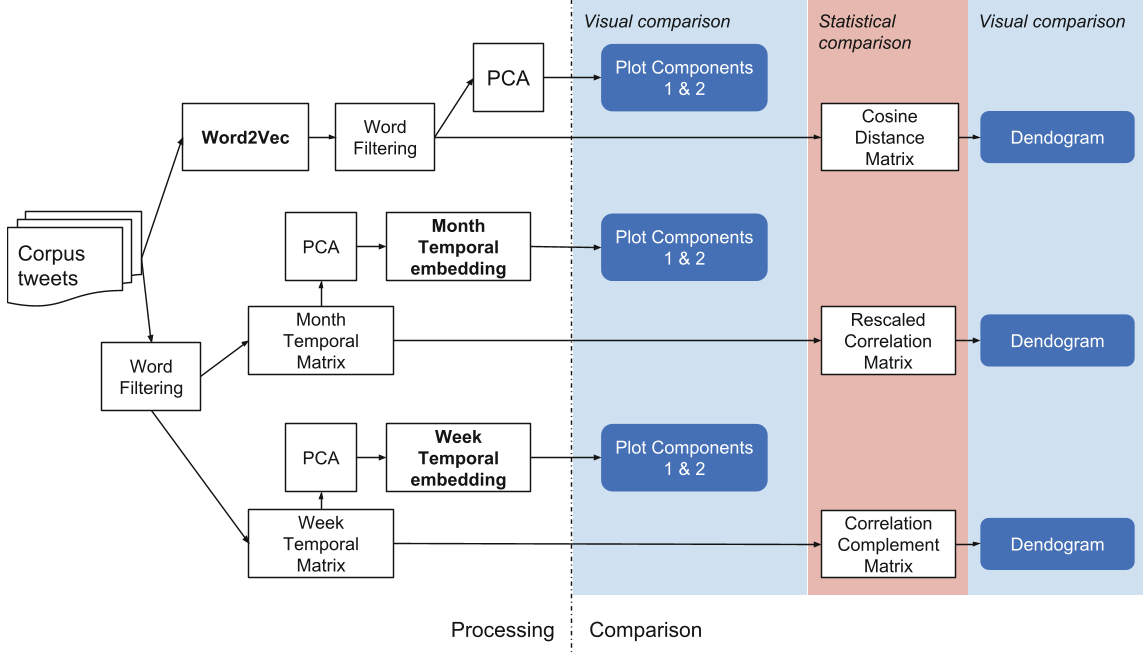
- Counts occurrences of specific keywords per time unit (week or month).
- Applies a Moving Average to smooth out the noise of sporadic tweeting.
- Uses Principal Component Analysis (PCA) to compress these temporal signals into an matrix.
The Framework Overview
The following diagram illustrates the dual-track pipeline used to compare these models, from raw tweets to visual dendrograms.
Experiments: Semantics vs. Synchronization
The authors tested their models on a massive corpus of 70 million tweets related to global festivals.
1. Statistical Independence
Using Kendall’s , the researchers found that Word2Vec and Temporal Embeddings have a correlation near zero (). This is a critical finding: it proves that temporal information is not just a "bonus" feature already present in Word2Vec—it is an entirely different signal that Word2Vec fails to capture.
2. Qualitative Win: The "Apple Music Festival" Test
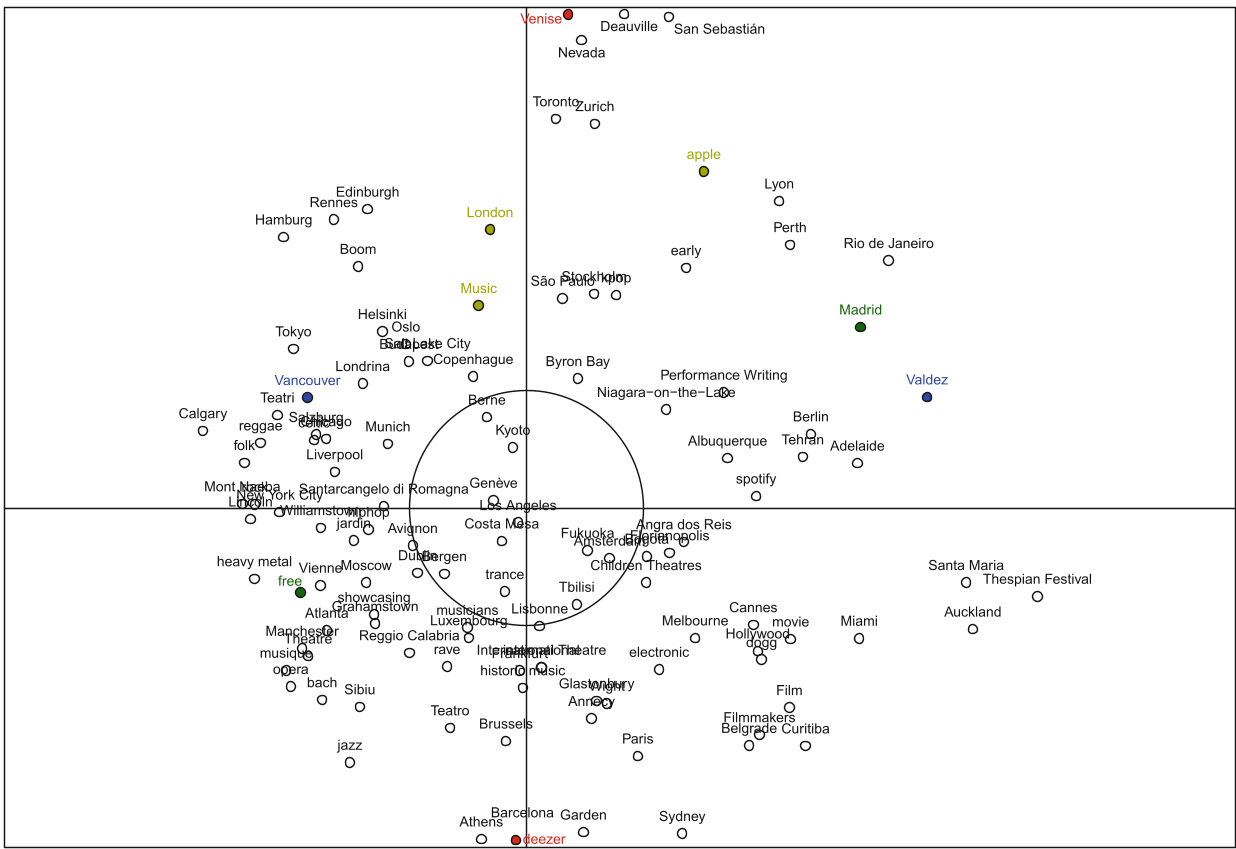
The visual comparison of PCA plots revealed a striking difference in how the models "think":
- Word2Vec clustered "London" with other cities (New York, Paris) and "Music" with "Jazz" or "Opera."
- Temporal Embeddings successfully moved "London," "Apple," and "Music" into the same space.
Why? Because during the festival window, these three unrelated words spiked in frequency simultaneously. To a temporal model, they are "synonyms in time."
3. Hierarchical Associations
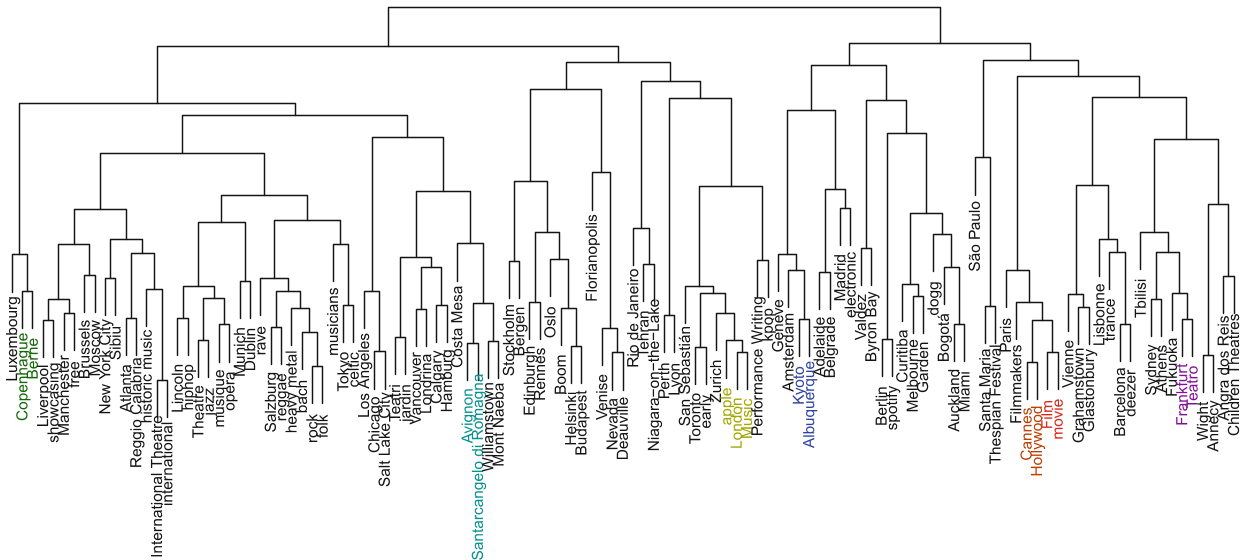
Using dendrograms, the authors showed that temporal models group "Cannes" with "Hollywood" and "Film" due to their shared seasonal relevance, whereas Word2Vec might separate them based on geographic vs. conceptual categories.
Critical Insight & Conclusion
The value of this work lies in the validation of Temporal Resolution. The study found that month-level analysis captures largely the same insights as week-level analysis but with much lower computational overhead.
Takeaway for Practitioners: If you are building an event monitoring tool or a real-time recommendation engine, relying solely on pre-trained embeddings (like BERT or Word2Vec) will leave you blind to the "happening now" factor. Integrating a temporal occurrence layer is essential for capturing the transient logic of social media.
Limitations: As a preliminary work, the study focused on a manually curated list of 119 words. Future work needs to scale this to the entire lexicon to see if the temporal signal remains clean or becomes drowned in noise.