
Beyond Topic Tracking: Temporal Anomaly Detection in Social Media
Temporal Anomaly Detection in Social Media
The paper introduces a temporal framework for identifying anomalous time periods in social media streams by combining information-theoretic term distribution analysis (PAKL) and spherical k-means cluster coherence. Tested on diverse Twitter datasets, the method successfully identifies major global events and cyclic institutional patterns with high robustness to varying sampling rates.
TL;DR
Researchers from Sandia National Laboratories have developed a robust, unsupervised framework to identify when social media content becomes anomalous. By combining term distribution shifts with document clustering coherence, the system can detect everything from sudden terrorist attacks to recurring academic cycles without needing pre-defined categories or being affected by fluctuating tweet volumes.
Background Positioning
In the landscape of Social Network Analysis (SNA), most researchers focus on what people are talking about (Topic Modeling) or how memes spread (Meme Tracking). This paper shifts the focus to the temporal coordinate, treating the stream of documents as a signal processing problem where the goal is to identify "bursts" of abnormal coherence or distribution shifts. It occupies a niche between traditional TDT (Topic Detection and Tracking) and statistical anomaly detection.
Problem & Motivation: The Noise of the Crowd
Social media is inherently noisy. Individual tweets are often low-value, but in aggregate, they reveal public sentiment and global events. Current methods often struggle with:
- Selection Bias: Requiring supervised categories or specific keywords.
- Sensitivity to Volume: Metrics that break down when the sampling rate or document arrival rate changes.
- Content vs. Context: Missing events that don't have a single "smoking gun" keyword but show a general tightening of conversation around a specific concept.
The authors' insight is that an anomaly is either a distributional shift (people starting to use new words) or a topical focus (people starting to talk about the same thing, even if using different words).
Methodology: The Dual-Engine Approach
The framework relies on two distinct engines to generate anomaly scores:
1. PAKL: The Distributional Engine
Instead of standard KL-Divergence, the authors use an Antisymmetric Kullback-Leibler (PAKL) score.
- Why? Unlike standard KL, PAKL differentiates between terms that are merely rare and terms that have actually dropped in frequency.
- Intuition: It measures how much the "vocabulary" of a specific hour or day deviates from the "normal" vocabulary of the entire month.
2. Cluster Coherence: The Conceptual Engine
Using 25-dimensional GloVe vectors, the system represents documents as points on a unit hypersphere.
- Mechanism: It performs spherical k-means clustering.
- The "Tightness" Metric: By treating the clusters as a von Mises-Fisher (VMF) mixture model, they extract a concentration parameter (). A higher means tweets are more focused on a single topic, signaling an anomaly even if no single keyword dominates.
 Figure 1: Conceptual illustration of temporal document stream processing.
Experiments & Results: Detecting the Signal in the Noise
The method was stress-tested on three major Twitter datasets: TwitterParisEnglish, TwitterOlympics, and TwitterUSUniversities.
Key Breakthroughs:
- Invariance to Scale: One of the most impressive findings was that the anomaly scores remained stable whether they sampled 10,000 or 50,000 tweets per day. This makes the method highly practical for varying API limits.
- The Power of Fusion: In the Olympics dataset, individual world championships didn't trigger the PAKL "keyword" sensor because different sports use different vocabularies. However, the Cluster Coherence engine caught it because the "concept" of sports and competition was tighter than usual.
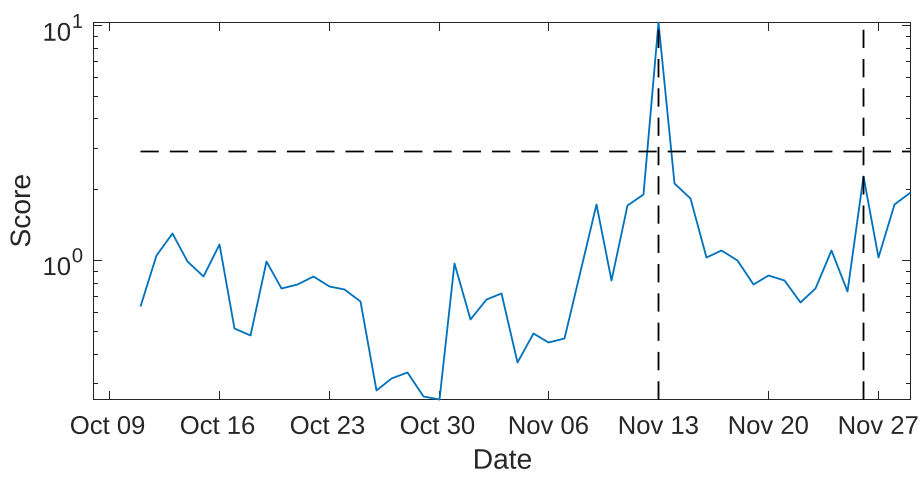 Figure 2: Fused scores for the Paris dataset. Note the massive spike during the Nov 13 attacks and the secondary spike for Thanksgiving.
Windowed vs. Global Fusion
For institutional data (like Universities), the authors used Windowed Fusion. Instead of comparing today to the "all-time" average, they compared it to the surrounding 30 days. This allowed the model to detect recurring cycles like "Finals Week" or "Winter Break" as distinct events within their local context.
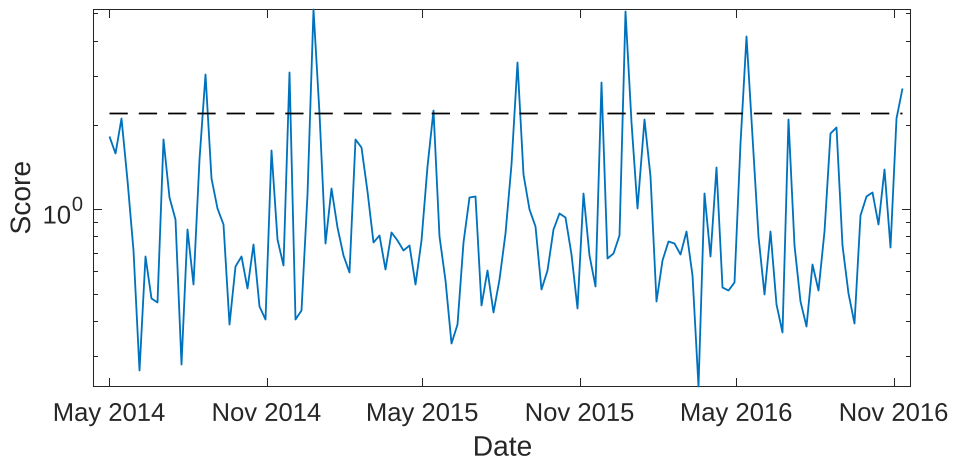 Figure 3: Windowed fusion showing the cyclic nature of the academic year.
Critical Analysis & Conclusion
Summary (Takeaway)
This research confirms that temporal anomalies in social media are best detected through a hybrid lens. While word-frequency shifts (PAKL) are great for sudden, named events (e.g., "Paris", "Thanksgiving"), cluster coherence is essential for broader thematic shifts (e.g., sports seasons).
Limitations
- Vocabulary Aging: While PAKL is robust, the underlying GloVe embeddings were static (trained on 2015 data). For 2026, these embeddings would likely fail to capture modern slang or new concepts (like Metaverse or GenAI).
- Dimensionality: Using only 25 dimensions for GloVe is efficient but might collapse complex topical nuances.
Future Outlook
The logical next step is replacing static GloVe vectors with Dynamic Embeddings or LLM-based representations that evolve in real-time. Additionally, integrating this with "sentiment anomalies" could help distinguish between positive temporal events (holidays) and negative ones (crises).