
Beyond Homogeneity: Why "When" You Share Matters in Social Diffusion
Temporal Behavior of Social Network Users in Information Diffusion
This paper presents a time-aware mining framework to analyze temporal user behavior in Online Social Networks (OSNs), specifically focusing on information diffusion. By clustering 2.8 million users from Renren based on sharing periods, the authors propose "Heter-ICM," a continuous-time diffusion model that accounts for heterogeneous propagation latencies across different user groups.
TL;DR
Most social media diffusion models assume users are "clones" who react with the same mathematical probability at any time of day. This paper shatters that assumption by analyzing 3 years of Renren data, proving that users fall into distinct "Day" and "Night" groups. By incorporating these heterogeneous behaviors into a new model called Heter-ICM, the authors demonstrate that information actually spreads much slower and more realistically than traditional models suggest.
The Flaw in the "Synchronous" Assumption
In the world of academic diffusion modeling, the Independent Cascade Model (ICM) is a gold standard. However, classic ICM often operates in discrete "ticks," assuming everyone is equally likely to pass on a message in the next time step. Even recent "continuous-time" models often fall into the trap of Temporal Homogeneity—assuming every link in a network follows the same exponential decay distribution for latency.
The reality? Humans are creatures of habit. Some are night owls; others are early birds. If a "Night-Group" user shares a video at 3 AM, their "Day-Group" friend won't see it until 8 AM. This "latency gap" is rarely captured in high-level math, leading to wildly inaccurate predictions of how "viral" a product or idea truly is.
Methodology: Mapping the Temporal DNA
The researchers proposed a time-aware mining framework. Instead of just counting total shares (which can be skewed by a single hyper-active day), they focused on sharing periods—the specific hours where a user is consistently active.
1. Feature Extraction
They used an aggregation model to identify "active spans." If a user shares videos within a short window, those actions are clustered into a single period representing a habitual "log-on" time. This creates a 24-dimensional feature vector for each user.
2. User Clustering
Using K-Means clustering, the team identified two optimal clusters ():
- Day-Group: Heavily active during daylight hours.
- Night-Group: Significant activity between 1:00 AM and 8:59 AM.
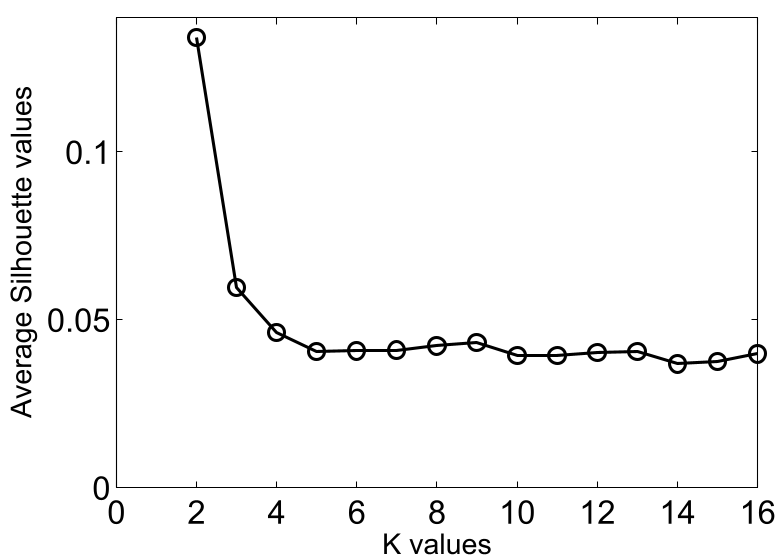 The Silhouette index confirmed that a two-group split () provided the most distinct and meaningful separation of user behaviors.
Key Insight: "Birds of a Feather Flock Together"
A fascinating discovery was the Most Recent Source (MRS) activation latency. The researchers found that for the Night-Group, the latency was very low (often < 1 hour), meaning Night-Group users were being influenced by other Night-Group users. Conversely, if a Day-Group user happened to share at night, their source was usually from several hours prior (during the day).
This suggests that OSN users aren't just grouped by interests, but by rhythms. Your social circle likely shares your sleep-wake cycle, creating "temporal islands" in the network.
Experimental Results: The Speed of Real Life
The authors compared their Heter-ICM (which uses group-specific latencies) against Homo-ICM (which uses a single average latency).
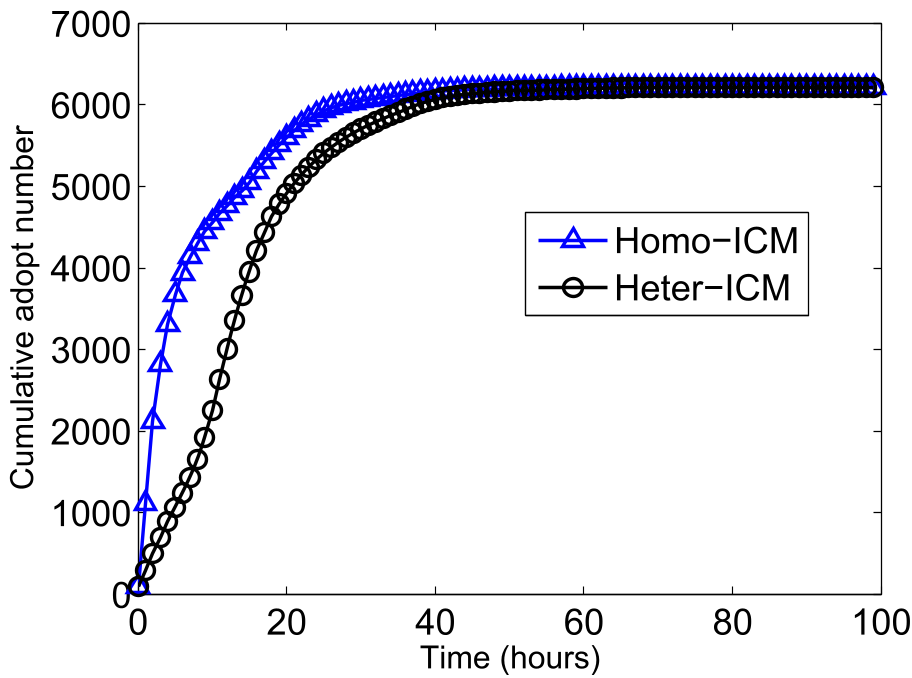 Comparison of diffusion speed: The Heter-ICM (lower curve) shows a much slower, more staggered growth compared to the optimistic Homo-ICM (upper curve).
The Verdict: The homogeneous model heavily overestimates how fast information spreads. By accounting for the fact that some users "pause" the diffusion chain during their off-peak hours, Heter-ICM provides a significantly more disciplined—and likely more accurate—view of viral trends.
Critical Analysis & Conclusion
Takeaway
For marketers and researchers, this paper highlights that timing is topology. A network might be highly connected on paper, but if half the nodes are asleep while the other half are active, the "functional" connectivity is much lower.
Limitations
- Binary Clustering: While the Day/Night split is a great start, modern social media users (especially globally distributed ones) likely exhibit more complex, multi-modal behavior patterns.
- Video-Only Data: The study relies on video-sharing URLs. Other behaviors (like "Liking" or "Commenting") might follow different temporal rules.
Future Outlook
The next step for this research involves exploring Non-Parametric models—using deep learning to learn the exact shape of a user's probability density function for sharing, rather than assuming it fits a standard curve like Rayleigh or Exponential.