
Predicting the Pulse of Social Networks: Temporal Centrality in OMSNs
Temporal Centrality Prediction in Opportunistic Mobile Social Networks
This paper investigates the predictability of node importance in Opportunistic Mobile Social Networks (OMSNs) using temporal centrality metrics. The authors propose three prediction methods—Last, Recent Uniform Average, and Periodical Average—demonstrating that human social regularity can be leveraged to forecast future Betweenness and Closeness centrality with high accuracy across real-world traces like MIT Reality and Infocom 06.
TL;DR
In the world of Opportunistic Mobile Social Networks (OMSNs), a node's "importance" is a moving target. This paper demonstrates that because human behavior is inherently regular, we can predict future node importance (Betweenness and Closeness centrality) by analyzing recent social contacts and daily cycles. By testing various averaging methods on real-world datasets, the authors prove that a node's future influence is deeply rooted in its immediate past and its periodic habits.
Problem & Motivation: The Myth of Static Importance
In many networking protocols, we identify "hub" nodes to facilitate data transfer. Historically, these hubs were identified using Static Centrality, which treats a week of movement as a single frozen snapshot.
However, OMSNs are driven by humans. A student might be a "central hub" in a lecture hall at 10 AM but an isolated node while studying in a library at 11 PM. The authors argue that:
- Stationarity is a false assumption: Node importance fluctuates wildly over time.
- Predictability exists: Human schedules (classes, commutes, meals) create patterns that can be exploited to forecast who will be important in the next hour.
Methodology: Capturing Social Regularity
The authors propose a framework that discretizes time into windows and evaluates three intuitive prediction strategies:
1. The "Last" Method
The simplest baseline: assume the next window will look exactly like the current one ().
2. Recent Uniform Average Method
Instead of relying on a single (potentially noisy) window, this method averages the last windows. It acts as a low-pass filter to capture the current social "trend."
3. Periodical Average Method
This targets the 24-hour cycle. To predict importance at 10 AM tomorrow, it averages the centrality values of previous days at 10 AM. It uses a modulo-based selection function to pick corresponding time slots from the history.
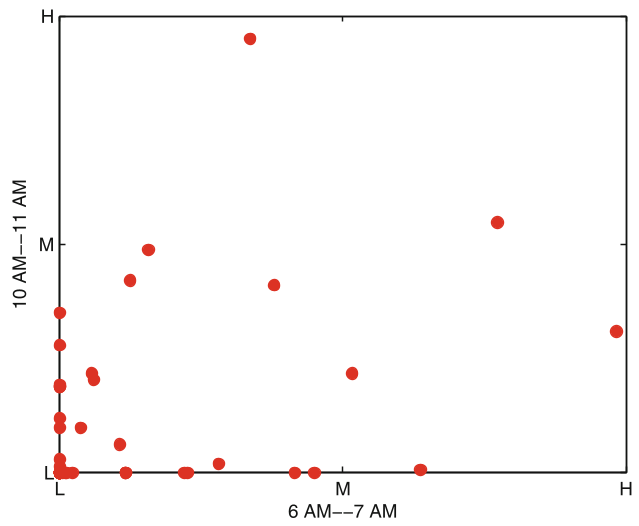 Figure: Correlation analysis showing that centrality at -4h and -24h (periodicity) is significantly higher than at other intervals.
Experiments & Results: MIT Campus vs. Infocom Conference
The researchers validated their methods using two distinct social environments:
- MIT Reality Trace: High regularity (students following university routines).
- Infocom 06 Trace: High entropy (conference attendees meeting new people constantly).
Key Findings:
- The 3-Hour Golden Window: In the Infocom trace, the Recent Uniform Average method performed best when hours. Beyond that, the social context changed too much.
- Routine Wins in Periodicity: The Periodical Average Method was significantly more effective in the MIT trace because campus life is strictly 24-hour-based, whereas conference behavior is more erratic.
- Betweenness vs. Closeness: In MIT, "Betweenness" (being a bridge) was best caught by recent averages, while "Closeness" (proximity to others) was best caught by periodic models.
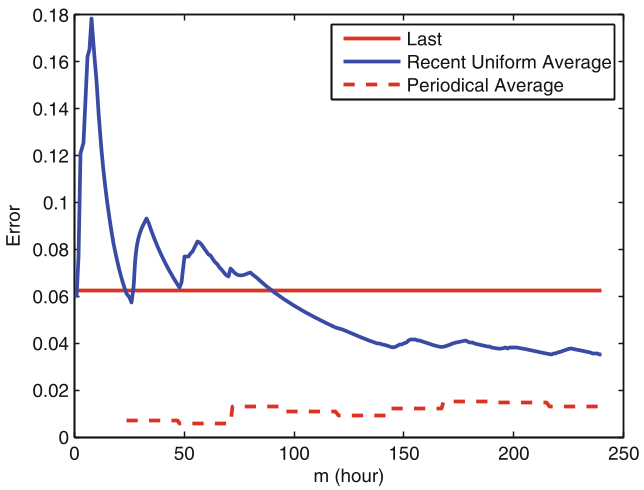 Figure: Error rates for different methods. The Recent Uniform Average demonstrates a clear "sweet spot" at m=3.
Critical Insight & Conclusion
The fundamental takeaway from this work is that Context dictates the Method. There is no one-size-fits-all predictor for social importance.
- For "Stable" Social Networks: Use periodic models to capture the rhythm of daily life.
- For "Dynamic" Events: Use short-term moving averages to capture the current flow of interactions.
Limitations: The paper relies on linear averaging. In modern contexts, these simple averages could serve as features for more complex temporal Graph Neural Networks (GNNs), which might better capture the non-linear "burstiness" of human encounters. Nevertheless, this work provides a vital empirical foundation for making OMSNs "socially aware."