
Temporal Churn: Why Diabetes Online Communities Are More Volatile Than We Thought
Temporal Community Structure Patterns in Diabetes Social Networks
This study employs temporal Social Network Analysis (SNA) to investigate community evolution in two large diabetes online forums. By applying Greedy Optimization (GO) for community detection and the Jaccard Similarity index for cross-temporal comparison, the paper reveals high network volatility, where sub-communities frequently dissolve and reform within a one-year cycle.
TL;DR
A longitudinal analysis of diabetes social networks reveals a surprising truth: these communities are not the stable, long-term support systems we imagined. Using temporal community detection and Jaccard similarity measures, researchers found that these networks are incredibly dynamic—most users engage intensely for less than a year post-diagnosis before moving on, leaving behind a constantly shifting sub-community structure.
Background Positioning
While many studies treat Social Network Analysis (SNA) as a static "photograph" of connections, this work acts as a "time-lapse video." It places itself in the academic coordinate system as a bridge between theoretical graph evolution and applied health informatics, challenging the assumption that high activity in health forums implies a cohesive, long-term community.
The Problem: The "Ghost Node" Fallacy
The authors argue that static analysis is fundamentally flawed for healthcare domains. As seen in the conceptual model below, a static view at time might show a dense network, but it obscures the fact that key influencers from have actually retired.
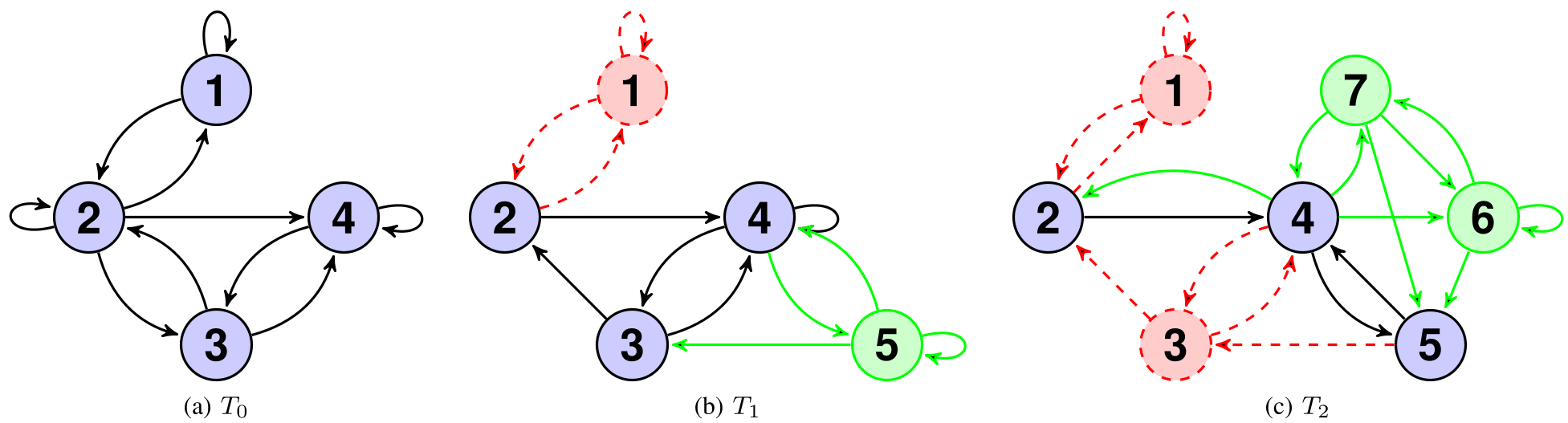
In healthcare, "retirement" is often a sign of success—the patient has learned to manage their condition. However, for community managers and researchers, this creates a "volatility" problem where common metrics of growth are actually driven by a high-turnover "revolving door" of new patients.
Methodology: Snapshot-Based Community Tracking
To track this volatility, the researchers used a three-step pipeline:
- Greedy Optimization (GO): A modularity-based algorithm to find clusters in annual snapshots.
- Jaccard Similarity Index: Used to measure how many members an "old" community shares with its "successor" the following year.
- Cohesion Heuristics: Examining clinical attributes like
years-since-diagnosisandHbA1clevels to see what actually binds a group together.
The "Diagnosis-to-Severance" Lifecycle
The most striking result was the Similarity Matrix. Between 2008 and 2009, community similarity scores were as low as 0.01 to 0.06. This is scientifically "dramatic"—it means that from one year to the next, the "sub-communities" are almost entirely composed of different people.
In the figure above, the green nodes (original members) are rapidly outnumbered by red nodes (new entrants), illustrating the evaporation of existing ties.
Key Findings:
- Scale-Free Nature: Despite the high turnover, the networks consistently follow a power-law degree distribution, meaning a few "veteran" users/moderators act as information hubs for the masses.
- The 2-Year Rule: 80% of active members were diagnosed less than two years ago. Once patients reach a "maintenance" phase in their health journey, they tend to leave the forum.
Critical Analysis & Conclusion
Impact on Future Interventions
This study proves that digital health interventions must be time-sensitive. Since the peak window of engagement is immediately following diagnosis, educational content and behavioral nudges should be front-loaded. Designing for long-term "gamified" retention might be counter-productive if the natural user journey is one of "learning and leaving."
Limitations
The study relies on public forum interactions, which misses private messages where deeper, more stable bonds might form. Additionally, the specific nature of diabetes—a self-managed lifestyle disease—might exhibit higher turnover compared to life-long conditions requiring constant clinical adjustment.
Final Takeaway
Online health communities are not "digital villages" but rather "emergency hospitals"—users arrive in crisis, get the "treatment" (information and empathy), and then go back to their lives. Understanding this temporal flux is essential for anyone building the next generation of social-led health platforms.