
What You Are is When You Are: Decoding POI Semantics Through the Lens of Time
What you are is when you are: the temporal dimension of feature types in location-based social networks
This paper introduces a behavioristic approach to define Points of Interest (POI) feature types using "Temporal-Semantic Interaction." By analyzing 440,939 check-ins from the Whrrl social network, the authors create "Semantic Signatures" that distinguish geographic features (e.g., Colleges vs. Bars) based on daily and weekly temporal bands rather than static physical descriptions.
TL;DR
Geographic features have long been defined by "what" they are—their physical attributes. This paper flips the script, arguing that "when" people visit a place is a more accurate indicator of its true nature. By analyzing nearly half a million check-ins from the Whrrl social network, the researchers demonstrate that temporal patterns (Temporal Bands) can act as unique fingerprints to distinguish between confusing categories like Bars, Cafes, and Colleges.
The Core Problem: The Failure of Static Definitions
In the world of Volunteered Geographic Information (VGI), categorization is a mess. One user might tag a location as a "Pub," while another calls it a "Nightclub." Traditional GIS ontologies, built by experts using rigid rules (e.g., "a bar must have tables and a license"), fail to capture the nuances of local culture and overlapping functionality.
The authors argue that current quality measures focus too much on positional accuracy (where it is) and completeness (is it on the map?), while ignoring attribute accuracy—whether the label actually matches the human experience of the place.
Methodology: Time as a Semantic Signature
The researchers introduce the concept of Temporal-Semantic Interaction. The heart of this method is the extraction of Temporal Bands—probability density functions that represent check-in frequencies over a 24-hour daily cycle and a 7-day weekly cycle.
1. Smoothing and Circularity
Because time is circular (11:00 PM Friday is close to 1:00 AM Saturday), the authors apply a moving-window smoothing kernel. This ensures that the transition between days and hours doesn't create artificial boundaries in the data.
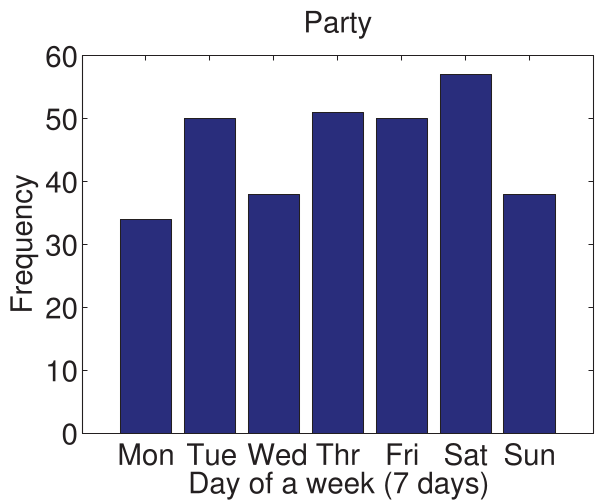 In the figure above, note the stark difference between "College" (9-5, weekday profile) and "Cocktail" (evening, weekend-heavy profile).
2. Measuring Similarity
To compare two categories (e.g., is "Stadium" more like "Museum" or "Airport"?), they use Total Variation Distance:
This allows them to quantify how similar two "Feature Types" are based purely on human interaction patterns.
Experimental Insights: Discovering Hidden Relations
The results reveal fascinating cultural insights. When analyzing Stadiums, the smoothed temporal bands showed a high similarity to Museums and Theaters (shared entertainment profiles) but also Beer. Why? Because, behaviorally, a stadium is a place where people go to consume beer at specific times. This "accidental" association is invisible to traditional ontologies but crystal clear in behavioral data.
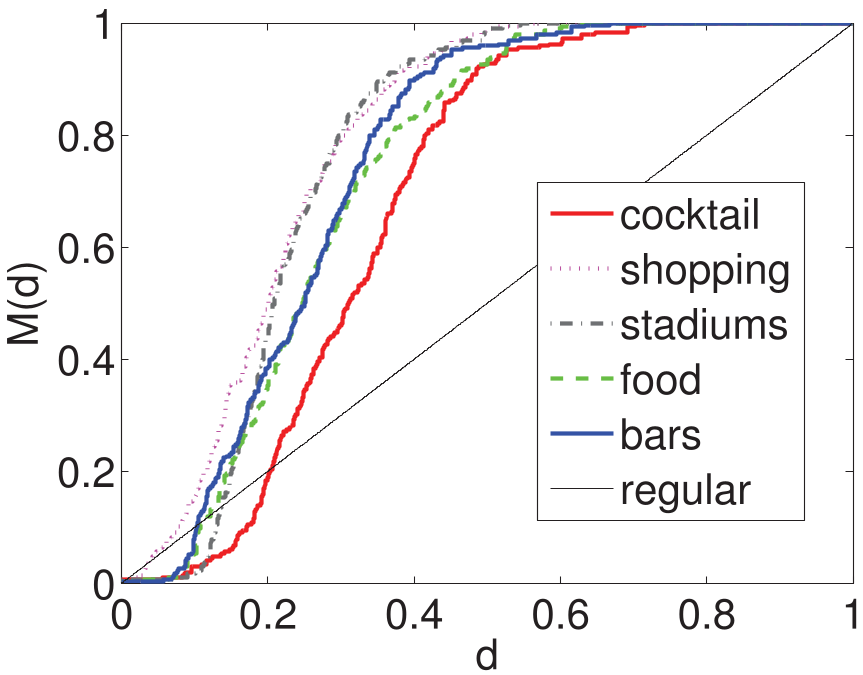 The M-function plot shows that general activities like "Shopping" have many temporal siblings, while specific activities like "Cocktail" have unique signatures that are easier to isolate.
Real-World Applications
The paper outlines three major technical applications for this research:
- Context-Aware Tag Recommendation: If a user checks in at 1:00 AM, the system should suggest "Nightclub" instead of "Hardware Store."
- Intelligent Place Selection: Re-ranking nearby search results based on the current time (e.g., prioritizing breakfast spots on Sunday mornings).
- Data Cleaning: Identifying errors in VGI. If a place is tagged as a "Bank" but has a check-in peak at 11:00 PM on Saturdays, the tag is likely incorrect.
Critical Analysis & Conclusion
This work marks a shift from Intensional Ontology (defining things by properties) to Extensional Ontology (defining things by usage).
Limitations: The study relies on Whrrl data from 2011, which is biased towards social-heavy locations (Nightlife, Dining). It lacks coverage of "quiet" feature types like cemeteries or industrial zones where people don't check in. Furthermore, regional differences (e.g., Mediterranean lunch habits vs. US habits) are acknowledged but not fully modeled.
Future Impact: By combining these temporal bands with spatial and thematic bands, we move closer to "Semantic Signatures" that can automatically map the world's functions with the same precision that spectral signatures map its physical terrain in remote sensing.