
Deciphering Friendship from GPS Trails: The Power of Temporal Diversity
10139_Role of Temporal Diversity in Inferring Social Ties Based on Spatio-Temporal Data.
The paper introduces the DAIICT Spatio-Temporal Network (DSSN) dataset and proposes "Temporal Diversity," a novel metric to infer the strength of social ties from fine-grained GPS data. By analyzing 0.7 million data points from a university campus, the method achieves superior predictive power for relationship strength compared to traditional location-based entropy.
TL;DR
Can your phone's GPS data reveal who your actual friends are versus just someone you share a classroom with? This paper introduces the DAIICT Spatio-Temporal Network (DSSN) dataset and a new metric called Temporal Diversity. By measuring how "randomly" two people meet throughout the day, the researchers show that time—not just location—is the secret sauce for predicting the strength of human relationships.
The Problem: The "Co-worker" Trap
Existing models for social tie inference often rely on Location Entropy (the variety of places you meet) or Encounter Frequency (how often you meet). However, these metrics suffer from a "schedule bias."
If you attend a lecture with 50 people every Monday at 9:00 AM, you will have high encounter frequency and perhaps even high location specificity with them. But you aren't necessarily "Very Good Friends" with all 50. Traditional models struggle to distinguish between:
- Mandatory Encounters: Dictated by schedules (classes, work).
- Voluntary Encounters: Dictated by choice (lunch, late-night hangouts, weekend trips).
The Insight: Frequency vs. Randomness
The authors hypothesize that social intimacy is correlated with temporal randomness.
If you meet someone only at 9:00 AM, that’s a routine. If you meet them at 10:00 AM on Monday, 2:00 PM on Tuesday, and 11:30 PM on Friday, that is Temporal Diversity. The more your meetings are spread across the 24-hour clock, the more likely you are to be close friends.
Methodology: Quantifying Temporal Spread
The researchers divided the day into intervals (e.g., minutes). They then calculated the Temporal Encounter Vector, representing the frequency of encounters in each slot.
To measure the "spread," they utilized Shannon Entropy to define Diversity ():
Handling Coincidences with Renyi Entropy
They also applied Renyi Entropy, which allows for a parameter to adjust sensitivity. By setting , the model gives more weight to rare, "out-of-schedule" time slots, effectively filtering out the "noise" of routine encounters.
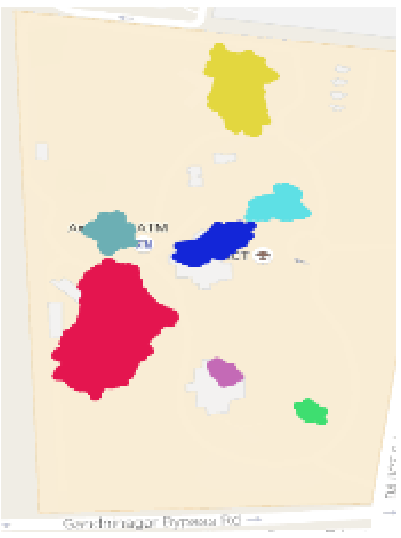 The study utilized a residential campus as a "microcosm," where buildings serve specific functions (hostels, labs, libraries), making the temporal context even more vital.
Experimental Results: Why Time Wins
The study compared three primary features against self-reported "Ground Truth" survey data:
- Temporal Diversity: The highest correlation with relationship strength (, ).
- Location Diversity: Significantly lower performance (, ).
- Mean Encounters: The weakest predictor ().
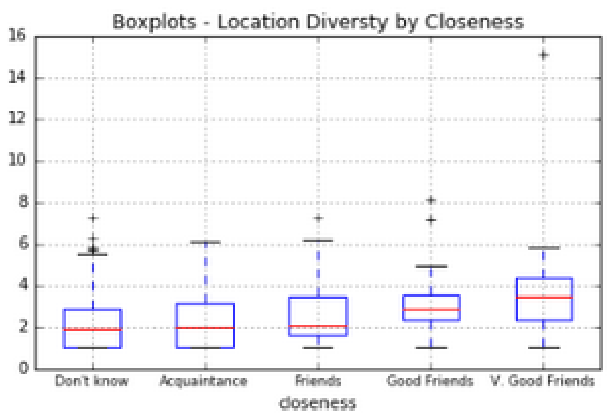 Visualizing the gap: Temporal Diversity (left) shows a much clearer upward trend as closeness increases compared to simple Mean Encounters (right).
Key Findings:
- The 60-Minute Sweet Spot: The model performs best when the day is divided into 1-hour blocks. Smaller intervals (5 min) are too noisy, while larger ones (12 hours) lose too much detail.
- Robustness to Sparsity: Unlike frequency-based models, Temporal Diversity works well even if you only have a few days of data.
- The "Friendship Velocity": For "Very Good Friends," Temporal Diversity grows rapidly as more data is collected over time, whereas for acquaintances, it stays flat and low.
Critical Analysis & Conclusion
The core takeaway is that human choice manifests as temporal entropy. In a world governed by schedules, our "free time" interactions are the most statistically significant indicators of our social structure.
Practical Implications:
- Privacy-Friendly Networking: Since this method relies on when people are together rather than exactly where they are at every second, it could potentially be implemented with less intrusive, coarser location data.
- Limitations: The study was conducted on a campus with an "age-homogeneous" population. In more complex urban environments with varying work shifts, the "scheduled" vs. "random" distinction might be harder to capture without more context.
Future Outlook
The release of the DSSN dataset provides a playground for researchers to explore how mobility intersects with happiness, academic performance, and even stress levels. As we move toward more "context-aware" AI, understanding the temporal rhythm of our lives will be as important as understanding our physical location.