
LRT: Why Your Location Recommender Needs to Understand the Clock
Exploring temporal effects for location recommendation on location-based social networks
The paper introduces LRT (Location Recommendation with Temporal effects), a location recommendation framework that incorporates user movement patterns on Location-Based Social Networks (LBSNs). By utilizing low-rank matrix factorization combined with temporal regularization, LRT captures the time-dependent nature of check-in behavior, significantly outperforming static recommendation baselines.
TL;DR
Location-Based Social Networks (LBSNs) like Foursquare provide a wealth of data, but most recommendation algorithms ignore the most critical variable: Time. This paper proposes LRT (Location Recommendation with Temporal effects), a framework that recognizes that your preference for a "Coffee Shop" at 8:00 AM doesn't translate to a preference for a "Nightclub" at those same coordinates. By modeling temporal "Non-uniformness" and "Consecutiveness," LRT sets a new standard for predicting where users want to go next.
The Problem: The Myth of the Static User
Traditional recommender systems treat you as a fixed vector of preferences. If you've visited a gym many times, the system assumes you like the gym all the time.
However, human mobility follows rigid temporal patterns. Prior works focused heavily on spatial (distance) and social (friends' check-ins) factors but lacked a deep dive into the temporal dimension. The authors argue that a static model fails because:
- It blurs different types of preferences (work vs. leisure) into a single average.
- It ignores the transitionary nature of our day (e.g., if you are at a restaurant now, you are more likely to visit a cinema next than a gym).
The Insight: Non-uniformness and Consecutiveness
The authors validate two fundamental temporal properties of human behavior:
- Temporal Non-uniformness: A user’s check-in distribution at 10:00 AM is statistically different from their distribution at 10:00 PM.
- Temporal Consecutiveness: Check-in preferences in adjacent hours (e.g., 1:00 PM and 2:00 PM) are more similar than those in distant hours (e.g., 1:00 PM and 9:00 PM).
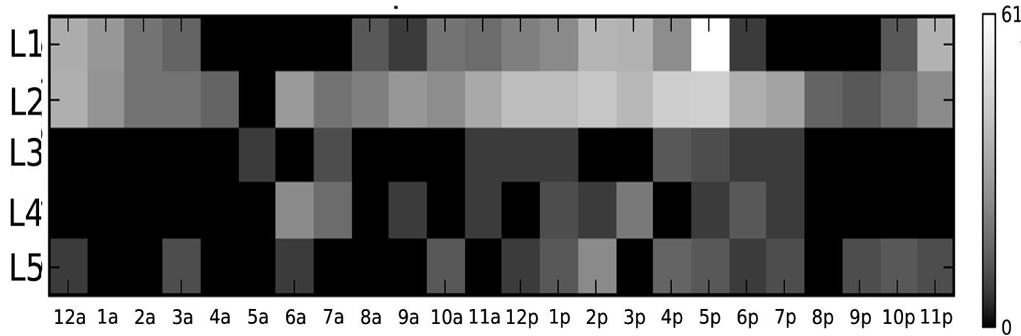 Figure 1: Illustration of a user's top 5 locations over 24 hours, clearly showing shifting density across different times.
Methodology: Factoring the Clock
The LRT framework consists of three main stages:
1. Temporal Division
The original user-location matrix is sliced into sub-matrices (e.g., for hourly states).
2. Temporal Factorization & Regularization
Instead of a single preference matrix, the model learns (user preferences at time ). To ensure the model respects the "Consecutiveness" property, they add a Temporal Regularization term. This term penalizes large differences between and using a cosine-similarity weighted diagonal matrix .
3. Temporal Aggregation
How do you combine 24 different "time-sliced" recommendations into one final list? The authors tested four strategies:
- Sum/Mean: Simple averaging.
- Maximum: Predicting based on the strongest signal.
- Voting: Treating each time slot as an independent expert.
Experiments: Does Time Really Matter?
The researchers used a Foursquare dataset spanning three months in 2011. The results were clear: LRT outperformed baselines across the board.
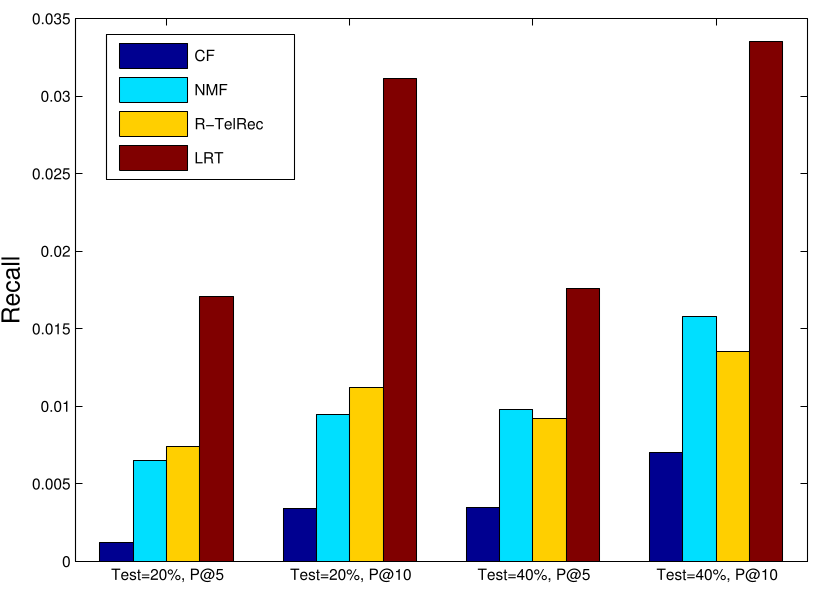 Table: Comparison showing Voting as the superior aggregation strategy.
Key Findings:
- Voting is King: The Voting strategy performed best because it acts as a noise filter, only recommending locations that are consistently strong candidates across relevant time states.
- Superiority over CF/NMF: LRT's ability to handle sparse data by modeling latent factors specifically for different times allowed it to beat standard Collaborative Filtering (CF).
- Flexibility: The model isn't just for hours of the day. It showed strong performance when applied to "Weekday vs. Weekend" and "Day of the Week" patterns.
Critical Analysis & Conclusion
The core contribution of this paper is the formalization of temporal regularization in Matrix Factorization for LBSNs. By linking adjacent time states, the authors prevented the model from becoming over-fit to the extreme sparsity of hourly check-ins.
Limitations: While powerful, the model assumes that location characteristics () are static. In reality, some locations might have "temporal characteristics" too (e.g., a park that is beautiful at sunset but dangerous at night).
Future Outlook: This work paves the way for "Spatial-Temporal-Social" unified frameworks. As we move into the era of LLM-based agents and real-time assistants, the principles of temporal non-uniformness outlined here remain highly relevant for context-aware AI.
Takeaway: If you aren't modeling when a user acts, you aren't truly modeling who the user is.