
Temporal Linguistic Variables: Bridging the Gap Between Time and Logic
Towards temporal linguistic variables
This paper introduces the concept of Temporal Linguistic Variables (TLVs), an extension of Zadeh's traditional linguistic variables designed to handle dynamic systems within fuzzy logic. It proposes a formal framework using Fuzzy Temporal Frames to model vague temporal concepts like "recently" and integrates them into fuzzy rule induction, achieving near-perfect classification accuracy (99.8%) on dynamic datasets.
TL;DR
This research addresses a fundamental limitation in Fuzzy Logic: its inherent "static" nature. While standard fuzzy systems excel at categorizing current states, they struggle with dynamic systems where the history of a variable matters as much as its current value. The authors introduce Temporal Linguistic Variables (TLVs)—a framework that allows models to reason with phrases like "if the pressure was very high recently". By formalizing "recently" as a fuzzy relation, they achieved a jump from 48.3% to 99.8% accuracy in dynamic system modeling.
The "Static" Trap in Dynamic Systems
In the world of fuzzy control, we usually map Input to Output . However, in real-world physics (like tracking a moving object), knowing the position is not enough; you need the velocity (the change over time).
The traditional "hack" is to add lag variables like or . This creates two problems:
- Complexity: If measurements are taken at irregular intervals, becomes meaningless.
- Semantic Loss: Humans don't think in terms of "Variable_at_T_minus_0.5ms"; we think in terms of "increasing" or "recently high."
Methodology: The Anatomy of a Temporal Frame
The authors treat time not just as a coordinate, but as a Fuzzy Relation. They introduce the Fuzzy Temporal Frame , where is a set of relations like before, recently, or now.
1. The Generative Grammar
Instead of simple labels like "High," a TLV uses a structured grammar:
<value> at <time quantifier> <ftr>- Example:
Highatsome_timerecently.
2. Computing Meaning with R-Implications
To make this mathematically rigorous, the authors define the membership function for these expressions. A critical insight was the use of R-implication (specifically Lukasiewicz implication). This ensures that if a variable's "highness" matches its "recency" perfectly, the truth value is 1, avoiding the counter-intuitive penalties found in simpler S-implications.
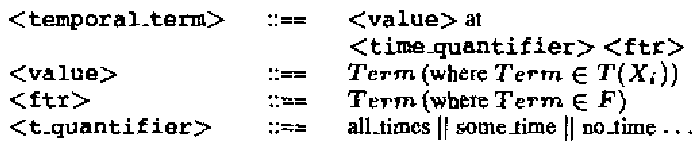 The grammar used to construct temporal terms from standard linguistic variables.
Experiments: Breaking the Derivative Barrier
To prove the method, the authors simulated a system where the output depends on the first derivative of a sine wave. A standard fuzzy system is blind to derivatives and can only guess based on the current value.
The authors defined two fuzzy temporal relations:
- Recently: Close to the current moment.
- Midterm: A slightly older window in the history.
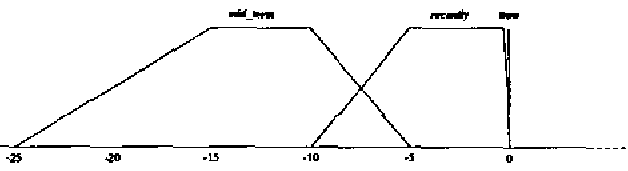 Fig 2: Defining the "shape" of time: The membership functions for 'recently' and 'midterm'.
The Results
The difference in performance was staggering:
| Method | Fuzzy Relations Used | Accuracy |
|---|---|---|
| Static (Standard) | None (Now only) | 48.3% |
| TLV (Partial) | Recently | 92.4% |
| TLV (Full) | Recently + Midterm | 99.8% |
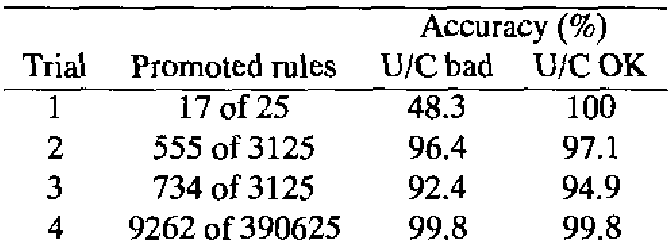 The experiment shows that as more temporal context is added, the model's ability to 'understand' dynamics approaches perfection.
Critical Insight & Conclusion
The genius of this work lies in its orthogonality. You don't need to change your underlying fuzzy inference engine or your machine learning algorithm (like ID3 or FAPACS). You simply change the Variable Type from a standard one to a Temporal one.
Takeaway for Practitioners: If you are working with time-series data where "trends" matter, stop adding features. Instead, model the temporal window as a fuzzy relation. This preserves the "Explainable AI" (XAI) nature of fuzzy logic while giving it the power to handle the flow of time.
Limitations: While powerful, the computational cost increases with the size of the historical buffer (), as the system must perform a max-min optimization over all past events in the history to evaluate a single rule.