
Beyond Detection: Predicting the Resurgence of Popular Topics in Social Networks
17538_When to Make a Topic Popular Again A Temporal Model for Topic Rehotting Prediction in Online Social Networks.
This paper introduces the Task of Topic Re-hotting Prediction (TRP) and proposes the Temporal User Topic Participation (UTP) model. By integrating users' interests, social circles, and external unexpected events, the model accurately predicts specific time points for a topic's resurgence using a novel Expectation-Maximization Gaussianization (EMG) algorithm and a weighting scheme for fluctuation smoothing.
TL;DR
In the fast-paced world of Online Social Networks (OSNs), topics don't just "die"—they often hibernate. This paper introduces the Topic Re-hotting Prediction (TRP) task, moving beyond simple detection to predict exactly when a dormant topic will trend again. By combining personal interests with external event triggers into a Temporal User Topic Participation (UTP) model, the authors achieve SOTA results in pinpointing topic "re-hotting" points.
The "Lazarus" Effect: Why Re-hotting Modeling is Hard
Existing research focuses heavily on Topic Detection (finding what's new) or Topic Evolution (how ideas change). However, nearly 23% of topics exhibit multiple peaks of popularity. Current models struggle with two things:
- Granularity: Discrete time-window models can tell you a topic might return next week, but not at what hour or day.
- Noise: Tiny "blips" in activity often cause false positives in re-hotting alerts.
The authors' insight? A user's decision to post is a binary tension between internal curiosity (friend circles/personal hobbies) and external shocks (breaking news/unexpected events).
Methodology: The UTP Model & EMG Algorithm
The core of the work is a generative model that treats user participation as a result of a latent "switch" variable ().
1. The Hybrid Architecture
- E-UTP (Event-Driven): Models topics triggered by external events (e.g., a sudden natural disaster).
- I-UTP (Interest-Driven): Models topics sustained by community interests and "friend-circles."
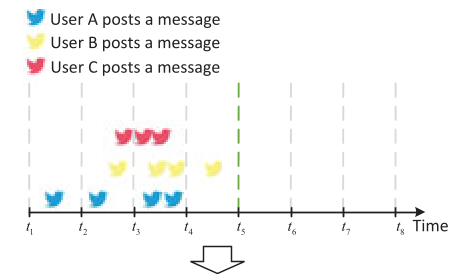
2. The EMG Algorithm (The Secret Sauce)
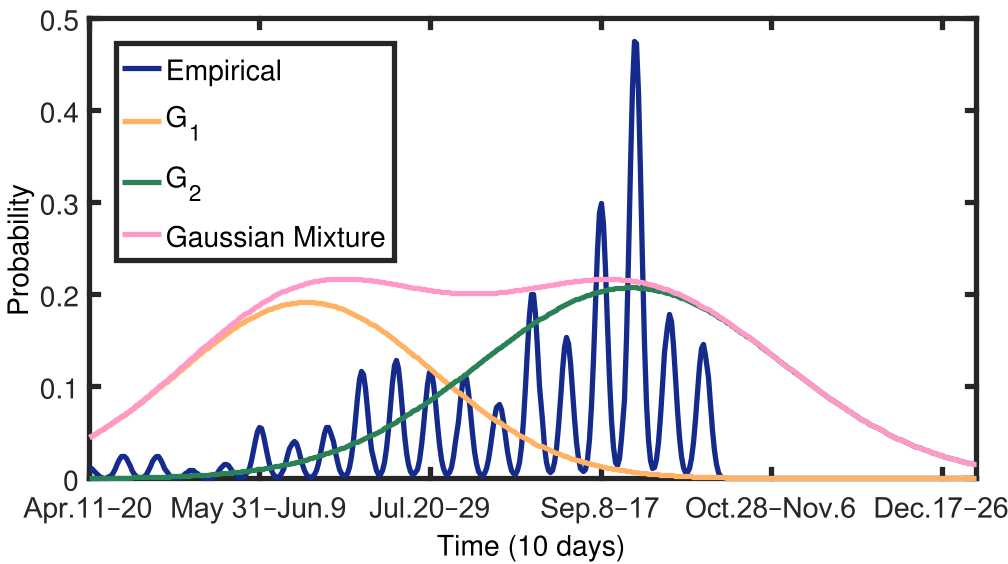
To solve this, the authors improved the standard EM algorithm by adding a G-Step (Gaussianization). The logic is elegant: social behavior over time roughly follows a Gaussian distribution. By fitting a Gaussian Mixture Model (GMM) to the topic participants, the model transforms discrete participation counts into a continuous probability density function, allowing for the prediction of precise time points ().
Handling the "Noise": The Weighting Scheme
Not every uptick in activity signifies a comeback. The authors introduced a weighting scheme that penalizes slight ascending trends if they aren't backed by "cumulative impact." This "smoothing" ensures that only topics with significant momentum are flagged as re-hotting.
Experimental Results: Real-World Validation
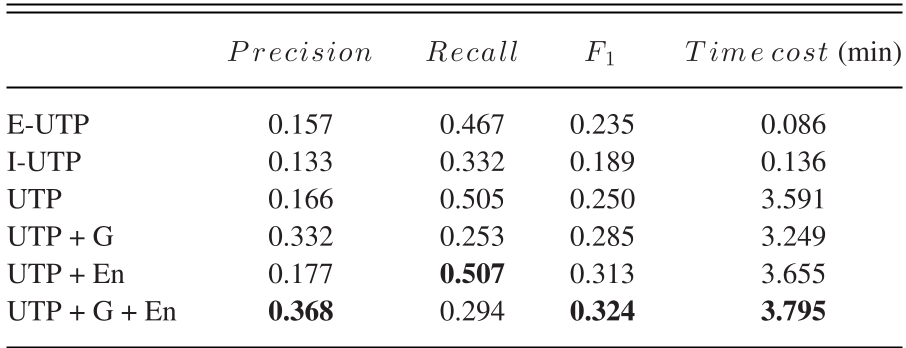
The model was tested on massive datasets from Twitter and Weibo. The comprehensive version, UTP + G + En (Gaussianization + Enhancement), consistently outperformed simpler versions.
Case Study: The iPad Cycle
In one striking example, the model was applied to "iPad" mentions on Twitter. The model predicted re-hotting spikes at and . These corresponded exactly with the real-world product announcements of the 3rd and 4th generation iPads.
Critical Insight & Future Outlook
This paper changes the perspective from "tracking a topic" to "understanding the user-event interaction." The switch variable is particularly brilliant—it acknowledges that while I might usually tweet about AI (Interest), I will suddenly tweet about an Earthquake (Event) if it happens near me.
Limitations: The model currently relies on pre-defined keywords for topics. Integrating LLM-based semantic embeddings could likely solve the "topic drift" problem where a re-hot topic uses different slang or keywords than its original peak.
Takeaway for Practitioners: If you are in digital marketing or public opinion monitoring, stop looking at "volume" and start looking at "participation probability density." The curves don't lie.