
T-PR: Solving the Longevity Bias in Social Trust Networks
Temporal PageRank on Social Networks
The paper introduces Temporal PageRank (T-PR), a novel ranking algorithm designed for social trust networks. By integrating three temporal dimensions—Built-up Time-length, Frequency, and Similarity—into the PageRank framework, it effectively mitigates bias against newer nodes and provides authority scores that better align with dynamic user behavior.
TL;DR
Standard ranking algorithms like PageRank suffer from a "seniority complex"—they favor old nodes simply because they've had more time to collect links. Temporal PageRank (T-PR) disrupts this by factoring in when links were created and how regularly users interact. Tested on Epinions data, T-PR improves Mean Reciprocal Rank by over 12%, proving that the timing of trust is just as important as the existence of trust.
The "Old Guard" Problem
In social networks, quality is fleeting. A user who was an authority in 2010 might be irrelevant today. However, traditional link-based algorithms are static:
- Accumulation Bias: Older pages sit at the top because they have a massive head start in link accumulation.
- Ignored Dynamics: They treat a link created 5 years ago the same as a link created 5 minutes ago.
- Trust Decay: In social environments, trust isn't permanent; it evolves. A new, high-quality user needs a way to break through the "rich-get-richer" cycle of standard PageRank.
Methodology: The Three Pillars of Temporal Trust
T-PR moves away from uniform transition probabilities (1/out-degree) and instead calculates a weighted transition based on three sophisticated temporal factors:
1. Built-up Time-length Factor (BTF)
Based on the sociological theory that trust increases over time, BTF measures the interval between a user's registration and the link creation. A link from a user who has "observed" the network for a significant period before trusting someone is weighted more heavily than a "snap" judgment.
2. Frequency Factor (FF)
This addresses reliability. A trustworthy user is typically active and adds links regularly. T-PR penalizes "bursty" behavior (adding hundreds of links at once, typical of bots or spam) by rewarding users with low variance in their interaction timestamps.
3. Similarity Factor (SF)
Using an adapted version of SimRank, this factor assesses whether two users behave similarly within a specific time window. It allows the model to recognize that an old user trusting a new user is valid if their recent behavioral patterns align.
 Above: The weighted fusion formula integrating BTF, FF, and SF into the transition matrix.
Experimental Validation
The authors utilized a dataset from Epinions.com, covering over 47,000 nodes and 258,000 trust links.
Evolution of Authority
By measuring OSim (Overlap Similarity) and KSim (Kendall’s Tau Similarity), the study found that traditional PageRank remains remarkably static over time. T-PR, however, shows lower similarity between time steps, indicating its ability to adapt to the changing landscape of who is actually relevant.
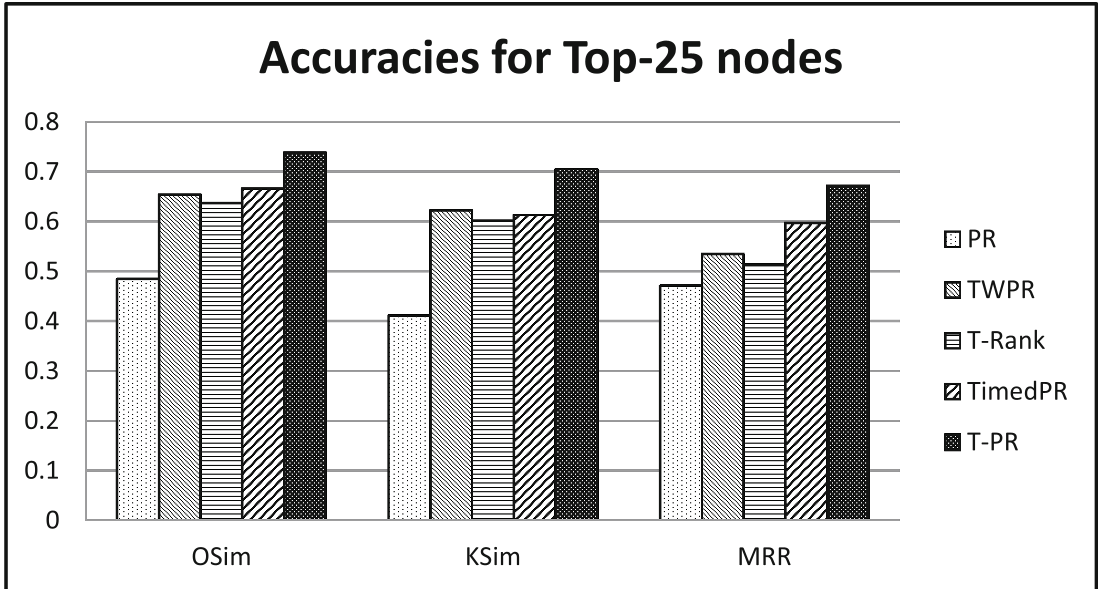 Figure: T-PR outperforms PR, TWPR, and TimedPR across all metrics (OSim, KSim, MRR), demonstrating that temporal factors lead to more accurate user recommendations.
Critical Insight & Conclusion
The genius of T-PR lies in its Inductive Bias: the assumption that trust is a function of time and consistency. While standard PageRank sees the web as a set of static documents, T-PR sees a social network as a living organism.
Limitations: The model relies on exponential decay, which requires fine-tuning of the parameter. A "one-size-fits-all" decay rate might not work for every community.
Future Outlook: Integrating these temporal weights into modern Graph Neural Networks (GNNs) could lead to even more robust recommendation systems that are resistant to "seniority" bias and social spam.