
Beyond Words: Leveraging Temporal Psycholinguistics and GCNs for Suicide Intent Estimation
Utilizing Temporal Psycholinguistic Cues for Suicidal Intent Estimation
This paper introduces a novel framework for suicidal ideation detection on Twitter by integrating temporal psycholinguistic cues and social homophily. It leverages a BiLSTM + Attention text classifier augmented with a Temporal Graph Convolutional Network (GCN) to model user history and community interactions, achieving a state-of-the-art F1 score of 93.89%.
TL;DR
Suicide ideation detection on social media is shifting from "what was said" to "how it evolved." This paper presents a specialized framework that combines BiLSTM-Attention text modeling with Temporal Graph Convolutional Networks (GCNs). By viewing a user's tweet history as a dynamic signal (composed of build-up, episodes, and noise) and their social circle as a homophily network, the researchers achieved a superior 93.89% F1 score, effectively filtering out sarcastic noise that plagues traditional NLP models.
The Missing Dimension: Time and Community
Most automated suicide detection systems treat tweets as isolated data points. However, clinical psychology suggests that suicidal ideation is rarely a spontaneous reaction but rather a trajectory. The authors identify two major gaps in current SOTA methods:
- Lack of Temporal Depth: Single-post analysis misses the "build-up" or "episodic" nature of mental distress.
- Ignoring Homophily: Depressive symptoms often cluster in social networks. If a user's environment exhibits high-risk signals, the user's own risk profile changes—a factor traditional text classifiers ignore.
Methodology: The Three-Pillar Approach
The core innovation lies in how the authors represent a user's "Suicidal Tendency" as a mathematical function.
1. The Temporal Weighting Scheme
Instead of simple averages, the model calculates a temporal function for a user's history . It breaks down suicidal signals into:
- Ideation Build-Up: An exponential function modeling the gradual accumulation of intent.
- Suicidal Episodes: A sinusoidal function capturing the phased, cyclic changes in intent.
- Temporal Surprise: A Gaussian noise component to account for the randomness of social media engagement.
2. Temporal GCN (Social Context)
The paper utilizes a GCN to model the "collusive" nature of online communities. Each node in the graph represents a user, but unlike standard GCNs, the features are time-weighted TF-IDF vectors. This allows the model to prioritize recent linguistic changes while still being informed by the user's neighborhood.
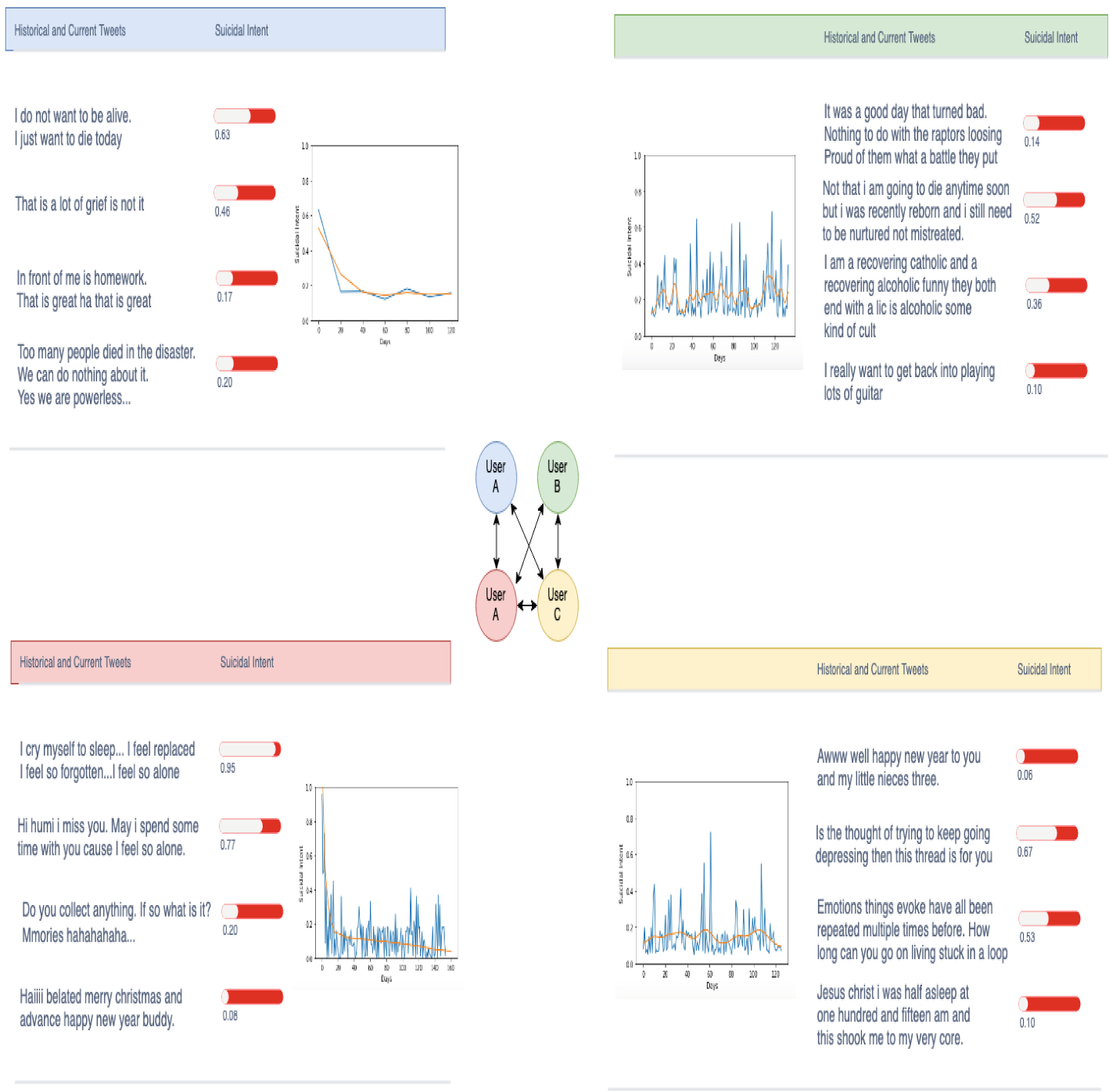 Fig 1. Analysis of historical behavior showing episodic nature and intent build-up across connected users.
Experiments and Breakthroughs
The team tested their approach on the SNAP-BATNET dataset (34,306 tweets).
| Model | F1 Score | Precision |
|---|---|---|
| BiLSTM + Attention (Text Only) | 91.26 | 70.02 |
| Text + Temporal Modeling | 92.75 | 91.98 |
| Temporal GCN (Proposed) | 93.89 | 88.73 |
Why it Works: The "Sarcasm" Filter
One of the most striking findings is the model's ability to suppress false positives. Phrases like "kill me... hahaha!!" are frequently flagged by text-only models as high risk. However, by looking at the Temporal Build-up and Social Context, the proposed model recognizes these as "noise" or "surprises" rather than part of a sustained depressive trajectory, dramatically improving precision.
Critical Insight & Conclusion
This work marks a transition from Content-Based Filtering to Behavioral Modeling. The insight that suicidal intent can be decomposed into sinusoidal episodes and exponential build-up provides a bridge between clinical psychology and deep learning.
Limitations: While powerful, the model relies on the availability of user timelines and graph connections, which are increasingly restricted by privacy APIs (like Twitter's recent API changes). Future work will likely need to explore how to achieve similar results with sparse or anonymized data.
Final Takeaway: To save lives using AI, we must look at the person behind the post, not just the words in the bubble.