
Temporal Sentiment Tracking: Decoding Public Emotion in Large-Scale Events
Temporal Sentiment Tracking and Analysis on Large-scale Social Events
The paper introduces a temporal sentiment tracking framework specifically designed for large-scale social events (e.g., festivals) using data from Facebook and Twitter. It proposes a lexical-based approach that integrates "Essential" textual features with "Auxiliary" non-textual features (like reactions and shares) to compute cross-platform sentiment polarity.
TL;DR
Researchers have developed a new framework to track how public sentiment evolves during major social events like music festivals. By combining traditional text analysis with "auxiliary" social signals—such as Facebook's 'Love' or 'Angry' reactions and Twitter's 'Retweets'—the team achieved higher precision in identifying positive, neutral, and negative shifts across time.
Context: Why Size and Time Matter
In the world of Online Social Networks (OSNs), sentiment analysis (SA) is often applied to static datasets or small-scale personal milestones. However, large-scale social events (festivals, protests, or sports) create a unique "temporal pulse." Public mood isn't static; it anticipates, reacts, and reflects. Existing tools often miss this because they treat a post in isolation, ignoring the secondary signals like how many people liked a comment or the specific type of reaction it garnered.
Methodology: Beyond Just Words
The authors propose a hybrid lexical approach. While the core sentiment is derived from SentiWordNet 3.0, the system doesn't stop at keywords.
1. Handling Linguistic Nuance
To tackle the "sarcasm" and "negation" problem, the framework uses Universal Dependencies. If a user says a festival "wasn't very good," the system identifies the negation (neg) and the adverbial modifier (advmod) to flip and scale the sentiment score appropriately.
2. The Weight of Engagement
The standout feature is the Aggregation Formula. Not all social signals are equal. For example, Facebook reactions are weighted more heavily than shares because they provide explicit emotional labels (e.g., Wow, Sad, Angry).
 Figure 1: The workflow from data crawling to cross-platform sentiment aggregation.
The paper defines an Attitude Rank () based on popularity thresholds, ensuring that a viral post carries more weight in the overall event sentiment than an obscure one.
Experiments: Testing at "Ultra Music Festival"
The researchers tested their method on data from the Ultra Music Festival. They categorized the analysis into three windows: Before, During, and After.
Key Findings:
- Auxiliary Power: Adding non-textual features (auxiliary) improved the F1-measure across the board. On Facebook, the Positive class F1 rose from 0.67 to 0.75 by including reactions.
- Platform Differences: Twitter showed a higher volume of sentiment expression, suggesting it’s the "go-to" platform for real-time reactions. However, Facebook provided more granular data due to its varied reaction set.
- Scalability: The precision of the model increased as the dataset grew, suggesting the lexical approach remains robust even as event data scales to millions of posts.
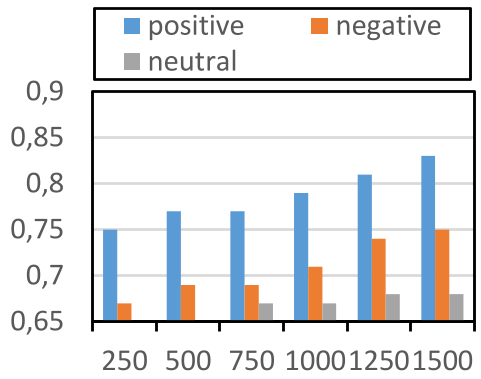 Figure 2: Precision tracking for Facebook sentiment during the event across different dataset scales.
Critical Insight: The "Haha" Ambiguity
Interestingly, the authors highlighted the ambiguity of the "Haha" reaction on Facebook. It can mean something is genuinely funny (positive) or it can be used to mock a post (negative). Their solution? A conditional formula that checks the ratio of Love/Wow vs. Angry/Sad to determine if "Haha" should be treated as a positive or negative signal. This level of heuristic detail is what makes the system practically viable.
Conclusion and Limitations
The study proves that temporal tracking is essential for understanding event dynamics. However, the authors admit that a purely lexical approach (dictionary-based) has limits. Future iterations aim to integrate Supervised Machine Learning to better capture slang and evolving internet dialects that fixed lexicons might miss.
Ultimately, this work provides a blueprint for brands and event organizers to move beyond "what" people are saying to "how" they are feeling as the clock ticks.