
TGQ: Rethinking Historical Group Analytics in Dynamic Social Networks
Temporal Social Network: Group Query Processing
This paper introduces the Temporal Group Query (TGQ) for Temporal Social Networks (TSN), focusing on retrieving connected groups of users based on historical activity participation and relationship duration. The authors propose two indexing structures, TA-tree and TF-tree, and an optimized graph-update algorithm that outperforms baseline iterative methods in historical group analysis.
TL;DR
Analyzing how groups form and dissolve over time in social networks is a heavy computational task. This paper introduces the Temporal Group Query (TGQ) and a pair of specialized temporal indexes (TA-tree and TF-tree). By shifting from a "reconstruct-at-every-step" approach to an incremental "graph-update" logic, the authors achieve a significant speedup in processing complex queries that combine keyword activities, time-stamped relationships, and online status.
Problem & Motivation: The "Static" Trap
Conventional social network analysis treats friendship as a snapshot. However, in reality, relationships have lifespans—people join groups, post activities during specific windows, and drift apart.
The authors identify a critical gap: existing queries like Social-Temporal Group Query (STGQ) focus on the future (e.g., finding a time when everyone is free to meet). They lack a Historical View. If a system analyst wants to find groups that were active during a specific election cycle with high online engagement, existing methods would need to "replay" the entire history of the graph, which is prohibitively slow for networks with millions of edges.
Methodology: The Core Engine
The paper's breakthrough lies in two areas: intelligent indexing and incremental computation.
1. Dual Indexing Strategy
Instead of a single monolithic database, the system splits search concerns:
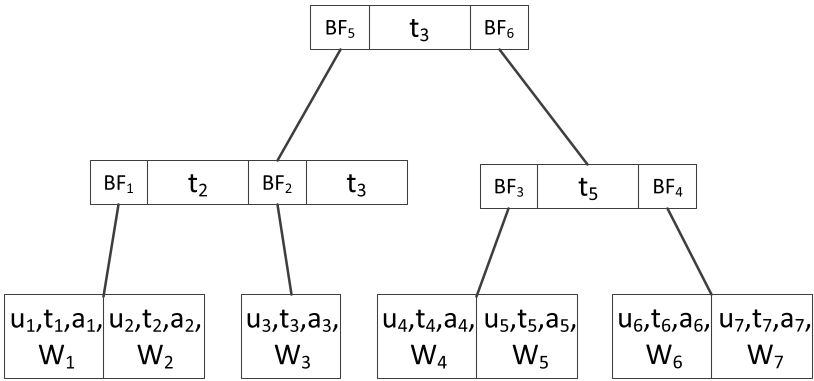
- TA-tree (Temporal Activity tree): A B+ tree enhanced with Bloom Filters. It filters users who participated in specific activities (keywords) during a defined time window .
- TF-tree (Temporal Friendship tree): Based on an MVB-tree, it indexes versions of relationships. This allows the system to instantly retrieve what the "friendship landscape" looked like at any point in history.
2. From Iteration to Updates (The "How")
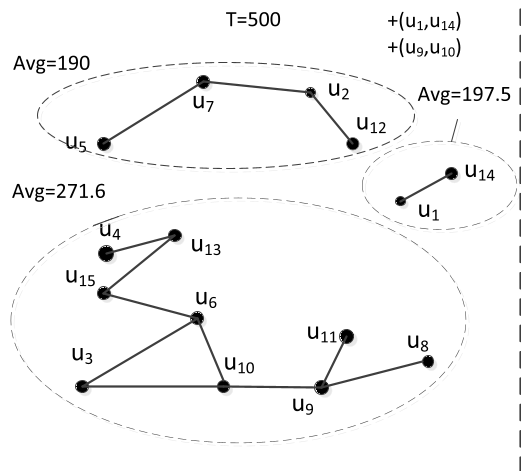
The Naive Searching method treats every timestamp as a new problem, generating a fresh graph and checking connectivity. The Optimized Processing method is more elegant. It builds an initial graph and then "patches" it by listening to relationship changes:
- Addition: Does a new edge connect two existing groups or bring in an isolated node?
- Removal: Does removing an edge split a group into two?
By only recalculating the Average On-line Duration (AOD) for affected components, the search space collapses, leading to much faster response times.
Experiments & Results
The researchers tested their approach on a massive dataset modeled after YouTube (3.2M users) and Amazon activity data.
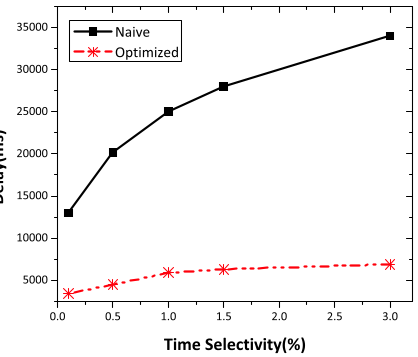
- Scalability: The optimized method consistently outperformed the naive approach across all variables.
- Pruning Power: The "Average On-line Duration" (AOD) serves as a powerful pruning tool. When the required threshold is higher, the algorithm can terminate the search early, significantly reducing latency.
- Complexity: While adding keywords (increasing TA-tree depth) increases latency, the optimized algorithm's gap over the baseline remains wide.
Critical Analysis & Conclusion
The TGQ framework is a robust step forward for temporal graph databases. By defining group satisfy-ability through both connectivity and temporal attributes (AOD), it mirrors real-world social dynamics more accurately than static models.
Takeaway: The real value here is the proof that incremental maintenance of connected components is the only viable path for historical queries on web-scale social data.
Limitations: The current model assumes "all-or-nothing" participation. Future extensions could incorporate the intensity of activity or, as the authors suggest, geographic attributes to enable "Socio-Spatial-Temporal" analytics.