
TTI Model: Redefining Social Influence through Universal Gravitation
Temporal Topic-Based Multi-Dimensional Social Influence Evaluation in Online Social Networks
The paper introduces the Temporal Topic Influence (TTI) evaluation model, designed to identify top-k influential users in Online Social Networks (OSNs). It uniquely integrates time-decay factors, topological network structures, and content-based topic distributions using a novel "User Gravitation Ability" metric.
TL;DR
Social influence isn't just about how many followers you have; it's about being the right person, talking about the right topic, at the right time. This paper introduces the Temporal Topic Influence (TTI) model, which treats user influence like physical gravity—where content similarity acts as "mass" and network links represent "distance"—to more accurately identify the true "opinion leaders" of the digital age.
Problem: The One-Dimensional Fallacy
Most influence evaluation tools are trapped in a single dimension:
- Structure-aware models (like PageRank) focus solely on links.
- Content-aware models focus only on what is said.
- Time-aware models track changes but ignore the "who" and "what."
The authors argue that real-world influence is a composite of these forces. A user might have millions of followers (high structure), but if they post about a dead topic (low temporal relevancy), their actual influence is negligible.
Methodology: The "Gravity" of Social Influence
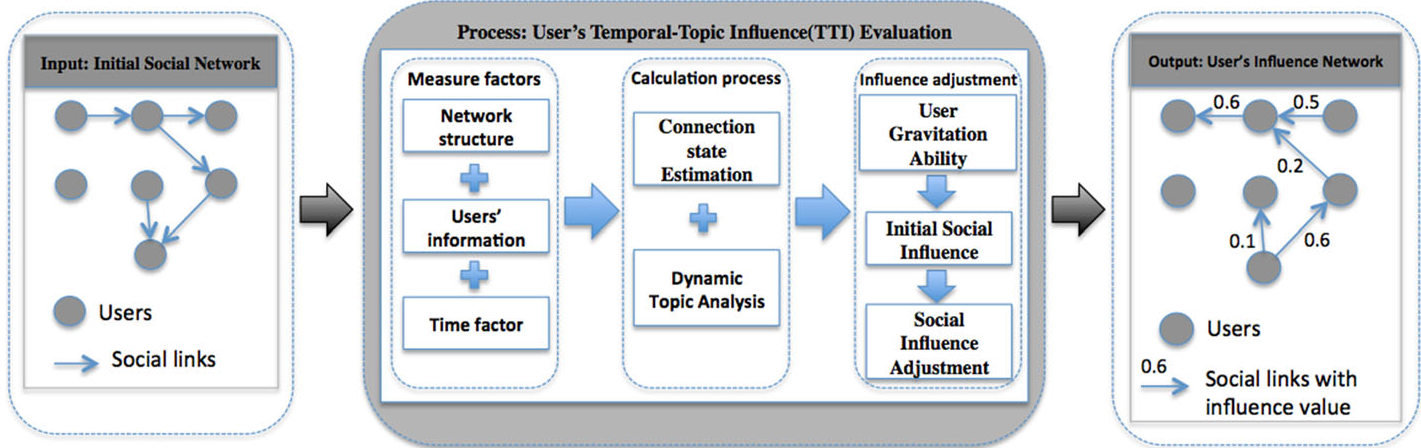
The core innovation is the User Gravitation Ability (). By translating social dynamics into physical variables, the authors create a sophisticated heuristic for influence:
1. Dynamic Topic Analysis (The "Mass")
Using Latent Dirichlet Allocation (LDA), the model extracts topic distributions from user posts. Crucially, it applies an Exponential Decay Function () to ensure that recent interests weigh more heavily than past ones.
2. Connection Distance (The "Distance")
The distance isn't just the number of hops. It incorporates Indirect Connection Probability (Jaccard coefficient of common friends). If you and I share many mutual friends, the "distance" between us effectively shrinks, increasing our mutual influence.
3. The Gravitation Formula
Inspired by Newton, the initial influence is calculated as: Where is the topic distribution and is the connection distance.
Refinement: The Markov Adjustment Process
Initial influence is static. To model how influence "flows" through a network, the authors use a Markov Representation. Similar to PageRank, a user's final influence score depends on the quality and quantity of their friends' influence. This iterative process ensures the model reaches a "stable state" that reflects the true equilibrium of the social ecosystem.
Experimental Results & Insights
The TTI model was tested against Sina Weibo datasets, comparing it to staples like TwitterRank and PageRank.
Efficiency in Distinction
One major issue with simple models (like Degree Centrality) is that many users end up with the same influence score (high duplication). TTI achieved the lowest duplication rate (11.3%), proving it can distinguish between users with extreme granularity.
Superior Information Cascade
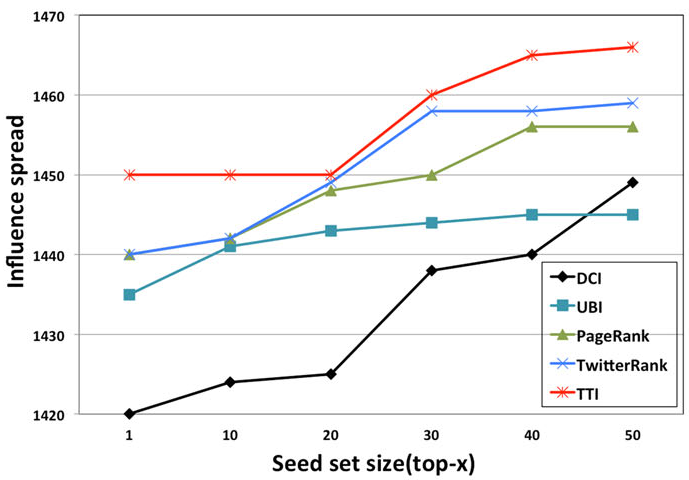
In Influence Spread simulations (IC and LT models), TTI consistently outperformed competitors. When picking "seed" users for a marketing campaign, TTI's selections reached a significantly larger audience, especially as the number of seeds () increased.
Critical Analysis & Future Outlook
Takeaway: TTI bridges the gap between content and structure. By treating social networks as a physical space with "gravitational" properties, it captures the intuition that influence decays over distance and time.
Limitations:
- The model currently relies on LDA, which might struggle with the ultra-short, slang-heavy nature of modern microblogs (e.g., Twitter/X).
- The "Six Degrees of Separation" constant () is a clever heuristic but might vary across different platforms or cultural contexts.
Future Work: Moving from time-static graphs to time-evolving graph neural networks could allow this model to predict future influence rather than just evaluating historical data.
Conclusion
The TTI model proves that in the noise of big data, multi-dimensional filters are the only way to find the signals that matter. For researchers and marketers, the message is clear: look for the gravity—the intersection of topic, timing, and topology.