
TSFES-OIM: Elevating Ontology Matching with Syntactic Tensors
Tensor-Based Syntactic Feature Engineering for Ontology Instance Matching
The paper introduces TSFES-OIM, a supervised learning framework for ontology instance matching that utilizes Tensor-Based Syntactic Feature Engineering. By combining Stanford Parser-driven syntactic analysis with a Multi-Tensor Hierarchy Network (MTHN), the method achieves significant precision improvements on the OAEI SABINE data linking task.
TL;DR
Ontology instance matching — the task of identifying if two different data instances refer to the same real-world entity — often hits a ceiling when relying purely on string similarity. This paper introduces TSFES-OIM, a system that uses Natural Language Processing (NLP) to extract syntactic roles (like subjects and objects) and a Multi-Tensor Hierarchy Network (MTHN) to model complex feature interactions. The result is a substantial boost in precision for "non-trivial" matches in the OAEI SABINE benchmark.
Background: Beyond String Matching
In the world of the Semantic Web, matching a "Topic" in one ontology to a "DBpedia Entity" in another is rarely a matter of simple identity. Descriptions are often buried in natural language abstracts. Existing SOTA methods (like AML or RiMOM) use structural or WordNet-based similarities, but they largely ignore the syntactic structure of the sentences describing the instances.
The authors argue that knowing a word is the Subject of a sentence provides a much stronger matching signal than simply knowing the word exists in the text.
The Problem: The Complexity of Feature Engineering
How do you tell a machine learning model that "A being the subject of description X" and "B being an alias of the source label" should together trigger a "Match" signal?
- Syntactic Blindness: Most matchers treat property text as a "bag of words."
- Feature Interaction: Manually defining every possible conjunction of features (Feature A and Feature B) leads to a combinatorial explosion.
Methodology: The TSFES-OIM Architecture
The system follows a sophisticated pipeline:
- Syntactic Extraction: Using the Stanford Parser to identify noun phrases specifically within Subjects and Objects of the instance descriptions.
- Rule-Based Augmentation: Determining relations between these extracted phrases (e.g., "Do they share a lowercased word?").
- The MTHN Tensor Model: This is the "secret sauce." Instead of a flat feature vector, data is mapped into an -order tensor. This allows the model to represent conjunctions of feature values as dedicated tensor entries.

The Multi-Tensor Hierarchy Network (MTHN) organizes these features into levels. Level 1 represents individual features, while Level 2 represents pairs of features occurring together. This creates a high-dimensional space where Logistic Regression can precisely weight which "combinations" of syntactic evidence are the most reliable indicators of a link.
Experiments and Results
The authors tested their approach on the SABINE Data Linking subtask (European politics domain). They compared the baseline StringEquiv against various TSFES-OIM configurations.
Key Findings:
- Syntactic Power: Variants using syntactic features (
1S,2S) consistently outperformed those using only lexical features. - The Power of 2: Moving from MTHN Level 1 (individual features) to Level 2 (conjunctions) provided a visible boost in precision, especially at higher recall levels.
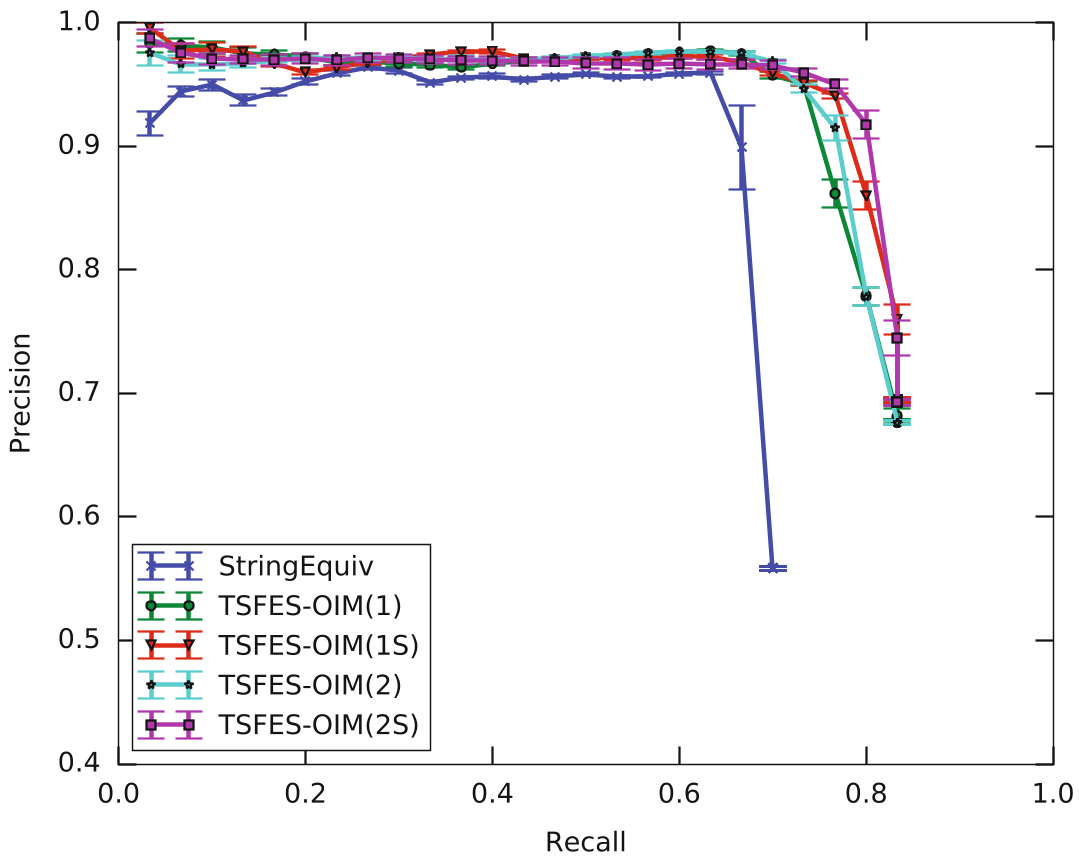
As seen in the graphs, TSFES-OIM(2S) (the red line) remains at the top of the curve. It handles "non-trivial" matches—cases where the labels aren't identical but the syntactic evidence is overwhelming—far better than the baseline.
Critical Insight: Why Tensors?
Most practitioners would use a simple "Feature Hash" or a flat vector for Logistic Regression. By using a Tensor-based representation, the authors provide a formal mathematical structure to the concept of Feature Crosses. This allows the weights in the Logistic Regression to act as a multi-linear evaluation of matches. While modern Deep Learning often handles interactions via hidden layers, the Tensor approach provides more explicit control and interpretability in the feature engineering stage.
Conclusion and Future Work
The paper successfully demonstrates that Syntactic Feature Engineering is a goldmine for ontology matching. By looking at how a word is used in a sentence (subject/object), we move closer to "understanding" the data rather than just "counting" it.
Future Outlook: The authors suggest integrating these syntactic features with structural (graph-based) and semantic (embedding-based) features. Combining the precision of syntactic tensors with the recall of Large Language Models (LLMs) could define the next generation of entity resolution.
Limitations
- Language Dependency: Currently supports English only due to the dependency on the Stanford Parser.
- Supervised Requirement: Unlike official OAEI contest entries, this requires "expert matches" for training, though it shows high performance even with a small 5% training ratio.