
Deciphering Digital Extremism: Using Centrality Algorithms to Map Terrorist Networks on Facebook
Analysis of Terrorist Groups on Facebook
This paper introduces a specialized "Facebook Operation" framework combined with Social Network Analysis (SNA) to monitor terrorist activities. It utilizes a centrality-based algorithm to identify key nodes within these networks responsible for propaganda dissemination and member recruitment.
TL;DR
This research presents a hybrid approach to counter-terrorism by combining Facebook Operation (agent-based data collection) with Social Network Analysis (SNA). By applying a specialized centrality-based algorithm, the authors identify the "most active nodes"—the key individuals responsible for recruiting new members and accelerating the flow of propaganda across the network.
Executive Summary
As Social Networking Sites (SNS) become the primary battleground for ideological influence, the ability to map and disrupt extremist cells is paramount. This paper situates itself at the intersection of Cyber-Intelligence and Graph Theory. Unlike generic monitoring tools, this work focuses on the "recruitment potential" of nodes, using structural position rather than just post frequency to identify high-risk targets.
Problem & Motivation: The Opaque Nature of Digital Cells
Existing counter-terrorism methods often face a "needle in a haystack" problem. Social platforms provide a shroud of anonymity and high-volume data that masks the hierarchy of extremist groups.
- The Limitation of Prior Work: Relying solely on keyword filtering or automated reporting often misses the "silent influencers"—nodes that don't post the most, but occupy the most strategic positions for recruitment.
- The Insight: The authors argue that a node's power is derived from its Centrality. A recruiter must be "between" different sub-communities to bridge them, or at the "center" of a star-graph to exert maximal influence.
Methodology: The "Facebook Operation" Framework
The methodology is a two-stage pipeline: Human Intelligence followed by Mathematical Analysis.
1. Facebook Operation (The Infiltration)
The authors define a specific protocol for data collection:
- Link Chart Construction: Mapping the target and their friends.
- Activity Monitoring: Tracking status updates, videos, and images.
- Agent Presence: Agents play the role of "friends" to gain access to private data that automated scrapers cannot reach.
2. The Centrality Algorithm
Once the relational data is harvested, it is modeled as a graph . The core contribution is a multi-centrality algorithm designed to detect the node that maximizes the "Member Rate" of the group.
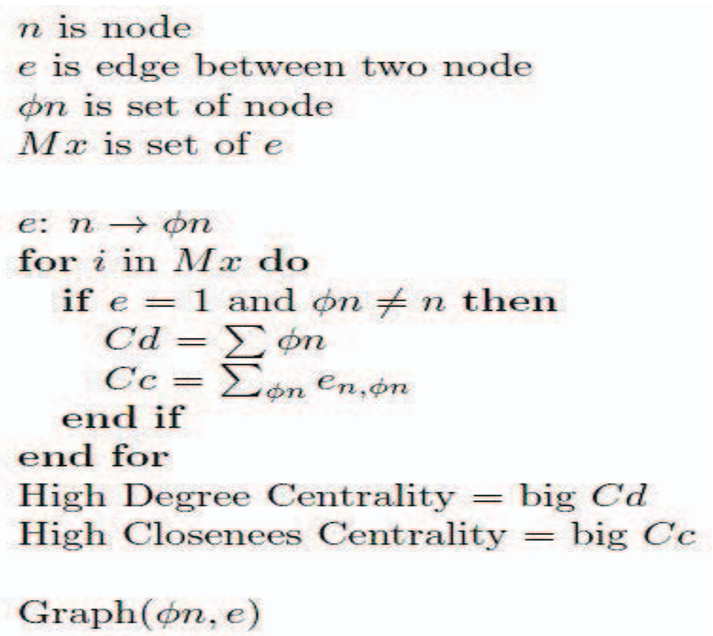 Figure 1: Conceptual visualization of the Social Network Analysis applied to detect core nodes.
The algorithm integrates different types of centrality (Closeness, Betweenness, and Degree) to find the node through which propaganda reaches the maximum number of people in the minimum amount of time.
Experiments & Results
The application of the algorithm on real-world "Facebook Operation" data yielded several key findings:
- Targeted Detection: The algorithm successfully isolated specific "active nodes" that were structurally essential for the group's survival.
- Resource Efficiency: The authors conclude that this method requires significantly less time and financial investment compared to traditional surveillance, as it focuses computational power only on the most influential participants.
- Recruitment Analysis: By identifying nodes with high Betweenness Centrality, the researchers could see who was bridging the extremist cell with "vulnerable" external nodes.
Critical Analysis & Conclusion
Takeaway
The synergy between human-led "Facebook Operations" and algorithmic analysis creates a powerful toolkit for national security. It moves the needle from passive observation to preventative disruption.
Limitations & Future Work
- Ethical Concerns: The paper focuses on the technical efficacy but leaves room for discussion on the privacy implications of agent-based "Operations."
- Dynamic Networks: Social networks are not static; terrorist groups frequently migrate or change handles. Future iterations of this work should incorporate Temporal Graph Analysis to track how centralities shift over time.
- Automation: Shifting from manual agent work to AI-driven "Social Bots" for data collection could be the next frontier in this research area.