
Beyond Uniform Sampling: Optimizing QoE Studies via Adaptive Crowdsourcing
Impact of test condition selection in adaptive crowdsourcing studies on subjective quality
This paper introduces and evaluates "Adaptive Crowdsourcing," a novel methodology for Quality of Experience (QoE) studies that dynamically allocates rating budgets based on statistical certainty. By prioritizing test conditions (TC) with higher rating variance (typically mid-range quality), the method aims to optimize the precision of resulting QoE models under fixed budget constraints.
TL;DR
In subjective Quality of Experience (QoE) research, the "one-size-fits-all" approach to distributing user ratings is inefficient. This paper proposes Adaptive Crowdsourcing, a method that uses real-time statistical feedback to allocate more ratings to uncertain test conditions. By focusing on the "middle ground" where users disagree most, researchers can achieve higher model certainty without increasing the total budget.
The Efficiency Trap in Subjective Testing
When conducting crowdsourced studies (like asking users to rate video quality from 1 to 5), the standard practice is to assign an equal number of participants to every test condition (e.g., 500kbps, 1000kbps, etc.).
However, human perception isn't uniform. As the authors note, ratings for very high or very low quality tend to be highly consistent (the SOS Hypothesis), meaning you hit "diminishing returns" on new data very quickly. Meanwhile, intermediate quality levels often confuse participants, leading to high variance and wider Confidence Intervals (CI). Traditional methods waste budget on the "obvious" cases while leaving the "ambiguous" ones undersampled.
Methodology: Statistical Adaptation
The core innovation is a feedback loop between the data collection and the participant assignment.
1. Discrete vs. Continuous Design
- Discrete (D-S): The system selects one of five fixed bitrates based on which one currently has the widest CI.
- Continuous (C-S): The system treats the bitrate as a spectrum, partitioning it into subranges and dynamically splitting those subranges where the standard deviation is highest.
2. The Decision Engine
The adaptation logic kicks in after a "cold start" period. Once a baseline number of ratings is collected, the algorithm calculates the uncertainty for each condition. The next user is automatically funneled to the condition where the data is most "noisy."
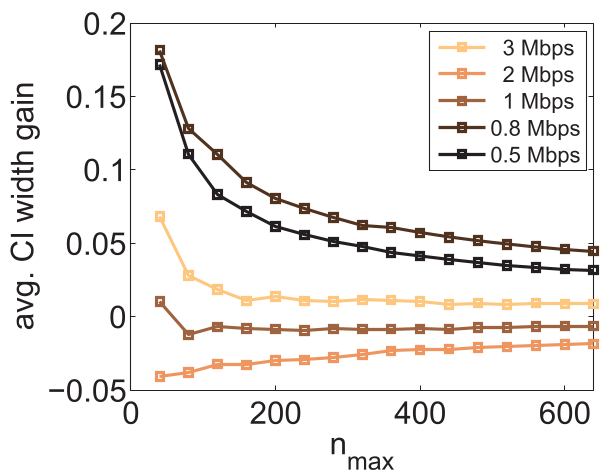 Fig 1: (Left) Ratio of ratings per TC showing how the adaptation favors low-to-mid bitrates where variance is higher.
Experimental Insights: Does it Work?
The authors simulated these strategies against a "ground truth" pool of 2,817 scores across 51 different bitrates.
- Confidence Gains: For low budgets, the adaptive strategies (D-S and C-S) reached significantly lower average CI widths than baseline uniform sampling.
- Continuous is King: Continuous test designs provided better overall fits for the QoE curves (logarithmic functions) because they provide a denser set of data points, allowing the regression model to iron out local noise.
- The "Excellent" Bias: Interestingly, the authors discovered a potential pitfall. In adaptive scenarios, if a high-quality condition receives a string of "5/5" ratings early on, the CI shrinks so fast that the algorithm stops sampling it. If those first few ratings were flukes, the final model might over-estimate the MOS for that condition.
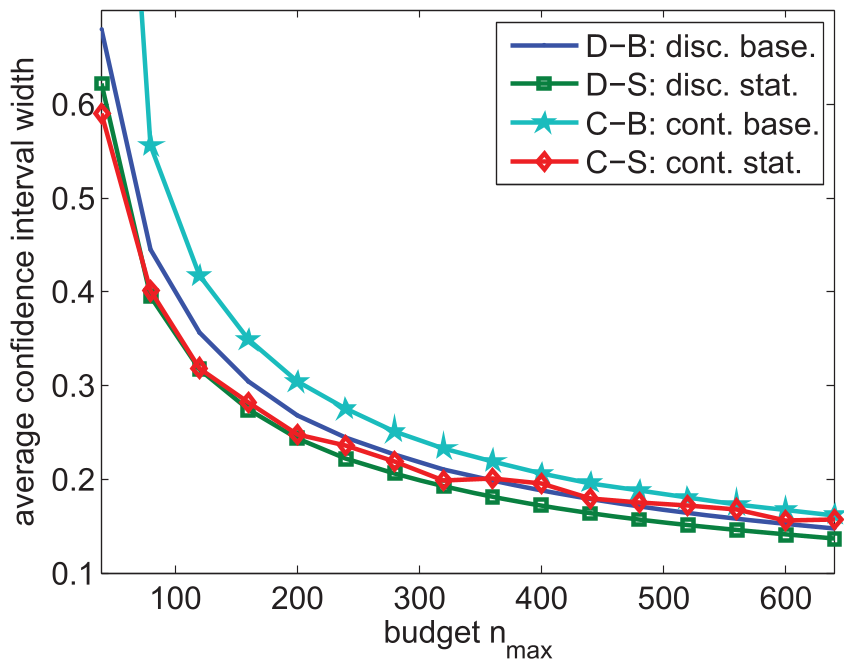 Fig 2: Average CI width across budget sizes. Adaptive methods (Green/Red) outperform Baselines (Blue/Cyan) at lower budgets.
Deep Insight & Conclusion
This work represents a move toward "Active Learning" in human-centric data collection. The methodology is particularly relevant today as we move toward evaluating more complex black-box systems (like AI-generated content).
Key Takeaways for Researchers:
- Iterative over Static: Stop treating crowdsourcing as a "launch and forget" task. Implement real-time monitoring to shift the budget to where it's needed.
- Continuous Design: Whenever possible, use a continuous parameter range rather than a few discrete points. It provides much higher resilience to outliers.
- Watch the Edges: Be careful with high-certainty areas. A small "minimum sampling" requirement should be enforced even for low-variance conditions to ensure the model doesn't lock into an early biased state.
While the paper focuses on video bitrates, the logic applies to any subjective study—from audio codecs to the helpfulness of LLM responses. The future of crowdsourcing is not just about more data, but about smarter data.