
[T2 Scaling] Why Your "Compute-Optimal" Model is Actually Under-Trained
Test-Time Scaling Makes Overtraining Compute-Optimal
This paper introduces Train-to-Test (T2) scaling laws, a novel framework that jointly optimizes model size (N), training tokens (D), and inference samples (k). By accounting for the cost and performance gains of repeated sampling (test-time scaling), T2 establishes that current pretraining recipes are suboptimal for models intended for intensive inference deployment.
TL;DR
The famous Chinchilla scaling laws (Hoffmann et al., 2022) have a blind spot: they assume a model will only be queried once. In the era of "o1-style" reasoning and "Large Language Monkeys," we often sample models hundreds of times to find the right answer. This paper introduces Train-to-Test (T2) scaling laws, proving that if you plan to use test-time scaling, the Chinchilla-optimal model is actually too big and too weak. The new rule? Train smaller models for much, much longer.
The Missing Link: Why Pretraining and Inference are Coupled
For years, pretraining and inference scaling have been treated as separate silos. We used Chinchilla to decide how to train (N and D), then used pass@k metrics to decide how to sample (k).
However, they are fundamentally linked by the budget. A smaller model is "weaker" per sample but "cheaper" to run. If you have a fixed total compute budget, should you spend it on a massive model you can only query once, or a tiny model you can query 1,000 times? T2 scaling provides the first rigorous mathematical framework to answer this by treating N, D, and k as a single optimization problem.
Methodology: Bridging Loss and Accuracy
The researchers faced a hurdle: Pretraining is measured by Loss (smooth and continuous), while Test-time is measured by Accuracy (pass@k, highly non-linear). They solved this with two distinct "Approaches":
- Approach 1 (Loss-based): They extended the Chinchilla power law by adding a term for :
- Approach 2 (Accuracy-based): They modeled per-question success using a Beta distribution. This is crucial because it accounts for the fact that some questions are easy and some are hard; you can't just use a simple average.
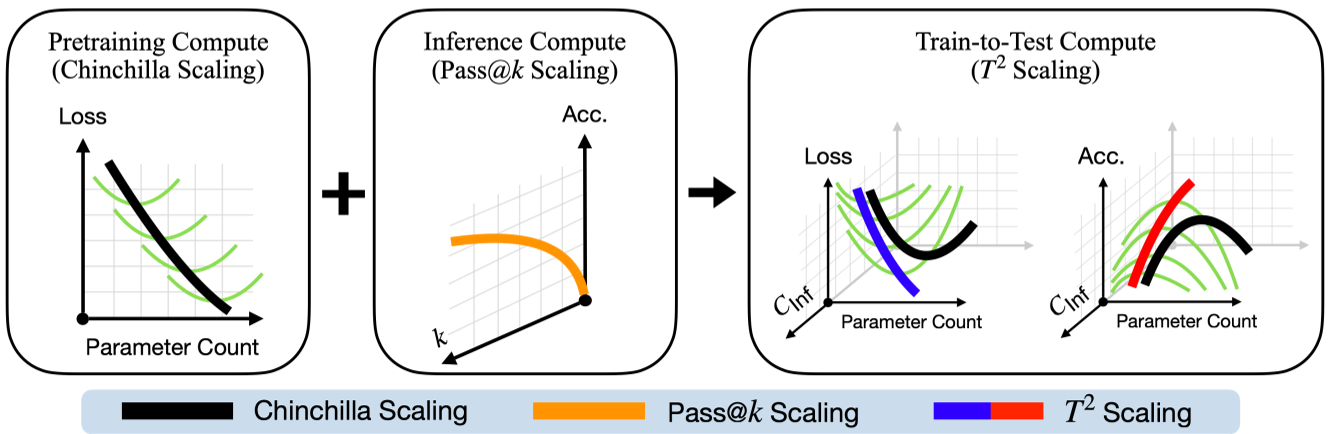 Figure 1: T2 scaling shifts the optimal frontier toward smaller, overtrained models compared to the Chinchilla baseline.
The "Radical" Shift to Overtraining
The most striking finding of T2 is how much it deviates from the status quo. While Chinchilla famously suggests ~20 tokens per parameter, T2 suggests that for inference-heavy tasks, we should be training models on hundreds or even thousands of tokens per parameter.
Key Breakthroughs:
- Monotonic Scaling: In Figure 3 (below), traditional Chinchilla scaling actually shows "non-monotonic" performance—meaning sometimes adding more pretraining compute makes the final pass@k worse because the model size grew too fast. T2 fixes this by scaling N, D, and k in harmony.
- Post-training Resilience: The authors found that while overtrained models are slightly "harder" to fine-tune (a known phenomenon), the benefits of overtraining still survive Supervised Fine-Tuning (SFT).
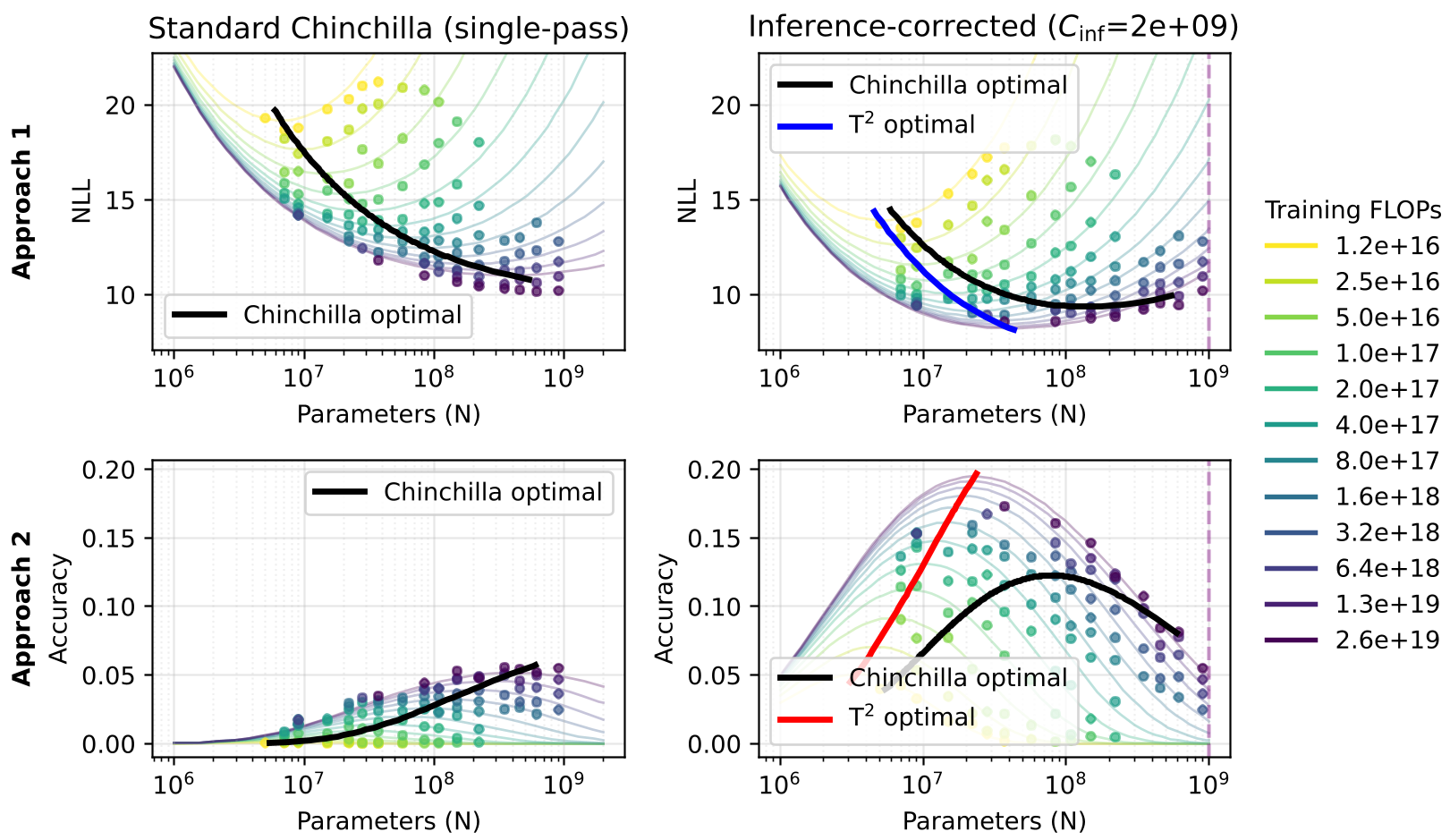 Figure 2: T2 scaling ensures monotonic improvement across compute scales, unlike inference-corrected Chinchilla curves.
Experimental Validation
To prove this wasn't just math on paper, the team trained 21 "heavily overtrained" checkpoints from scratch. Across 8 tasks (from ARC science questions to synthetic reasoning), the results were unanimous:
- Pass@k Gains: Overtrained models reached significantly higher pass@k accuracy than "optimal" Chinchilla models of the same total compute.
- Efficiency: Smaller models (e.g., 37M) allocated more samples (k) outperformed massive models (901M) under the same total budget.
| Task | Best Overtrained (Size) | Chinchilla Opt (Size) |
|---|---|---|
| Simple Reasoning | 57.90% (37M) | 18.40% (901M) |
| Spatial Reasoning | 6.00% (37M) | 1.10% (901M) |
| Table 1: Overtrained models consistently crush Chinchilla-optimal checkpoints when inference budget is considered. |
Critical Insight & Future Outlook
The industry has already subconsciously moved toward this (e.g., Llama-3 and Gemma are technically "overtrained" by Chinchilla standards). T2 scaling provides the theoretical permission to push this even further.
Limitations: The study focuses on models under 1B parameters. Scaling this behavior to 70B+ models remains a frontier challenge. Additionally, "repeated sampling" is just one type of test-time scaling; future work must integrate more complex "search" and "reasoning" compute (like Chain-of-Thought) into the T2 formula.
Final Takeaway: If you are building a model for a specific heavy-duty inference product, stop following Chinchilla. Use T2 to find your true "Train-to-Test" equilibrium.