
Testing DOSN Scalability: Architecture, Personality, and the Paradox of Network Size
Testing scalability and performance of decentralized on-line social networks
The paper introduces a simulation platform designed to evaluate the scalability and performance of Decentralized Online Social Networks (DOSNs). It features a traffic simulator based on the Five Factor personality model and a distributed storage engine to test various network configurations and architectures.
TL;DR
Decentralized Online Social Networks (DOSNs) are often praised for privacy but criticized for performance. This paper tackles the "Scalability Gap" by introducing a robust simulation platform. The key finding? Traditional "User-Centric" storage—where all of a user's data stays on one node—is a performance killer. Instead, "Data-Centric" distribution and dynamic network scaling are the secrets to surviving real-world traffic spikes.
Background: Why Decentralization Stalls
While platforms like Diaspora and Safebook have attempted to break the monopoly of centralized giants, they often struggle with latency. In a centralized system, high-speed backplanes connect data. In a DOSN, your friend's photo might be stored on a home PC across the globe. This paper identifies that we lack the tools to measure why and how these delays accumulate under realistic human behavior.
Methodology: Simulating the Human Element
The researchers didn't just generate random data; they built a simulator that mimics human psychology.
1. The Traffic Simulator (The "Why")
Using the Five Factor Model, the simulator assigns personality traits (Openness, Extraversion, etc.) to virtual users, which dictates their "upload/like/view" ratios. For example, high Extraversion correlates to higher posting rates. This activity follows a Power Law distribution, reflecting the "celebrity effect" where a few nodes generate most of the traffic.
2. The Storage Engine (The "How")
The engine tests two primary axes:
- Data Placement: User-centric (keep my data together) vs. Data-centric (spread it out).
- Node Selection: Random vs. Load-Aware (choose the node with the least traffic).
Experimental Insights: Data-Centricity Wins
The team tested the platform across three hardware scenarios: Home PCs (low bandwidth), Traditional Servers (high bandwidth), and Cloud VMs.
The User-Centric Trap: The results showed that User-Centric storage creates massive bottlenecks. When a "timeline" view is requested, a single node is hammered with requests for every post and photo belonging to that user. In contrast, the Data-Centric Load-Aware approach spreads this burden across the network, effectively parallelizing the download.
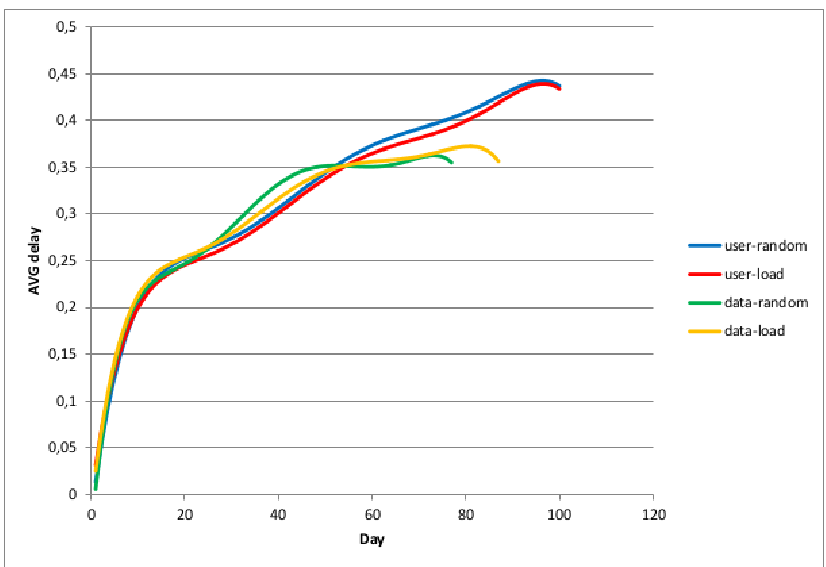 Figure: In the Home PC scenario, Data-Centric approaches maintained lower average delays for nearly 40% longer than User-Centric ones.
The "Size Paradox" and Dynamic Scaling
Counter-intuitively, the study found that more nodes aren't always better. In the early stages of a network, a massive number of nodes increases the overhead of data retrieval.
To solve this, the authors proposed a Dynamic Growth Model:
- Start with a compact network.
- Monitor capacity.
- Add 10% more nodes only when current nodes reach 80% storage capacity.
This dynamic approach outperformed static networks by ensuring the infrastructure was "right-sized" for the current user load.
Critical Analysis & Conclusion
This research moves the conversation from "Privacy at all costs" to "Efficiency by design." By proving that load-aware, data-centric architectures are mandatory for DOSNs, it provides a blueprint for future Fediverse-like systems to avoid the latency traps of the past.
Limitations: The study assumes a centralized "orchestrator" for the simulation metrics. In a truly decentralized production environment, the "Load-Aware" check would incur its own gossip-protocol overhead, which the paper leaves for future work.
Final Takeaway: Decentralization doesn't have to be slow; it just needs to stop being "User-Centric" at the storage layer.