
Beyond Keywords: Decoding Emotions on Weibo via Emotion Cause Extraction
Text-based emotion classification using emotion cause extraction
This paper introduces a novel emotion classification framework for Chinese microblogging (Weibo) that integrates Emotion Cause Extraction (ECE) as a core feature selection mechanism. By identifying the "trigger events" behind sentiments using a rule-based system and SVR, the authors achieve significant improvements in fine-grained emotion recognition (Happiness, Anger, Disgust, etc.) over traditional statistical baselines.
TL;DR
Researchers from Tsinghua University have moved beyond simple word-counting for sentiment analysis by focusing on the event that triggers the emotion. By building a rule-based system to extract "Emotion Causes" from Weibo posts and feeding them into an SVR classifier, they’ve demonstrated that understanding the "Why" significantly boosts the accuracy of "What" a user is feeling.
Context: The Social Media Sentiment Challenge
Microblogging platforms like Weibo are goldmines for public opinion, but they are notoriously difficult to analyze. Posts are short, informal, and rife with sarcasm. Traditional statistical methods (like SVM with InfoGain) often treat sentences as "bags of words," completely missing the connection between an event (e.g., "losing a wallet") and the resulting emotion ("sadness").
The authors argue that an emotion is not just a standalone label; it is the result of a cause event. Based on sociological "narrative analysis," they posit that if we can extract the event, we can classify the emotion more accurately.
Methodology: The "Why" is the Key
The proposed framework follows a sophisticated pipeline that bridges the gap between rule-based linguistic depth and machine-learning scalability.
1. The Emotion Cause Extraction (ECE) Subsystem
The authors adapted a formal linguistic framework for the chaotic environment of microblogs. They defined a "Marker List" (e.g., "makes me," "because," "saw that") and "Linguistic Patterns" to pinpoint the cause.
Instead of full clauses, they targeted a (Noun, Verb, Noun) triple to represent the event frame.
- Example: "The Voice surprised me."
- C (Cause): The Voice
- K (Keyword): Surprised
- E (Experiencer): Me
2. Feature Merging and SVR
Because not every post has an explicit cause, the authors didn't rely solely on ECE. They merged the ECE results with traditional Chi-squared () features. This hybrid feature set was then fed into a Support Vector Regression (SVR) model, which is more robust for the imbalanced nature of social media data.
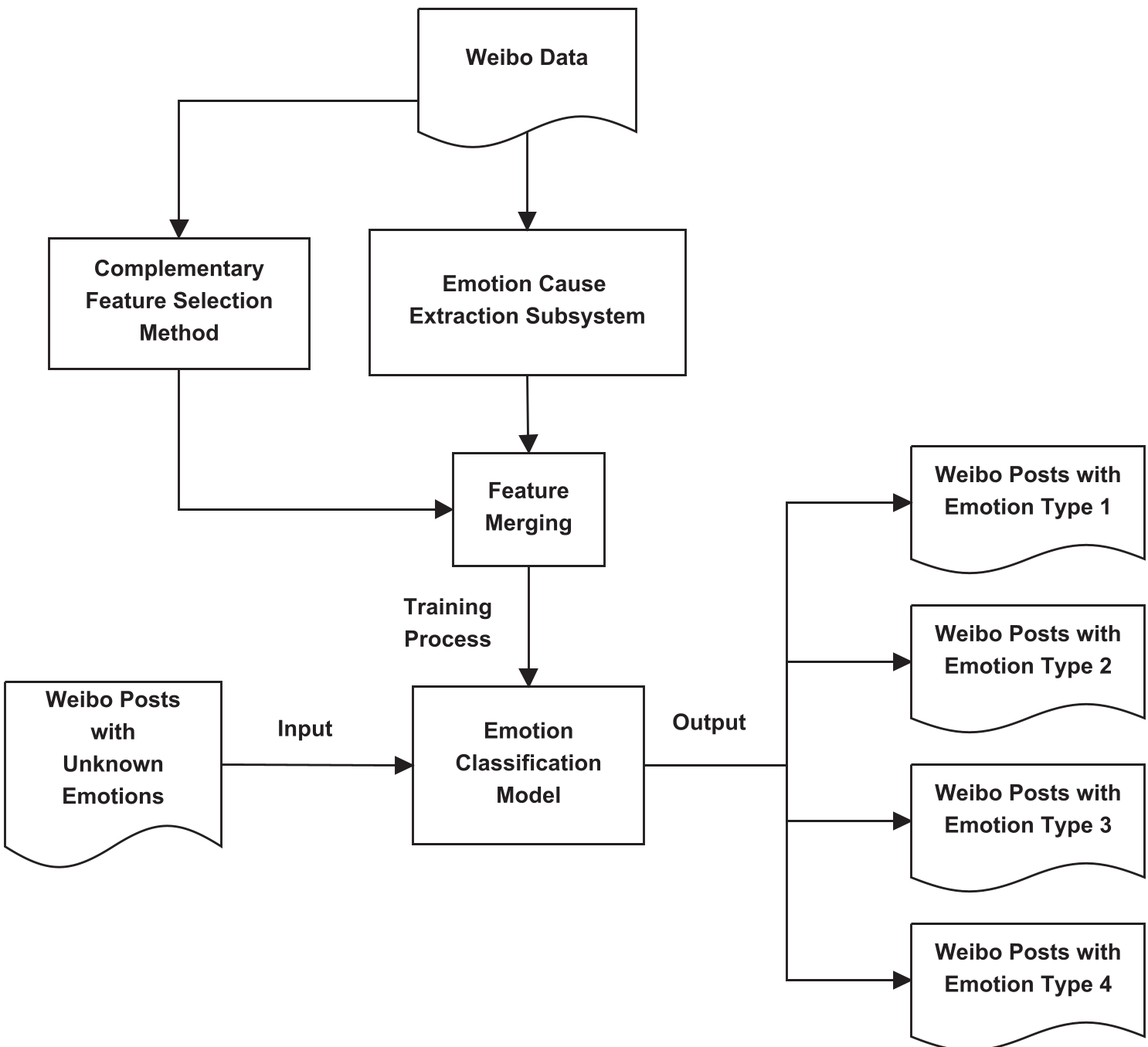 (Note: Fig 1. reveals the flow from raw Weibo posts to the final SVR classification stage.)
Experiments: Proving the Narrative Theory
The authors curated a dataset of 16,485 Weibo posts, manually labeled with six basic emotions: happiness, anger, disgust, fear, sadness, and surprise.
Performance Gains
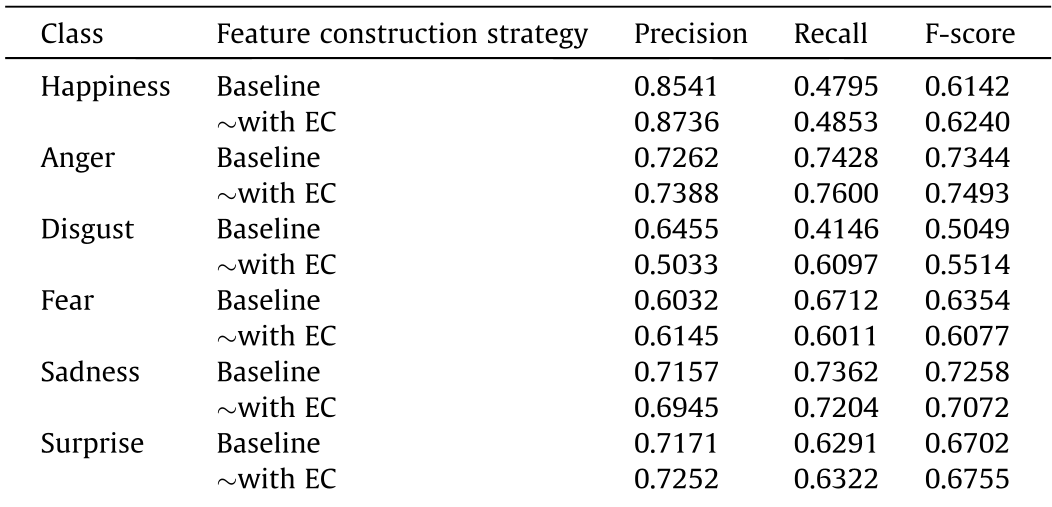
The results confirm that context matters. By specifically extracting causes, the model became much better at distinguishing between nuanced negative emotions.
| Emotion | Baseline F-score | With EC (Emotion Cause) | Improvement |
|---|---|---|---|
| Happiness | 0.6142 | 0.6240 | +0.01 |
| Anger | 0.7344 | 0.7493 | +0.02 |
| Disgust | 0.5049 | 0.5514 | +0.09 |
Interestingly, the performance for "Sadness" slightly dropped. The authors’ insight? Users are less likely to explicitly narrate the cause of their grief on social media compared to their outrage (Anger) or excitement (Happiness).
Critical Insight: Why This Matters
The fundamental contribution of this paper isn't just a higher F-score; it is the methodological shift. By treating emotion as a narrative structure rather than a statistical distribution, it opens the door for:
- Interpretability: We don't just know the user is angry; we know what they are angry about.
- Robustness via Inductive Bias: Rules about how humans express cause-and-effect act as a stabilizer, preventing the model from being misled by high-frequency but irrelevant "noise" words.
Conclusion & Future Outlook
While the rule-based extraction part still requires manual linguistic engineering, this research lays the groundwork for more advanced "Emotion-Cause Pair Extraction" (ECPE) which is now a major sub-field in NLP using Transformers. The transition from "What" to "Why" remains one of the most effective ways to move toward truly empathetic AI.
Takeaway for Practitioners: When dealing with short-text sentiment, look for the trigger. A model that knows "why" as well as "how" will always be more reliable than a black-box statistical classifier.