
TCA: Bridging the Semantic Gap in Text Categorization with Domain Ontology
Text Categorization Based on Domain Ontology
The paper introduces the Text Categorization Agency (TCA), a framework that integrates domain ontology into machine learning-based text categorization. By mapping text to semantic concepts rather than raw words, it achieves higher interpretability and performance while significantly reducing feature dimensionality using the COSA algorithm.
TL;DR
The Text Categorization Agency (TCA) is a hybrid framework that injects domain knowledge into machine learning pipelines. By shifting the objective from "word matching" to "concept matching," the authors significantly reduced feature dimensionality (54% reduction) while achieving a SOTA F1-score of 97.7%. Unlike traditional ML, TCA focuses on the logical "Why" behind a category, providing human-readable rules instead of accidental word correlations.
Problem & Motivation: The "Bag-of-Words" Trap
While Machine Learning (ML) replaced the labor-intensive Knowledge Engineering of the 90s, it introduced new headaches:
- Lack of Semantics: ML models often treat "Professor" and "Faculty Member" as unrelated tokens.
- Curse of Dimensionality: Large vocabularies create sparse, high-dimensional matrices that degrade performance.
- Brittle Correlations: Models often pick up "noise" words that happen to appear in training data but have no logical link to the category.
The authors argue that the missing ingredient is Domain Ontology—a formal representation of entities and their relationships that provides the "common sense" ML models lack.
Methodology: The Three-Layer Architecture
The TCA framework is structured into three specialized layers designed to transform raw, messy text into clean, semantic vectors.
1. The Ontology Layer
This is the "brain" of the system. It contains Structure Ontology (defining how different documents are formatted) and Domain Ontology (defining concepts like "Academic Staff" vs. "Administrative Staff").
2. Structurization & Semantic Extraction
Here, the system moves beyond simple tokenization. It uses a "Left Filtering Maximization" algorithm to extract expressions and matches them against the domain vocabulary.
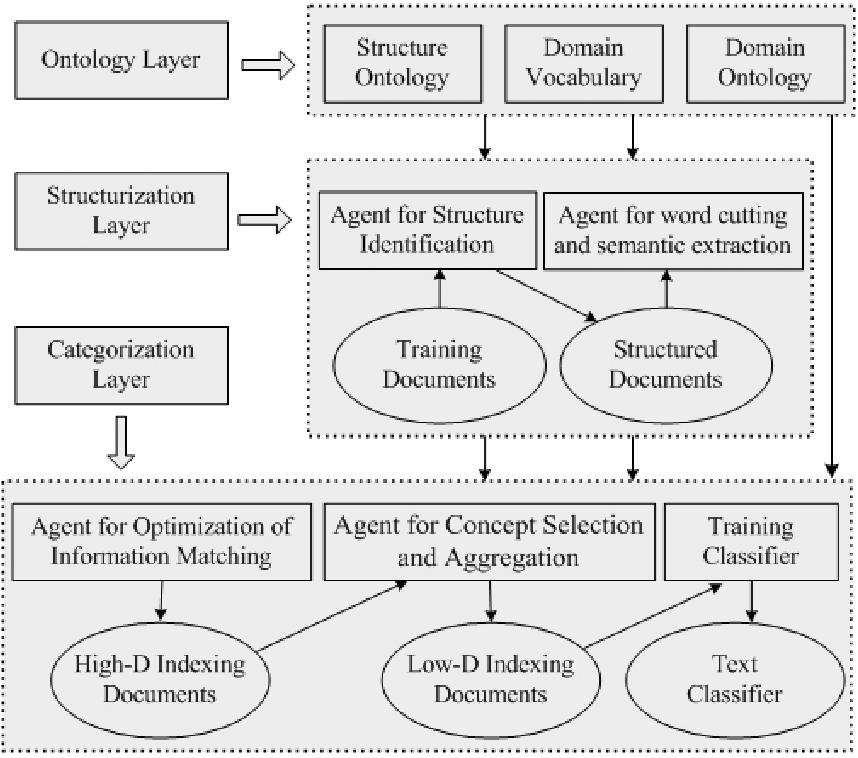
3. Dimensionality Reduction via COSA
To prevent system bloat, TCA uses the COSA algorithm. It filters out concepts with "extremely low support" (noise) and splits "extremely high support" concepts (too generic) into sub-concepts. This transforms a High-Dimensional Indexing Document Set (HDIDS) into a lean, Low-Dimensional version (LDIDS).
Experiments: Precision Meets Logic
The researchers tested TCA on a dataset of university staff profiles, categorizing individuals into academic or non-academic roles.
Quantitative Performance
The inclusion of Ontology provided a clear performance boost across all base classifiers:
| Method | Dimensions | Precision (%) | Recall (%) | F1 (%) |
|---|---|---|---|---|
| Naive Bayes | 859 | 95.3 | 89.9 | 92.5 |
| TCA + Naive Bayes | 397 | 96.1 | 97.7 | 96.9 |
| RIPPER | 859 | 97.2 | 92.5 | 94.8 |
| TCA + RIPPER | 397 | 97.7 | 97.7 | 97.7 |
The "Explainability" Reveal
One of the most striking findings was the quality of the learned rules.
- Standard RIPPER produced a rule:
if: vpi <= 0, then: non-academic. The term "vpi" was a meaningless artifact of the dataset. - TCA + RIPPER produced:
if: CONCEPT professor = 0, then: non-academic.
This demonstrates that by using an ontology, the model learned the actual logic of the domain rather than overfitting to string noise.
Critical Insight & Conclusion
TCA effectively demonstrates that Feature Engineering is still a Knowledge Engineering task. By using ontologies, we can impose a "semantic constraint" on our models.
Takeaway: In specialized domains (law, medicine, research), raw data is never enough. Integrating structured knowledge bases like ontologies is the only way to achieve both high precision and the transparency required for professional applications.
Future Outlook: The authors suggest that moving toward autonomous learning—where the system updates its own ontology based on new text—is the next frontier in bridging the gap between symbolic AI and machine learning.