
Decoding Trust: A Text Mining Approach to Twitter Event Credibility
A Text Mining Approach for Evaluating Event Credibility on Twitter
This paper presents a text mining framework to automatically evaluate the credibility of events on Twitter. By utilizing the CREDBANK dataset and a Topic-Term Matrix (TTM) approach, it classifies events into three levels—Absolutely-credible, Intermediate-credible, and Incredible—achieving a peak accuracy of 82.86% with a Decision Tree classifier.
TL;DR
Social media is a double-edged sword: it provides instant news but accelerates the spread of misinformation. This paper introduces a streamlined text-mining pipeline to solve the "Event Credibility" problem. By treating groups of topic-related keywords as documents and applying traditional machine learning, the researcher achieved over 82% accuracy in distinguishing real news from rumors, outperforming more complex graph-based models.
Background & Motivation
The identification of "fake news" or "incredible events" is often treated as a needle-in-a-haystack problem. Prior work usually looked at user profiles (follower counts) or propagation patterns (how many retweets). However, the author of this study argues that the content itself—specifically the core terms defining an event—contains latent patterns that signal whether an event is trustworthy.
The fundamental challenge lies in the unstructured nature of Twitter data and the ambiguity of human judgment. How do we move from subjective human "ratings" to a hard algorithmic classification?
Methodology: The Topic-Term Approach
The core of this research is the transformation of raw event data into a Topic-Term Matrix (TTM).
- Event Representation: Instead of analyzing millions of individual tweets, events are condensed into their top three LDA (Latent Dirichlet Allocation) terms.
- Credibility Mapping: Using the CREDBANK dataset, the author mapped 30 human scores (from -2 to +2) into three discrete categories:
- Absolutely-credible: Clear consensus on accuracy.
- Intermediate-credible: Mixed signals or uncertainty.
- Incredible: Generally flagged as false.
- Feature Extraction: The "StringToWordVector" filter in Weka was used to convert these topic terms into frequency-based features.
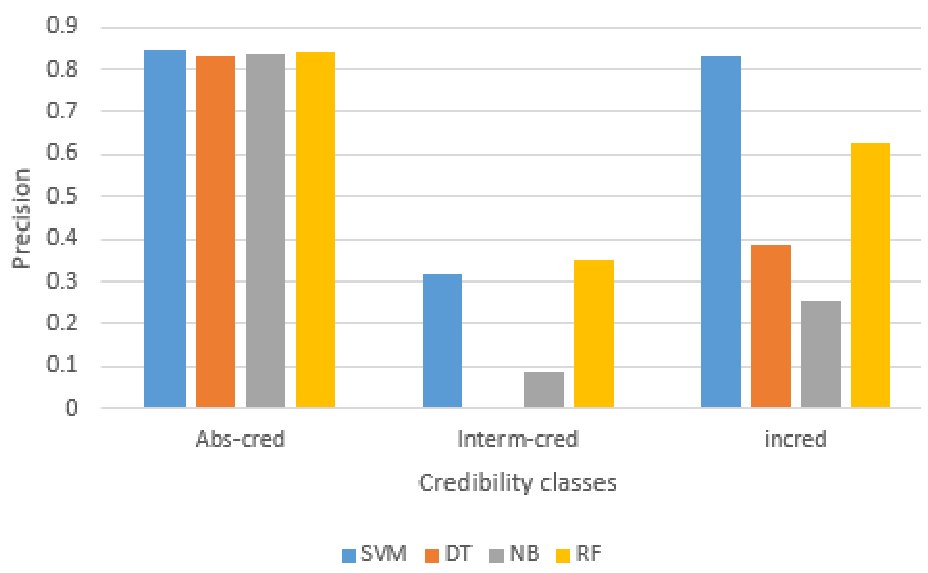 Fig 1. Representation of the dataset after preprocessing, showing topic keys and their mapped credibility labels.
Experimental Performance
The study compared four major classifiers: Support Vector Machine (SVM), Decision Trees (DT), Random Forest (RF), and Naïve Bayes (NB).
Key Findings:
- Decision Tree Wins: The DT classifier hit an accuracy of 82.86%, likely because its hierarchical structure effectively captures the "if-then" logic of certain keywords appearing in credible vs. non-credible contexts.
- Precision vs. Recall: While DT had the best overall accuracy, SVM was remarkably precise at identifying the "Incredible" events, making it a potentially better choice for systems where "false alarms" (labeling a real event as fake) must be minimized.
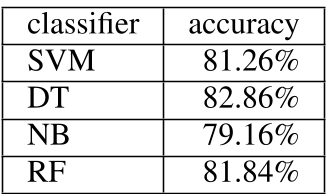 Table 1. The performance comparison showing that text mining outperforms the previous SOTA (72%) by nearly 10 percentage points.
Critical Insight: Why Does Simple Text Mining Work?
One might wonder: why does a simple word-count matrix beat a complex graph-based optimization (like the PageRank-style propagation used in earlier studies)?
The answer lies in Inductive Bias. Rumors and fake news often use sensationalist language or specific clusters of "viral" terms that differ linguistically from traditional news reporting. By focusing on the Topic Terms specifically, the model ignores the "noise" of individual user behavior and focuses on the semantic essence of the event.
Summary & Future Outlook
This work demonstrates that "Topic Documents" are a powerful abstraction for social media analysis. While effective, the author notes a critical limitation: annotator bias. Humans don't always agree on what is "credible," especially in politically charged environments.
The next frontier for this research involves moving beyond unigrams to Contextual Embeddings (like BERT or RoBERTa) and explicitly modeling the bias of the crowdsourced annotators themselves to create a more robust "Ground Truth."
Takeaway for Practitioners: If you are building a moderation tool, don't overlook basic text features. Sometimes the most effective signal isn't who said it, but the vocabulary they used to describe the event.