
Invisible Signatures: Protecting Authorship in the Social Media Wilderness
Text Watermarking in Social Media
The paper proposes a novel text watermarking method specifically designed for Social Media (SM) environments, utilizing Unicode homoglyph substitution. The approach achieves 100% compatibility across 18 major SM platforms, including character-limited services like Twitter, while maintaining visual indistinguishability and original text length.
TL;DR
Social Media (SM) platforms are the primary battleground for content theft, yet they offer zero built-in protection for text authorship. This paper investigates whether platforms like Facebook or Twitter watermark your posts (spoiler: they don't) and introduces a sophisticated Unicode Homoglyph substitution technique. This method embeds proof of ownership that is invisible to the eye, preserves string length, and survives the "copy-paste" journey across 18 different social platforms.
The "Zero Noise" Problem in Text
In image or audio watermarking, we can hide data in "noise"—frequencies or pixels that the human eye/ear ignores. Text has zero noise. Change a single character, and you risk changing the meaning; add a space, and you break the formatting.
The problem is even worse on Social Media:
- Length Constraints: Twitter's (then) 140-character limit leaves no room for metadata.
- Sanitization: Most platforms "clean" text, stripping tabs or multiple spaces, which kills traditional "whitespace-based" steganography.
- Copy-Paste Robustness: A watermark is useless if it disappears the moment someone selects the text and moves it to another app.
Methodology: The Art of the Unicode "Confusable"
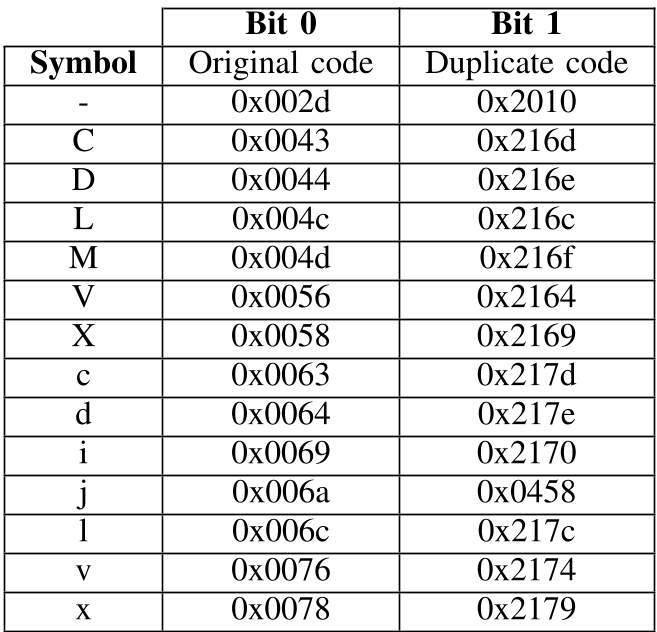
The researchers' core insight lies in the massive Unicode library. There are thousands of "homoglyphs"—characters that look exactly like Latin letters but are technically different characters. For example, the Latin 'C' (0x0043) and the Roman numeral 'C' (0x216d) are visually identical in many fonts.
How the Embedding Works:
- Hash Generation: A unique watermark is generated by hashing the content itself.
- Bit Mapping: For every character in the message that has a known "safe" homoglyph, the system decides whether to keep the original (Bit 0) or swap it for the homoglyph (Bit 1).
- Universal Compatibility: The authors filtered the Unicode list to find a "Goldilocks" set of characters that are accepted by all 18 SM platforms without being flagged or rendered as "tofu" (empty boxes).
Proving Robustness: 18 Platforms, 0 Failures
The researchers didn't just test this in a lab; they scraped 6,000 posts from public figures (like Barack Obama and Macklemore) and attempted to watermark them.
Their comparison against existing methods (like Unispach and Whitesteg) revealed a stark contrast. While previous methods relied on tabs and extra spaces—which are often deleted by platform filters—the homoglyph method achieved 100% success.
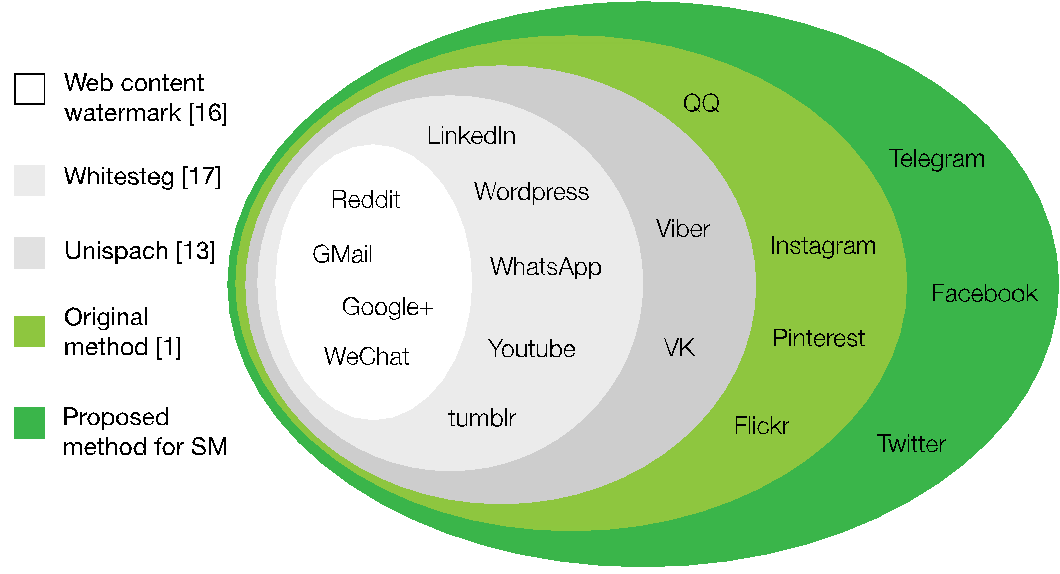 Fig 1. Comparison showing the proposed method's universal compatibility versus existing literature.
Visual Indistinguishability
One of the most impressive feats is the lack of "layout shift." Using a technique called "image similarity metric," the team proved that their method doesn't cause the text alignment to jump or jitter, unlike whitespace methods which clearly displace the text.
(Note: The paper demonstrates that while Whitesteg and Unispach create noticeable red-shifts in alignment, the proposed method remains perfectly overlaid with the original text.)
Critical Insight & Conclusion
This work addresses a critical gap in digital rights management (DRM). While users might think Social Media platforms protect their data, this study confirms they do not apply any text watermarking.
The Takeaway: If you want to prove a tweet or a post originated from you, you cannot rely on the platform. The proposed homoglyph approach provides a "blind" verification system—you don't need the original text to extract the watermark, only the secret key utilized during the hash-mapping phase.
Limitations: The method's invisibility depends on the font used by the OS. On some systems, a homoglyph might look slightly "off" compared to the surrounding font. However, for the vast majority of mobile and web users, these signatures remain entirely ghost-like.