
Deciphering Emotion Across Contexts: The Challenge of Cross-Genre Interoperability
Textual Emotion Classification: An Interoperability Study on Cross-Genre Data Sets
The paper presents an interoperability study of the READ-BioMed-EC emotion classification system, originally trained on Ebola-related Twitter microblogs, when applied to open-domain Web blog posts. It evaluates cross-genre generalization across nine emotion and attitudinal classes using a combination of Naive Bayes ensembles and lexicon-based features.
TL;DR
Can an AI trained to detect fear and anger in "Ebola tweets" accurately sense the same emotions in a personal web blog? This research explores the READ-BioMed-EC system's ability to cross the "genre gap." The findings are a wake-up call for NLP practitioners: supervised models fail miserably (F1 drop to 0.12) when switching genres without retraining, though they set new state-of-the-art records once adapted.
The Problem: The "Genre Gap" in Sentiment Analysis
Emotion detection is no longer just about "positive" vs. "negative." In modern Human-Computer Interaction (HCI) and public health surveillance, we need to distinguish between fear, surprise, and sarcasm. However, most models are "home-grown" for specific datasets—usually Twitter.
The problem is that a sentence in a blog post (averaging 13.4 tokens with high variance) is structurally and semantically different from a tweet (constrained by character limits and specific hashtags). When a model trained on the frantic, short-hand nature of Twitter meets the more structured prose of blogs, it loses its inductive bias, leading to a total collapse in predictive power.
Methodology: READ-BioMed-EC Architecture
The authors utilized the READ-BioMed-EC classifier, an ensemble system designed for health threat monitoring.
Key Components:
- Naive Bayes Ensemble: One binary classifier for each of the 9 classes (Ekman's 6 + Sarcasm, News, Criticism).
- Hybrid Feature Set:
- Standard Bag-of-Words (BoW).
- Stanford Sentiment Analyzer: Providing coarse-grained polarity.
- Lexicon-based Sub-classifier: An unsupervised module that calculates similarity between the text and emotion-specific vocabularies.
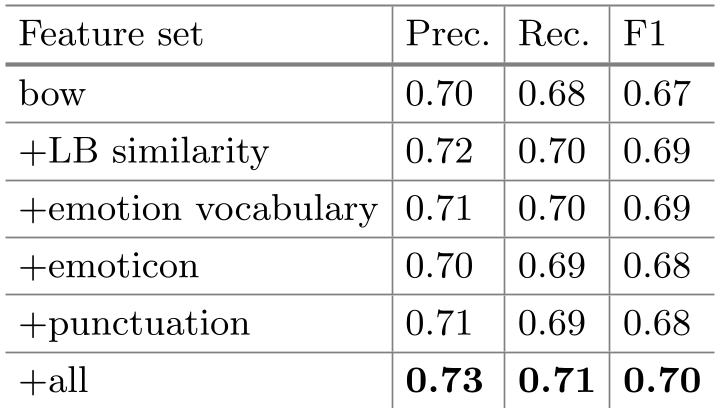 Table 4: Performance of various feature sets on the blog dataset. Note how the combination of BoW and specific lexicons yields the best results.
Experiments: The Price of Domain Shift
The study compared three scenarios on the AS-WB (Aman & Szpakowicz Web Blog) dataset:
- Cross-Genre (Direct): Tweet-trained model tested on blogs.
- Lexicon-only (Unsupervised): Using only the rule-based component.
- Retrained (Within-Genre): Training and testing on blogs using a 10-fold cross-validation.
Critical Results
The results (shown in Tables 1 and 2 of the paper) reveal a stark contrast:
- Zero-shot failure: The Twitter-trained model achieved a Macro F1 of only 0.12, barely matching a simple majority-class baseline.
- The Power of Rules: Surprisingly, the lexicon-based sub-classifier achieved an F1 of 0.64 without seeing a single training example from the blog set. It was more robust than the sophisticated machine learning model.
- New SOTA: When retrained on the blog data, READ-BioMed-EC hit an F1 of 0.74, significantly outperforming the original AS-WB benchmark (0.58).
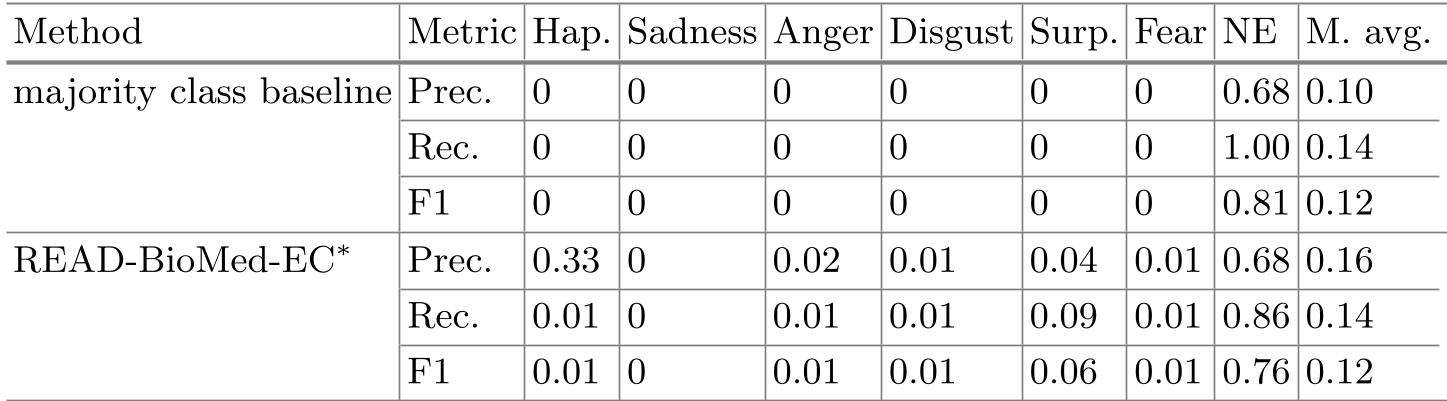 Table 1: The dismal performance of direct cross-genre application (READ-BioMed-EC) compared to the baseline.*
Deep Insight: Why did it fail?
The researchers performed a token-level and sentiment-level analysis to find the culprit. While the average length was similar (~14 tokens), the distribution was not.
- Single-token sentences: The blog set had 205 single-word sentences (e.g., "Burn!", "Anyway."), while the tweet set had only 2.
- Sentiment Imbalance: The Ebola tweet set was overwhelmingly negative (70%+), whereas the blog set had a much higher proportion of "Happiness" and "Surprise."
A model trained in a "crisis environment" (Ebola) becomes biased toward negative triggers, making it blind to the nuances of open-domain blog writing.
Conclusion & Future Work
This paper demonstrates that while READ-BioMed-EC is a powerful architecture—capable of setting new state-of-the-art results when properly trained—it is not a "plug-and-play" solution across genres.
The Takeaway: If you are deploying an emotion classifier in the wild, do not trust a model trained on a different genre. However, if you lack training data, lexicon-based/rule-based systems are your best bet for a robust, albeit less precise, baseline. Future research will likely focus on "growing" these lexicons automatically to bridge the gap between genres.