
TF-MF: Rethinking Traditional Methods for Superior Twitter Geolocation
10675_TF-MF improving multiview representation for Twitter user geolocation prediction.
This paper introduces TF-MF, a multiview representation model for Twitter user geolocation prediction. By combining TF-IDF-based linguistic features with NetMF-based network embeddings, the method achieves state-of-the-art (SOTA) performance, particularly in scenarios with minimal supervision.
TL;DR
The paper "TF-MF: Improving Multiview Representation for Twitter User Geolocation Prediction" demonstrates that combining traditional TF-IDF text features with Matrix Factorization-based network embeddings (NetMF) provides a robust solution for locating social media users. Remarkably, this approach shatters previous State-of-the-Art (SOTA) records in low-data scenarios, proving that clever feature engineering often beats complex end-to-end architectures when supervision is minimal.
Background & Positioning
In the landscape of social computing, geolocation is a foundational pillar for crisis response, local search, and public health. This work positions itself as a systematic comparative study between content-based, network-based, and hybrid (multiview) methods. Unlike many papers that chase "Deep Learning for the sake of Deep Learning," this work critically evaluates whether modern document embeddings (doc2vec) actually help in finding where a user lives—and the answer is a surprising "not always."
The Problem: The Sparsity of Ground Truth
The real-world bottleneck for geolocation is that only a tiny fraction of social media data is geotagged. While Graph Convolutional Networks (GCNs) are powerful, they often require significant supervision to learn effectively. Furthermore, modern NLP embeddings often prioritize semantic similarity over the subtle "dialectal" and "geographic references" (e.g., local sports team names or regional slang) that signify a specific city.
Methodology: The Power of TF-MF
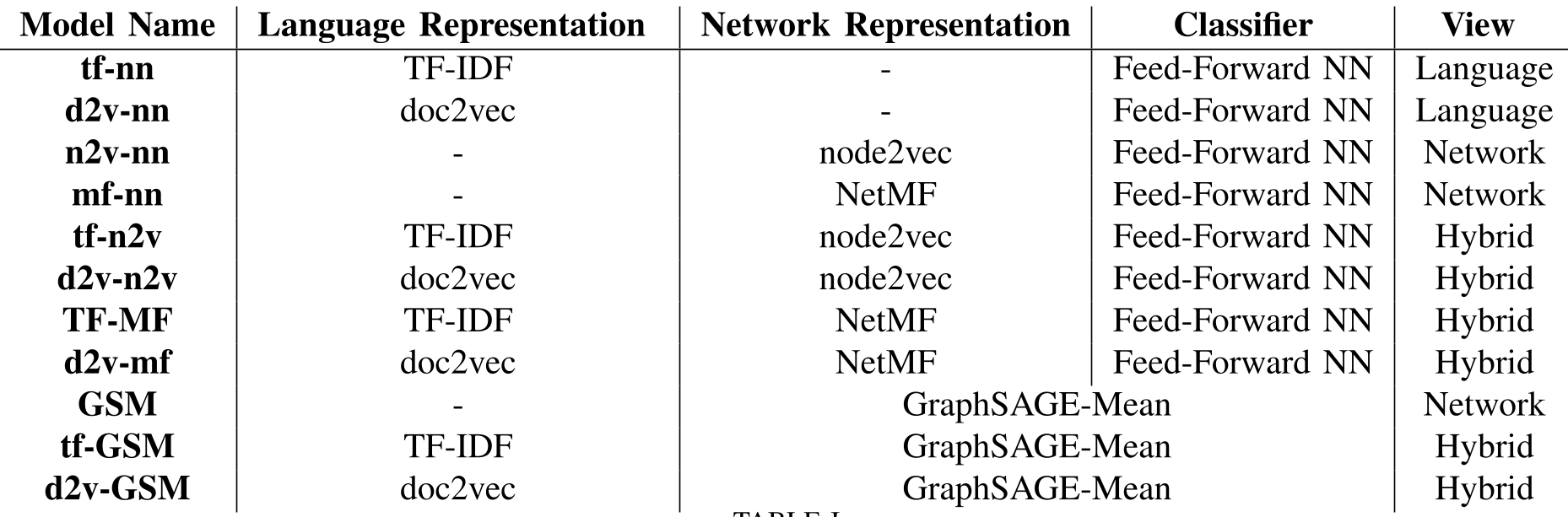
The authors hypothesized that a user's geographical footprint is best captured by two distinct views:
- Linguistic Content (TF-IDF): Rather than abstract semantics, simple frequency-based methods capture the specific local keywords that act as geographical anchors.
- Social Context (NetMF): Based on the principle of Location Homophily, your social "mentions" graph reveals your location because you are likely to talk to people in your vicinity.
The TF-MF architecture fuses these views into a feed-forward neural network to map users to discrete geographical "buckets" created via a k-d tree discretization.
Experiments and Results
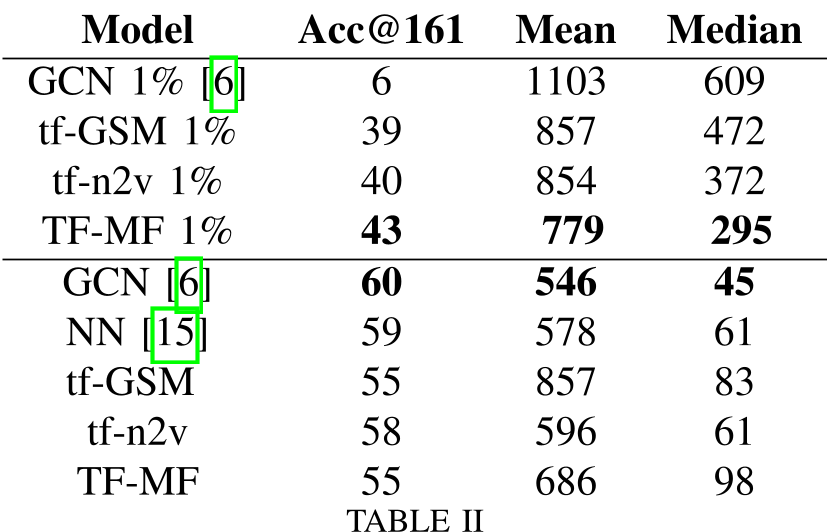
The researchers tested their approach on the GEO-TEXT benchmark. The results revealed a dramatic performance gap in "Minimal Supervision" (using only 1% of training data):
- TF-MF (Proposed): 43% Accuracy @ 161km.
- Previous GCN SOTA [6]: Only 6% Accuracy @ 161km.
This represents a massive leap in efficiency. Interestingly, the study found that TF-IDF outperformed doc2vec across almost all configurations, suggesting that for geolocation, "lexical noise" is actually "geographical signal."
Critical Insight: Why does it work?
The success of TF-MF stems from the realization that Network signals are stronger than Text signals. In the social sphere, who you talk to is a more consistent predictor of your city than what you say. By using NetMF (a factorization-based embedding), the authors successfully captured the structural properties of the mention-graph that GraphSAGE or GCNs might struggle to learn with extremely sparse labels.
Conclusion & Future Outlook
TF-MF serves as a reminder that the most "complex" model isn't always the "best" model. By identifying that traditional frequency features paired with robust network embeddings provide better inductive bias for geolocation, the authors have provided a blueprint for practical, data-efficient social sensing. Future research will likely see these insights applied to multilingual sets and more diverse social platforms where "geographic homophily" may manifest differently.
Takeaway: If you are dealing with low-resource geolocation, stop using doc2vec and start looking at your social graph structure.