
Thank You For Being A Friend: Why Hybrid Sybil Defenses Fail Against Smart Attackers
Thank You For Being A Friend: An Attacker View on Online-Social-Network-Based Sybil Defenses
This paper presents a critical security analysis of second-generation "hybrid" Sybil defense systems in Online Social Networks (OSNs), such as Integro, Votetrust, and SybilFrame. The authors demonstrate that by exploiting user behavior and employing targeted "breadth-first" friendship strategies, an attacker can effectively bypass these state-of-the-art defenses which combine graph topology with machine learning.
TL;DR
Think "hybrid" defenses—combining Social Graphs with Machine Learning—are the silver bullet for fake accounts? Think again. This paper reveals that by simply being "friendly" and targeting the friends of existing victims, attackers can bypass major systems like Integro, Votetrust, and SybilFrame. Even the most advanced defenses today face a grim trade-off: either let the bots in or ban a massive chunk of your real users.
The Evolution of the Arms Race
Detecting Sybils (fake accounts) has moved through two major phases:
- Gen 1 (Structural): Assumed Sybils are isolated. Reality: Sybils are actually quite good at making friends.
- Gen 2 (Hybrid): Combines graph structure with ML (e.g., "Does this user look like a spammer?").
The authors of this paper argue that even Gen 2 is fundamentally flawed because it underestimates the adversarial intelligence. If an attacker knows how the defense "thinks," they can simply change their social behavior to look like a popular human.
The Proactive Attacker's Insight: The "Friend of a Friend" Hack
The core vulnerability identified is the mutual friend effect. Research shows that a user is 3.5x more likely to accept a friend request if they share mutual connections with the requester.
The authors proposed the Targeted Peripheral Attack:
- Step 1: Send random requests to find "Entry Points" (credulous users).
- Step 2: Once in, ignore the rest of the network and only target the friends of that entry point.
- Step 3: Use the high acceptance rate to inflate trust scores and bypass ML filters that look for "rejected request" ratios.
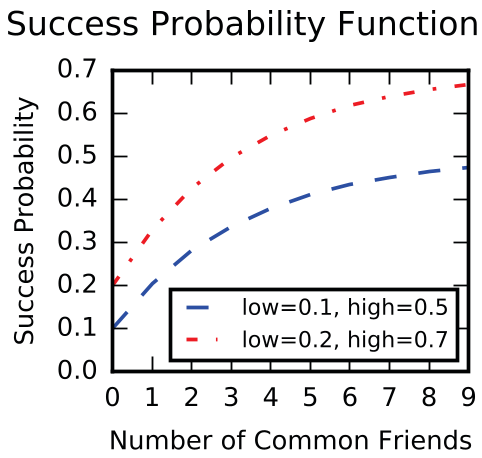 Figure 1: The attacker uses a Breadth-First Search (BFS) strategy to infiltrate social circles, drastically increasing their "honest" appearance.
Methodology: Testing the "Unbeatable"
The authors implemented three heavyweights:
- Integro: Focuses on predicting "victims" (users likely to be friended by bots) and de-weighting their edges.
- Votetrust: Tracks the ratio of accepted vs. rejected invitations.
- SybilFrame: Uses "Loopy Belief Propagation" to spread trust/distrust across the graph based on node and edge features.
Key Results: A Prohibitive Cost
The evaluation on real-world graphs (Facebook, Slashdot) shows a total breakdown of defense performance under targeted attacks.
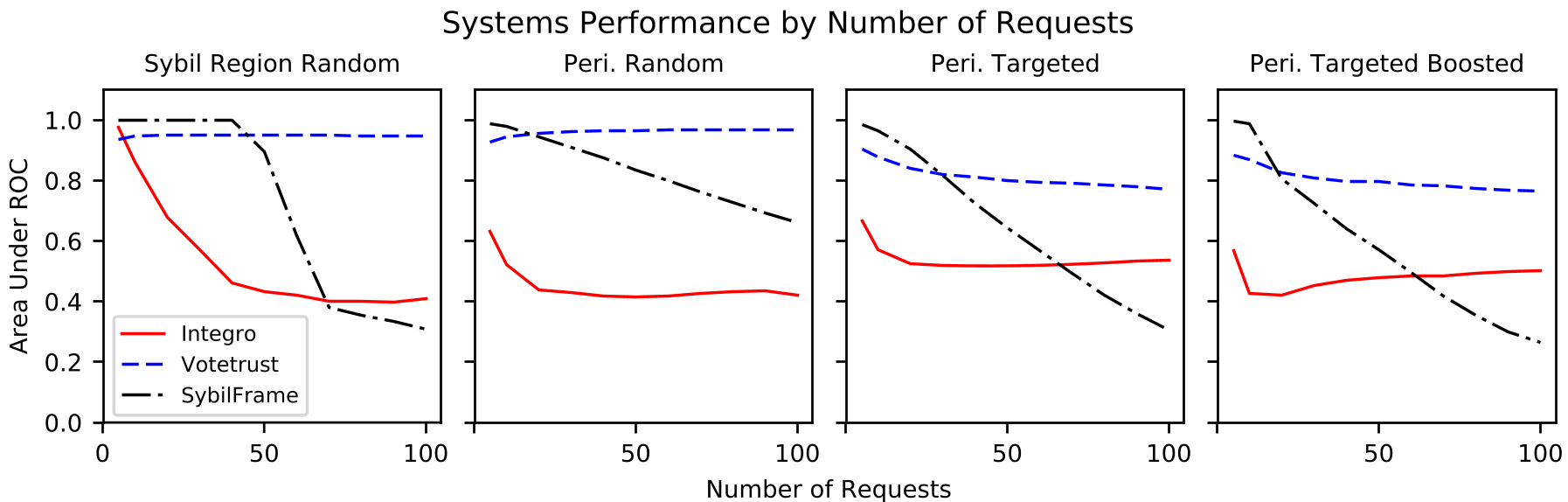 Figure 2: As the number of requests increases, the Area Under the Curve (AUC) for these systems drops significantly. Note how SybilFrame's performance collapses after a certain threshold of "successful" attack edges.
The False Positive Crisis
For a system like Votetrust, catching all Sybils results in a 30% False Positive Rate. In a network like Facebook with billions of users, a 30% FP rate would mean millions of legitimate users being banned daily—an operational nightmare.
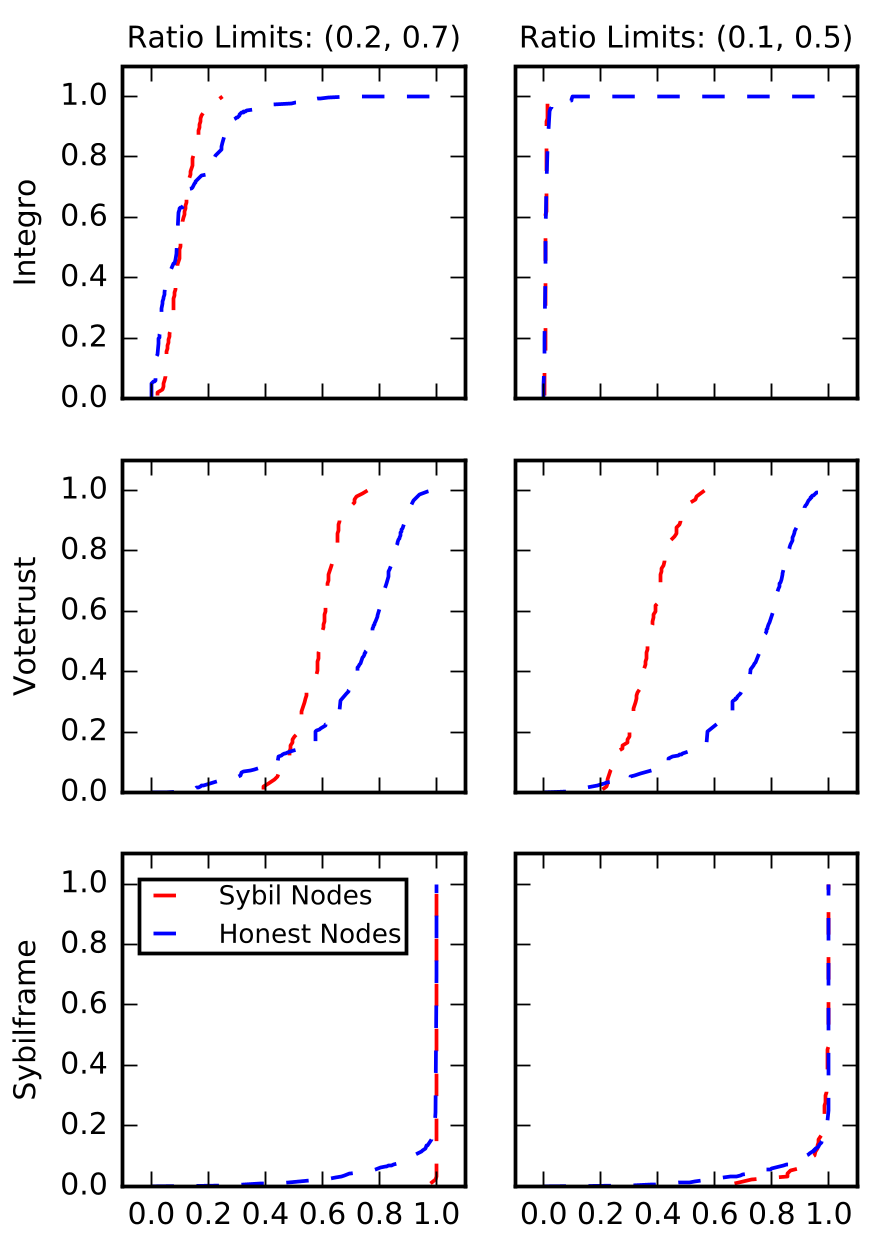 Figure 3: The overlapping CDFs show that the "ranks" assigned to Sybils and Honest users become indistinguishable under a targeted peripheral attack.
Conclusion and Deep Insight
The paper's most stinging critique is directed at SybilFrame. Its reliance on ML "priors" creates a feedback loop. If the attacker tricks the initial classifier (by having a high clustering coefficient or low rejection rate), the graph algorithm actually amplifies that error, firmly embedding the Sybil as an "honest" node in the system's eyes.
The Takeaway: We cannot rely on static graph features. Future defenses must account for the temporal and dynamic nature of how friendships are formed, rather than just the state of the graph at a single point in time.