
The B-Chase Algorithm: Bridging the Gap Between ML and Linear MIMO Detection
3826_The Chase Family of Detection Algorithms for Multiple-Input Multiple-Output Channels.
This paper introduces the Chase family of detectors for MIMO channels, a framework that unifies various detection algorithms by translating the Chase error-control decoding principle from time to space. The authors propose the "B-Chase" detector, which utilizes BLAST-ordered decision-feedback (BODF) as subdetectors to achieve near-Maximum Likelihood performance with significantly reduced computational complexity.
TL;DR
High-performance MIMO detection traditionally requires Maximum Likelihood (ML) search, which is computationally expensive (Sphere Decoding). Conversely, Linear or Decision Feedback (BODF) methods are fast but lack accuracy. The B-Chase Detector bridges this gap by applying a spatial version of the Chase decoding algorithm, achieving near-ML results with up to 68% less complexity by using smart candidate list processing.
Problem & Motivation: The Complexity Wall
In Multiple-Input Multiple-Output (MIMO) systems, the receiver must separate overlapping signals. The ML detector is the gold standard for accuracy but its complexity scales exponentially with the number of antennas and modulation order. While algorithms like "Sphere Decoding" help, they still suffer from unpredictable worst-case latency.
The authors observed that existing "list detectors" (which create a set of possible solutions and pick the best) often use brute-force first-symbol enumeration. They realized that by translating the Chase error-control decoding logic—originally used for binary codes—into the spatial domain of MIMO, they could create a flexible detector that handles "unreliable" spatial symbols more intelligently.
Methodology: The Chase Framework
The Chase detector follows a 5-step process that generalizes many existing algorithms:
- Selection: Pick a "first" symbol index to focus on.
- List Generation: Create a list of the most likely candidates for that symbol.
- Cancellation: For each candidate, subtract its influence from the received signal.
- Subdetection: Use a simpler detector (like BODF) to guess the remaining symbols.
- Selection: Pick the final vector that minimizes the Euclidean distance to the received signal.
Architecture Overview
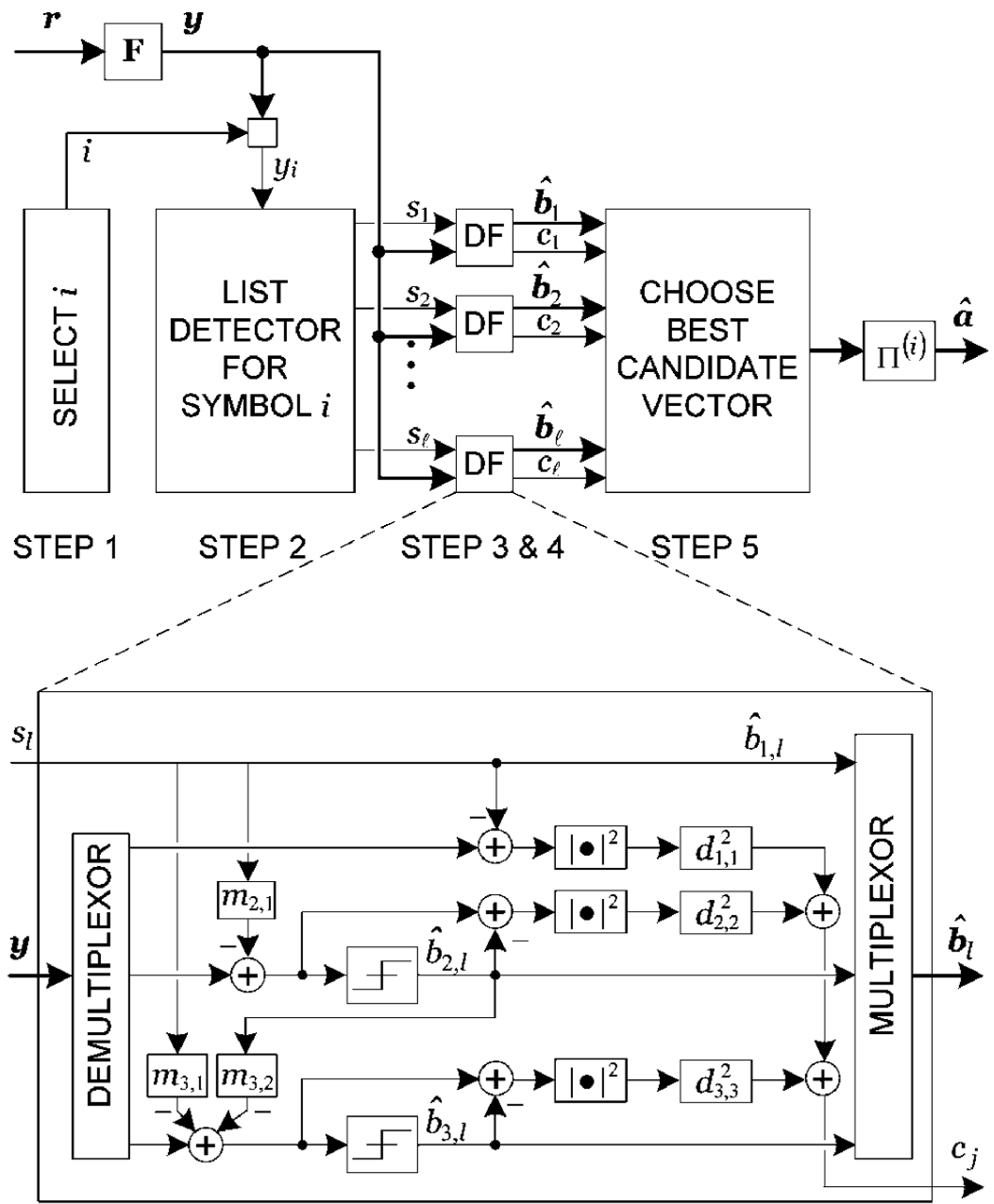
The genius of B-Chase lies in its "Selection Algorithm." Unlike BLAST (which always picks the most reliable symbol first), B-Chase knows it has a list of candidates to "rescue" an unreliable symbol. Therefore, if the list is long, it can afford to pick a less reliable symbol first to ensure the remaining sub-channel is better conditioned for the subdetectors.
Experimental Performance
The researchers tested the B-Chase family on 4x4 Rayleigh-fading channels using 16-QAM modulation.
Performance vs. Complexity Trade-off
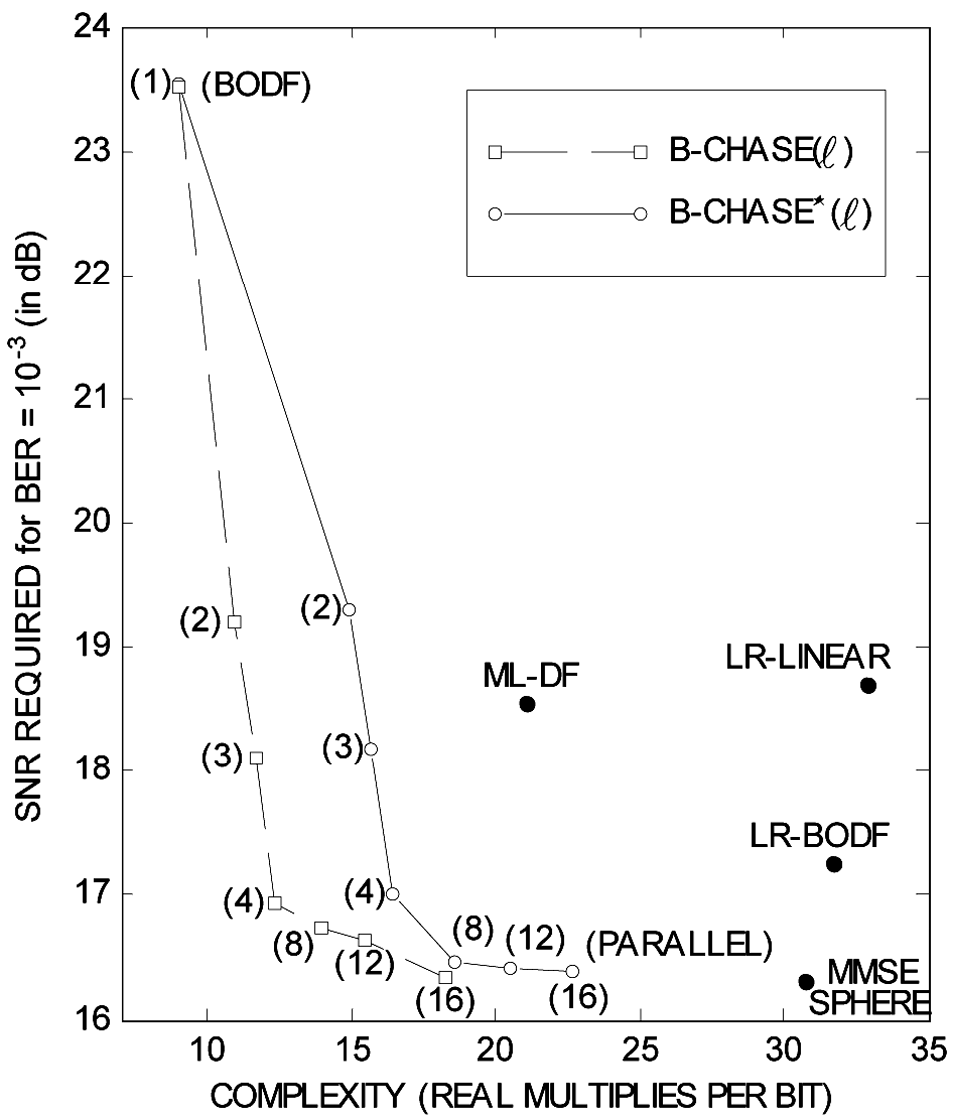
- Near-ML Performance: B-Chase(16) achieves results within 0.4 dB of the ML detector.
- Efficiency: At the 99.9% complexity quantile (critical for hardware design), B-Chase(16) requires only 18 real multiplies per bit, compared to 57 for a standard ZF Sphere Detector—a 68% reduction.
- Massive Gains over BODF: Even with a tiny list of , B-Chase outperforms the industry-standard BLAST-ordered DF by 4.4 dB, with only a minor 17% increase in operations.
Critical Analysis & Conclusion
The B-Chase detector provides a tunable framework for MIMO receiver design. By adjusting the list length , engineers can scale the receiver from a simple BODF detector up to a high-performance ML approximation based on available power and latency budgets.
Takeaway: The "Spatial Chase" approach proves that we don't need to search the entire vector space. By identifying one critical symbol and providing a small list of "second guesses," we can achieve nearly all the diversity gain of an ML detector at a fraction of the cost.
Limitations: While B-Chase reduces core processing, its preprocessing complexity (QR decompositions) is relatively high. This makes it most suitable for channels that are relatively stable (large coherence time ), where the preprocessing cost can be amortized over many symbols.