
Scaling Online Social Networks: The Power of Social-Aware Partitioning and Replication
The Little Engine(s) That Could: Scaling Online Social Networks
This paper introduces SPAR (Social Partitioning and Replication), a middleware designed to scale Online Social Networks (OSNs) by jointly optimizing graph partitioning and data replication. By ensuring that a user's data and their one-hop neighbors' profiles are colocated on the same server, SPAR achieves "local semantics," vastly outperforming traditional DHT-based random partitioning.
TL;DR
Scaling Online Social Networks (OSNs) is notoriously difficult due to the "highly interconnected" nature of social data. Traditional horizontal scaling (partitioning data randomly across servers) results in massive network overhead and slow query response times. This paper presents SPAR, a middleware that leverages the social graph's structure to minimize replication while ensuring all data needed to serve a user's request is physically located on the same server (Local Semantics). The result? A 3x increase in throughput and an 8x reduction in network traffic compared to industry-standard tools like Cassandra.
The Problem: The "Multi-get" Bottleneck
Modern OSNs like Facebook and Twitter face a "Designer's Dilemma": spend resources on features or on complex infrastructure to avoid "death-by-success." Most distributed databases (Cassandra, HBase) use Random Partitioning (based on DHTs).
While this balances the storage load, it ignores the social context. If User A has 100 friends, their profiles are likely scattered across 100 different servers. To generate a simple news feed for User A, the system must perform a "multi-get" request across the network. This architecture is only as fast as the slowest responding server (the long-tail latency problem) and creates a massive network I/O bottleneck.
Methodology: The SPAR Approach
SPAR (Social Partitioning and Replication) is a middleware layer that sits between the application and the database. Its core philosophy is simple: Data that is accessed together should be stored together.
1. Local Semantics
SPAR ensures that for every user, their "master" profile and a "slave" replica of all their one-hop neighbors exist on the same machine. This allows the application to query a single server as if it were a centralized database, drastically simplifying development.
2. Joint Optimization
Unlike offline graph partitioning (like METIS) which only tries to minimize edge cuts, SPAR's greedy heuristic jointly considers partitioning and replication. When a new edge is formed, SPAR decides whether to move a master node or create a new replica based on which action minimizes the total system overhead.
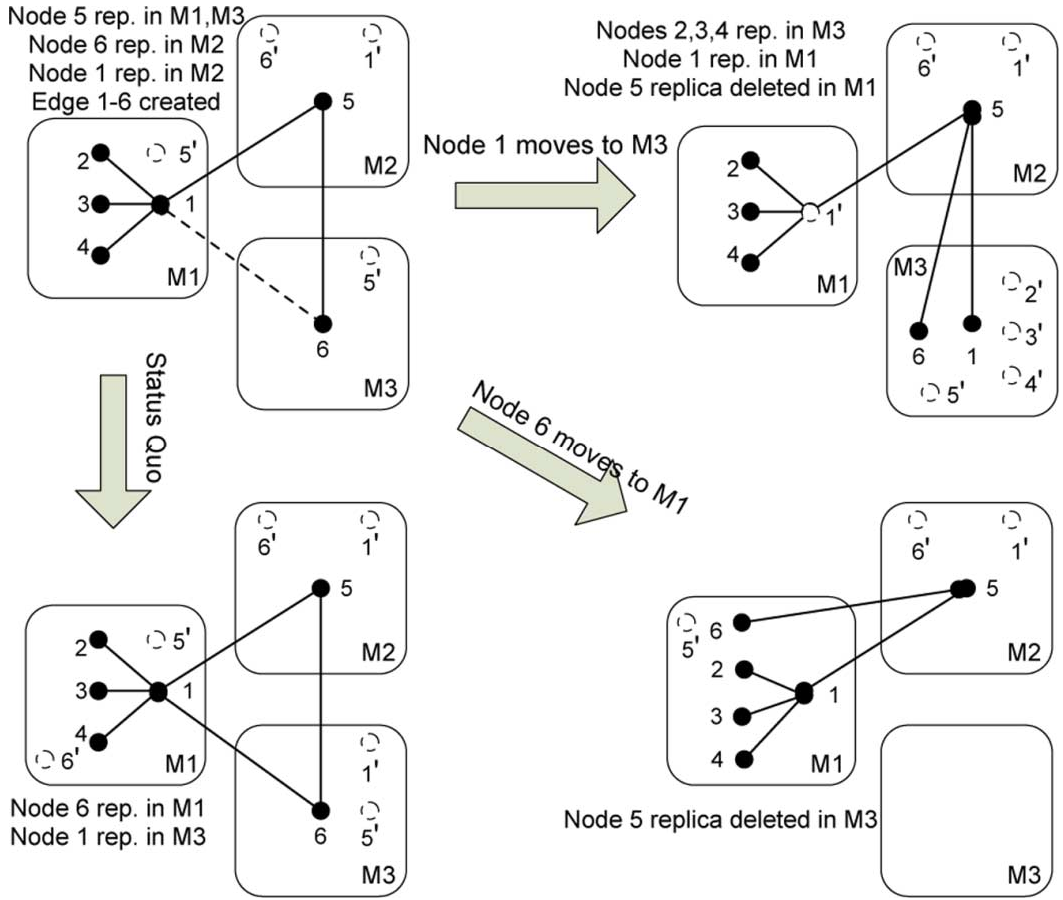 In the figure above, SPAR evaluates different configurations (moving masters vs. status quo) to maintain locality with minimum added replicas.
3. Efficiency via Redundancy
A brilliant insight in SPAR is the reuse of replicas. Since distributed systems require redundancy for fault tolerance anyway, SPAR uses these mandatory replicas to satisfy its locality requirements, effectively achieving local semantics at a "discounted" cost.
Performance: SPAR in the Wild
The authors tested SPAR against Cassandra (using Facebook's data model) and MySQL on a cluster of 16 commodity "little engines."
Key Metrics:
- Throughput: SPAR reached 800 req/s while maintaining sub-100ms latency, a 4x improvement over Cassandra's random partitioning.
- Network Traffic: By eliminating cross-server queries for feed generation, SPAR reduced aggregate cluster traffic by 8x.
- Replication Overhead: Even with locality constraints, SPAR's overhead grows sub-linearly with the number of servers, proving it is a sustainable scaling strategy.
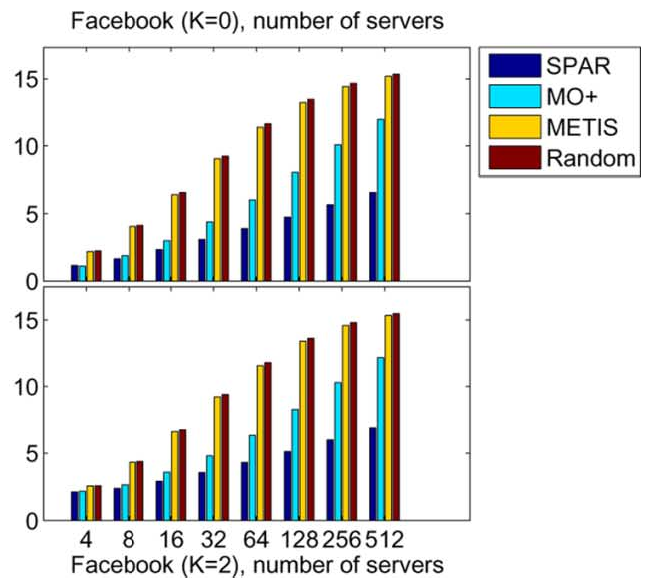 Experimental results across Twitter, Orkut, and Facebook show SPAR consistently maintaining lower replication overhead than METIS or Random Partitioning.
Critical Insight & Conclusion
The genius of SPAR is its recognition that OSN data is not random—it is structured by human relationships. By moving the complexity of data placement into a transparent middleware, it allows developers to write code for a "single machine" while the system scales horizontally across hundreds.
Limitations: SPAR focuses on one-hop neighbor locality. While this covers "News Feed" use cases (which dominate OSN traffic), it might not directly benefit deep graph traversals (e.g., "Friends of Friends" recommendations or pathfinding).
Final Takeaway: In the era of massive social data, the most efficient way to scale is to respect the underlying graph structure. SPAR provides a blueprint for building high-performance, socially-aware distributed systems using cheap, commodity hardware.