
Digital Trenches: How Twitter Formed the Frontline of Brazil's 2015 Protests
The People Have Spoken: Conflicting Brazilian Protests on Twitter
This paper presents a computational social science study of conflicting 2015 Brazilian protests using Twitter data. By employing Latent Dirichlet Allocation (LDA) and Probabilistic Latent Semantic Indexing (pLSI), the authors analyze over 274,000 tweets to identify the distinct demands, organizational tactics, and ideological subjects of both pro-government and anti-government factions.
TL;DR
In early 2015, Brazil was a nation divided. Between March 13 and 15, two massive waves of protests—one supporting President Dilma Rousseff and one demanding her impeachment—collided on the streets and online. This paper uses Topic Modeling (LDA and pLSI) to dissect 274,000 tweets, revealing that while the opposition was a broad, distributed movement focused on corruption, the government supporters were a highly centralized unit focused on one enemy: the "coup-backing" mainstream media.
Problem & Motivation: Beyond the Street Noise
Political protests are no longer just about the number of people in the streets; they are about who controls the narrative in the "digital public square." The researchers recognized that Brazil, as one of the world's most active social media hubs, offered a unique dataset to study how polarization manifests in real-time.
The core challenge was to move past basic sentiment analysis and actually uncover the latent subjects and organizational tactics of two groups that were essentially speaking different languages on the same platform.
Methodology: The Statistical Lens of LDA and pLSI
The authors didn't just look at hashtags; they applied two heavyweight algorithms to "listen" to the underlying themes:
- LDA (Latent Dirichlet Allocation): A probabilistic model that treats documents as a mixture of topics.
- pLSI (Probabilistic Latent Semantic Indexing): Useful for finding discrete word-topic associations.
By comparing these, the authors could filter out "noise" and identify the core pillars of each movement's rhetoric.
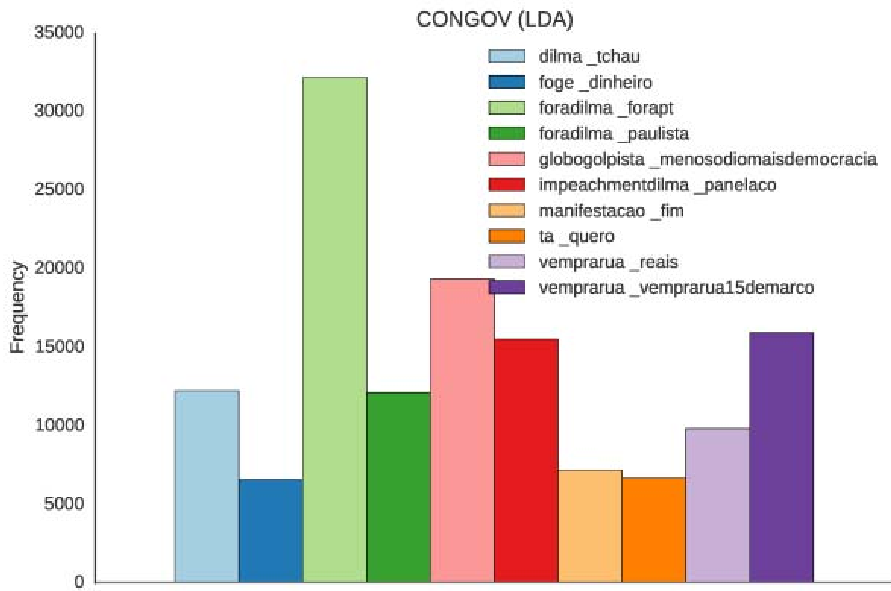 Figure 1: LDA frequency distribution showing a dominant cluster of media-critical topics.
Key Findings: Centralization vs. Distribution
The study revealed a fascinating asymmetry in how these groups operate:
- The Anti-Media Crusade: For pro-government supporters, the protest wasn't just against the opposition; it was against Rede Globo (Brazil's largest TV station). Terms like globogolpista (Globo coup-backer) dominated their digital footprint.
- The "Super-User" Strategy: Perhaps most strikingly, the pro-government side was driven by a few incredibly prolific activists. One user, Larissa Alves, accounted for a massive share of the pro-government volume.
- The Distributed Opposition: The anti-government group, while having top users, showed a much "flatter" distribution. This suggests a more organic, widespread movement of individuals rather than a coordinated strike team of activists.
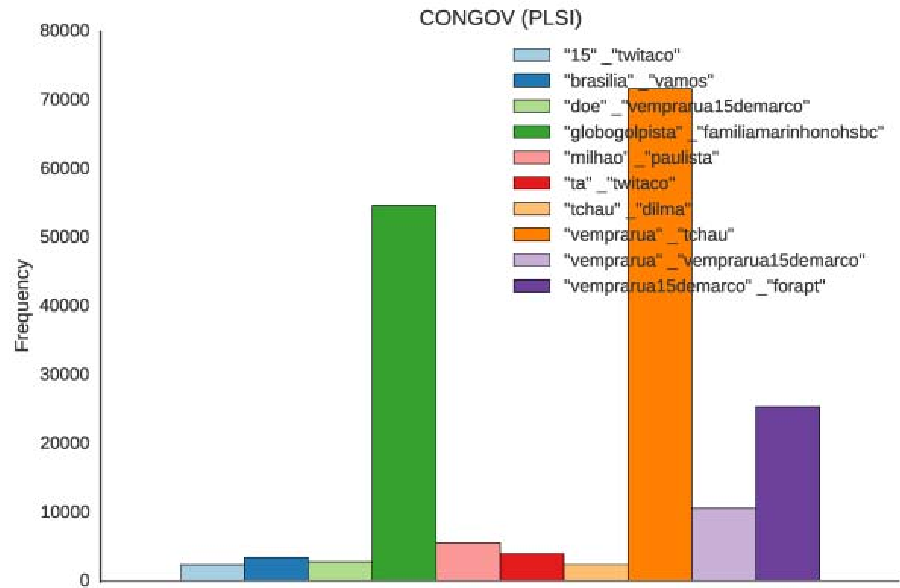 Figure 3: LDA frequency in the opposition dataset, showing a diverse spread of anti-corruption and impeachment themes.
Temporal Tactics: The Early Bird Catches the Narrative
The time-series analysis showed that pro-government supporters were strategically active in the early hours (before dawn) of the opposition's protest day. Their goal? To "pre-poison" the well of public opinion and attempt to dominate Trending Topics before the marches even began.
Critical Insight: The Power of the Minority
The paper concludes that while the opposition had the sheer numbers on March 15th, the pro-government group utilized a centralized activist strategy to maintain a disproportionately loud "voice" in the digital sphere.
Takeaway for Today: This study serves as an early blueprint for understanding "astroturfing" and coordinated digital campaigning. It proves that in the age of algorithms, a small, dedicated group of "super-users" can effectively simulate a massive counter-movement, complicating our understanding of "public opinion."
Limitations
- The study relies on keyword filtering, which might miss nuanced sarcasm or users who didn't use specific hashtags.
- Geospatial data was not fully utilized to see if these digital trends mapped to local street clusters.