
The Architecture of Influence: How News Actually Flows Through Twitter
7173_The World of Connections and Information Flow in Twitter.
This paper presents a large-scale empirical study on Twitter's information flow by categorizing 54 million users into Mass Media, Evangelists, and Grassroots. Using a dataset of 1.7 billion tweets, it characterizes how these groups interact to spread major international news (e.g., Iran elections) and niche topics, establishing a data-driven framework for "necessity and sufficiency" in audience reach.
TL;DR
By analyzing nearly 2 billion social links, this study debunked the myth of the "powerful grassroots" in news propagation. While ordinary users make up 98% of Twitter, the real heavy lifting of information flow is done by Mass Media and a crucial middle-class of Evangelists. Surprisingly, news doesn't always flow down; sometimes the "masses" lead the media.
Problem & Motivation: Beyond the Follower Count
In the early days of social media research, many assumed that Twitter was a democratic "town square" where anyone could start a revolution. However, the authors observed a massive disparity in connectivity. They sought to move beyond "who has the most followers" to ask: Who is actually necessary to make a topic go viral?
Existing theories like the Two-Step Flow suggested a rigid hierarchy. This paper tests whether digital networks have broken that hierarchy or simply created a new kind of "Digital Elite."
Methodology: The Three Tiers of Twitter
The researchers crawled 54 million users and categorized them into three distinct archetypes based on their In-Degree (Follower count):
- Mass Media (>100,000 followers): The 0.01%. They act as broadcast beacons.
- Evangelists (200 – 100,000 followers): The 1.4%. Opinion leaders, minor celebrities, and niche experts who bridge gaps.
- Grassroots (<200 followers): The 98.6%. The vast majority who, despite their numbers, often act as passive consumers.
 Figure 1: The heavy-tailed distribution of followers shows the extreme disparity between the "Mass Media" elite and the "Grassroots" majority.
Core Findings: The Necessity and Sufficiency Test
To measure influence, the authors used a clever logic:
- Sufficiency: If we only had the top X users, how much of the audience could they reach?
- Necessity: If we removed the top X users, would the news still spread?
1. The Power of the Elite
For major headlines like the "Michael Jackson Death" or "Iran Elections," Mass Media sources were sufficient to reach over 70% of the audience. Even though they posted the fewest tweets, their structural position made them unavoidable.
2. The Bridge of Evangelists
While Media reaches the core, Evangelists are the ones who push news into the "long-tail"—reaching audiences who don't follow mainstream news. For minor or niche topics (like "#googleapps"), Evangelists were responsible for over 90% of the reach.
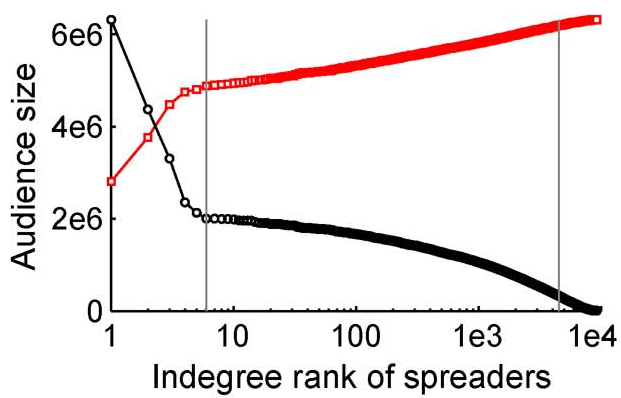 Figure 3: For major topics, the "Sufficiency" (red line) leaps up instantly due to Mass Media, while "Necessity" (black line) drops sharply when those elite nodes are removed.
3. Bottom-Up Information Flow
The most groundbreaking finding was the reversal of flow. In events like the AirFrance crash, Grassroots and Evangelists often reported the news hours before the Mass Media.
| Audience Type | Received from Grassroots | Received from Evangelists | Received from Mass Media |
|---|---|---|---|
| Mass Media | 5.91% | 89.93% | 4.16% |
The table above shows that Mass Media outlets actually receive nearly 90% of their information from Evangelists, proving that "In-Degree" does not dictate the direction of information.
Critical Analysis & Conclusion
Takeaway
Twitter is not a peer-to-peer social network; it is a collaborative broadcast system. The "Evangelist" group is the most socio-technically significant part of the ecosystem—they are the aggregators that feed the media and the distributors that feed the masses.
Limitations
The study relies on a 2009 snapshot. In today's Twitter (X), the introduction of algorithmic "For You" feeds and "Blue Check" boosting has likely altered these dynamics, possibly concentrating power even more or creating "echo chamber" silos that this study's global visibility model wouldn't fully capture.
Future Outlook
For designers of recommendation engines, this research suggests focusing on "Evangelists" rather than just "Mass Media" to discover up-and-coming trends before they hit the mainstream.