
Decoding the DNA of Diplomacy: Automating Thematic Detection in Global Politics
Discovering thematic structure in political datasets
The paper introduces a hybrid embedding/clustering algorithm designed to uncover the thematic structures of "measurement instruments" (e.g., UN resolutions or IGO memberships) in sociopolitical datasets. By combining hierarchical clustering with Principal Component Analysis (PCA) and correlation-based similarity, the authors successfully identify latent political themes such as "human rights" and "regional geography" that drive international alignments.
TL;DR
Researchers from Yale University have developed an algorithm that moves beyond just mapping who is allied with whom, focusing instead on why. By treating UN resolutions and International Organizations as "measurement instruments," their hybrid clustering/PCA method automatically extracts latent themes—like human rights or regional interests—from massive, noisy datasets.
Background: The "Why" Question in Security Informatics
In the world of security informatics and international relations, we often see "actors" (countries, organizations) and their "actions" (voting, joining groups). While we can easily map alliances using traditional social network analysis, understanding the thematic drivers—the hidden logic behind these moves—is much harder.
Prior work often used Principal Component Analysis (PCA) or Multidimensional Scaling (MDS) to plot countries in 2D space. However, these methods often fail to capture the hierarchical "about-ness" of the issues being voted on. This paper flips the script: it analyzes the resolutions to explain the actors.
Methodology: Mining Correlations and Principal Components
The core innovation is a recursive algorithm that builds a bridge between hierarchical clustering and dimensionality reduction.
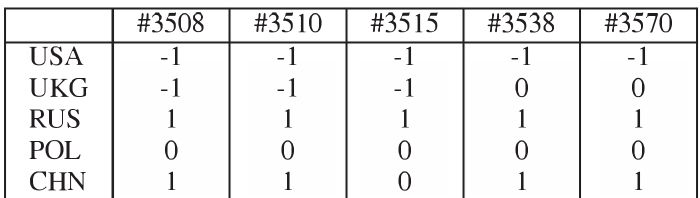
- Symmetry of Two-Mode Networks: The authors treat the relationship between countries and resolutions as a two-mode network where roles are interchangeable.
- Absolute Correlation as Similarity: They argue that if two resolutions are highly anti-correlated (e.g., a pro-Israel vs. an anti-Israel vote during the Cold War), they belong to the same topic. Thus, the absolute value of correlation is the ideal distance metric.
- The Pipeline:
- Standardization: Normalize columns to zero mean and unit variance.
- Centroid Selection: Group clusters within a "correlation radius" .
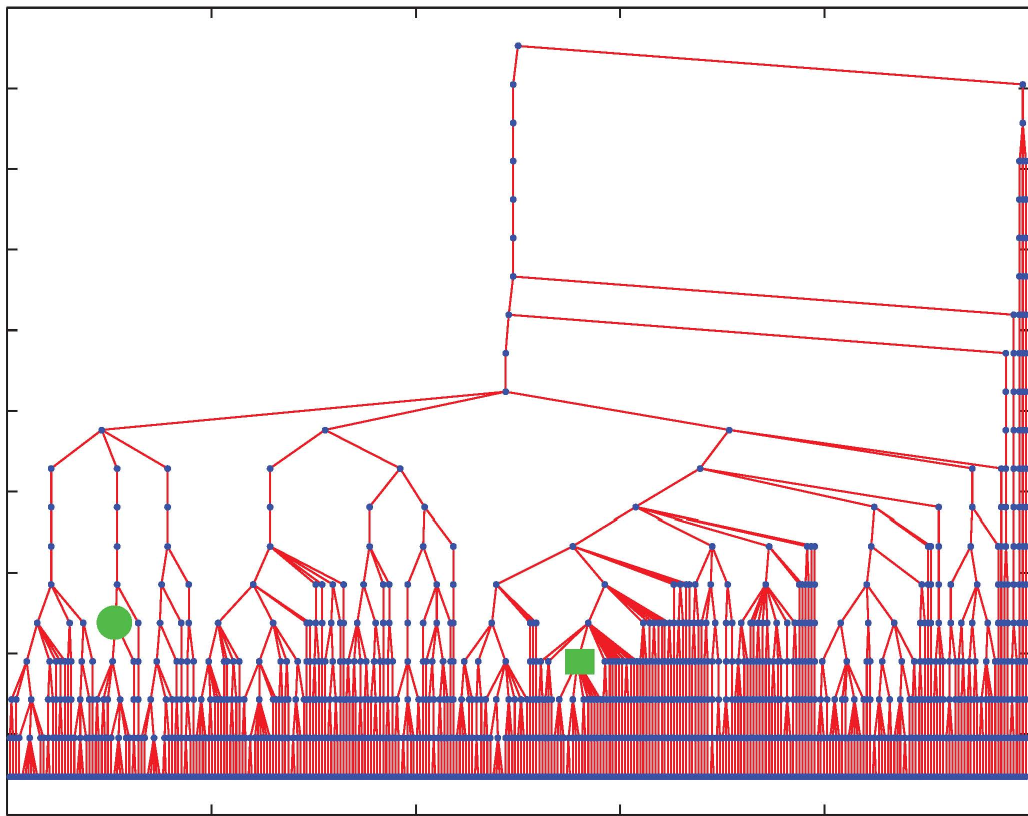
- PCA Projection: For each group, compute the first principal component to act as a "thematic representative."
- Cooldown: Gradually decrease the radius (the "cooldown ratio") to refine the hierarchy.
Experimental Results: UN Voting and IGO Landscapes
The authors tested their algorithm on two significant datasets:
1. UN General Assembly (1998-2002)
The algorithm successfully isolated specific political "hot spots." It didn't just group random votes; it extracted coherent thematic bundles. For instance, one cluster was exclusively dedicated to Middle East issues (Palestine, Jerusalem, Syrian Golan), while another was a distinct Human Rights cluster (focusing on Sudan, Iran, and Iraq).

2. Inter-Governmental Organizations (IGO)
The thematic structure of the IGO dataset (year 2000) was found to be predominantly geographical. The algorithm automatically partitioned organizations into high-fidelity regional clusters:
- European Cluster: CERN, NATO, OSCE, etc.
- Caribbean Cluster: ACS, CARICOM, OECS, etc.
Critical Insight: From Themes to Kernels
Why does this matter for the future of AI in politics? By discovering these thematic structures, the authors can create better "similarity kernels." If we know that "Human Rights" is a driving theme, we can project actors into a space defined by that theme.
Limitations: The reliance on linear PCA within the clusters might miss non-linear manifolds in even more complex datasets. Additionally, the "cooldown" parameters require manual tuning for different types of data (e.g., crime vs. voting).
Future Outlook: These algorithms aren't just for history; they are a blueprint for visualizing modern cybersecurity threats. By identifying "Who is doing what," and more importantly, the "Motivational Theme" behind it, security analysts can predict future alliances and conflicts before they manifest in the real world.