
From Matrices to Friendships: A Linear Algebra Approach to Directed Social Discovery
A Theoretical Approach for Discovery of Friends from Directed Social Graphs
This paper presents a theoretical framework for social network analysis using graph theory and linear algebra to identify key entities in directed social graphs. The authors propose methods to discover popular followees and "second-degree followees" using adjacency matrix computations, specifically leveraging matrix squaring (A²) to determine paths of length 2.
TL;DR
In the era of Big Data, social platforms like Twitter and Instagram generate massive directional graphs. This paper provides a rigorous mathematical framework using Adjacency Matrices and Linear Algebra to identify popular users and "second-degree followees"—the backbone of modern recommendation systems. By squaring the graph's matrix, the authors can systematically uncover hidden social connections at scale.
Background: The Shift to Directed Graphs
While Facebook popularized the "undirected" mutual friend model, the modern social landscape is predominantly directional. Following someone does not imply they follow you back. This asymmetry complicates social mining. The authors position this work as a theoretical bridge, moving beyond simple counting to path-based discovery in big directional data.
The Core Insight: Why Linear Algebra?
The fundamental problem in social discovery is finding "friends of friends" who aren't already your friends. In graph terms, these are second-degree followees.
The authors leverage a classic graph theory property: If is an adjacency matrix, the entry of represents the number of walks of length from vertex to vertex .
Methodology: Calculating Second-Degree Followees
To find a second-degree followee for user , we aren't just looking for any path of length 2. We must filter out:
- Direct Followees: People the user already follows.
- Self-Loops: The user themselves (if they follow someone who follows them back).
The authors propose a logic-based subtraction method: Where is the number of non-zero entries in the -th row of , and accounts for intersections with the original follows in .
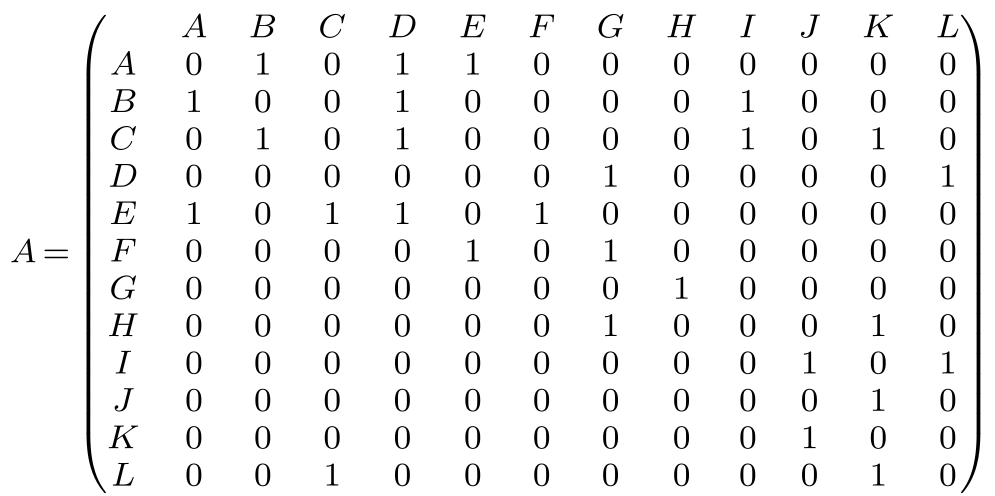 Figure 1: Adjacency matrix representation of a 12-user directed social graph.
Experiments & Scalability
The authors tested their approach using two massive datasets from the Stanford Network Analysis Project (SNAP):
- Google+ (ego-Gplus): ~107K nodes and 13.6M edges.
- Twitter (ego-Twitter): ~81K nodes and 1.7M edges.
The experiment confirmed that identifying "Popular Followees" is a simple column-sum operation (calculating In-degree), while second-degree discovery scales mathematically with matrix multiplication efficiency.
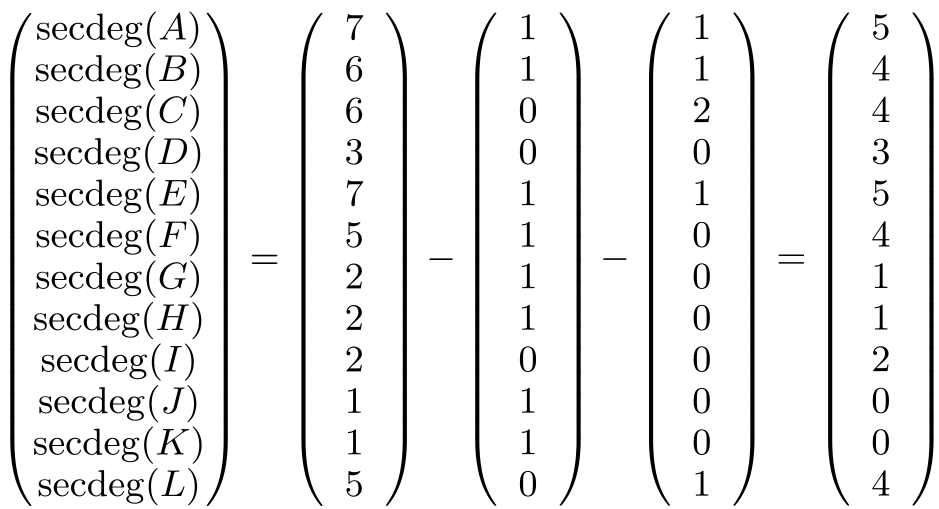 Figure 2: Step-by-step vector calculation for determining second-degree followee counts across the sample network.
Critical Analysis & Future Directions
The beauty of this approach lies in its simplicity and mathematical elegance. By reducing social discovery to matrix operations, it allows developers to utilize high-performance linear algebra libraries (like BLAS or GPU-accelerated frameworks) to process social data.
Limitations:
- The paper primarily focuses on paths of length 2. Higher-degree relationships (paths of length 3 or 4) would require higher powers of , which can lead to "matrix explosion" in terms of density.
- It treats all edges equally, whereas real-world "friendship" often requires weighted edges (interaction frequency).
Future Work: Integrating these linear algebra foundations with Machine Learning could lead to hybrid models where matrix-derived features serve as input for deep learning-based recommendation engines.