
Deciphering the Social Skeleton: Optimal Structure Learning via Value Injection
Theoretical Computer Science
The paper investigates learning hidden Independent Cascade social networks using exact Value Injection Queries (activating/suppressing nodes). It proposes an algorithm that achieves optimal structure learning for general graphs in queries and for tree structures.
TL;DR
How do you map a hidden social network if you can only trigger nodes and watch one person's reaction? This paper provides the mathematical "scalpel": an optimal algorithm that uses Value Injection Queries (activating and suppressing agents) to reconstruct any independent cascade network, even those with cycles.
Background: The Hidden Map
In viral marketing or epidemiology, we see the result of a spread but rarely the map of influence. The Independent Cascade Model is the gold standard here: each person has a probability of influencing a neighbor. Previous research focused on learning acyclic circuits, but real social networks are messy and full of feedback loops. This work marks a milestone by tackling cyclic graphs with an information-theoretically optimal query bound.
Problem & Motivation: The Limits of Observation
Standard observation is passive. If you want to know if Alice influences Bob, simply watching them isn't enough—Carol might be influencing both. To truly isolate an edge , you need to:
- Activate .
- Suppress everyone else who might influence .
- Observe the result.
The authors identify that without the ability to "silence" (suppress) nodes, learning the exact weights of a network is often impossible due to confounding paths.
Methodology: The Scalpel of Excitation Paths
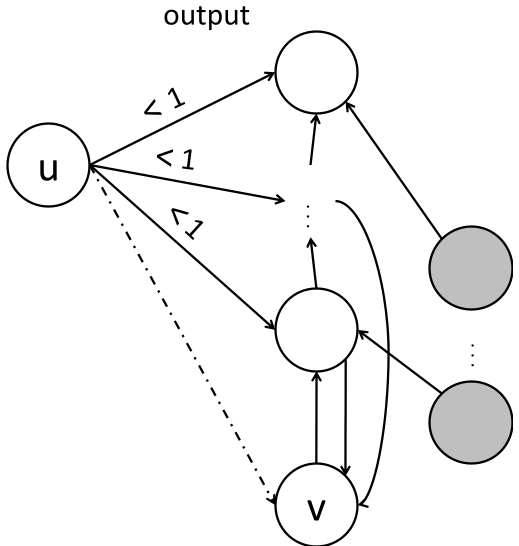
The core breakthrough is the usage of Excitation Paths. An excitation path is a controlled experiment where a specific sequence of nodes is left free to act as a "wire" from the target node to the output, while all other potential distractors are suppressed (fixed to 0).
1. Building the Leveled Graph
The algorithm starts by finding "Up-Edges"—those moving closer to the output node. By measuring the success probability of firing a node through a known path, the authors calculate the weight of the edge using:

2. Handling Cycles and Down-Edges
Unlike previous models, this approach handles cycles. It processes the network level-by-level, from the deepest nodes (furthest from output) to the output itself. By maintaining a "complete set" of known nodes, it systematically tests for "Down-Edges" (edges moving away from the output) and "Level-Edges" (edges between nodes of equal distance).
Experiments & Results: Proving Optimality
The paper doesn't just provide an algorithm; it proves it's the best possible.
- General Networks: The bound is proven optimal via an information-theoretic lower bound.
- Trees: In hierarchies (trees), the complexity drops to , similar to sorting.
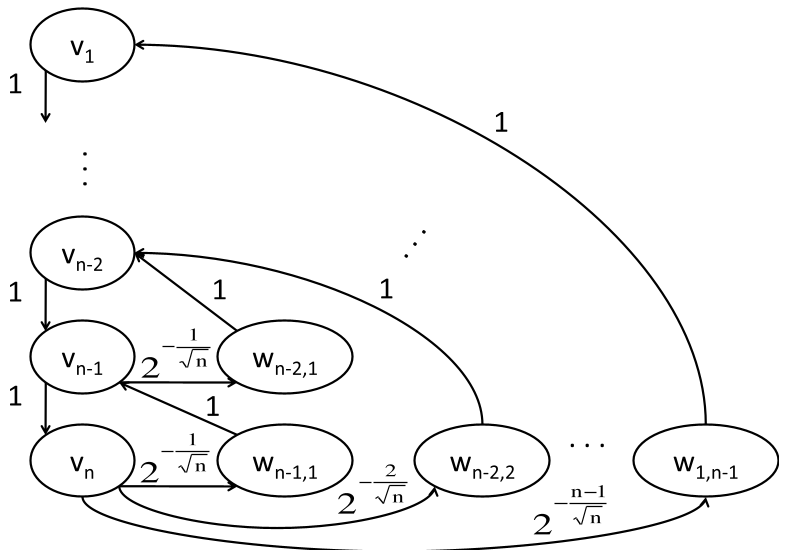
- The "Path Dilution" Warning: In a critical analysis (Section 5), the authors show that in some networks, a single path might have tiny influence, but the aggregate of many paths is huge. This warns future researchers that "path-based" methods might fail when query results are noisy (non-exact).
Critical Insights: Why it Matters
This work bridges the gap between Active Learning and Network Science.
- Submodularity: The authors prove that social influence in this model is submodular, allowing a greedy algorithm to find "influential nodes" effectively, even without knowing the full network structure.
- Product Implication: For a marketing firm, this suggests that the most efficient way to understand a market isn't just A/B testing, but "perturbation testing"—temporarily incentivizing or blocking certain influencers to see how the "output" (sales) changes.
Limitations & Future Work
The biggest hurdle is the Exact Query assumption. In the real world, we rarely get "exact probabilities"; we get binary samples (Alice bought the product or she didn't). Moving these algorithms into the "Approximate/Sampling" regime is the next great frontier for this research.
Takeaway: If you want to understand a system, don't just watch it—poke it, silence its parts, and measure the pulse.