
Decoding the Small World: How Categories Power Social Navigation
Theoretical Computer Science
The paper introduces "membership dimension" as a novel metric to explain the small-world phenomenon through category-based greedy routing. It provides a constructive proof that any connected network can support efficient routing using a category system with a polylogarithmic membership dimension relative to the network size.
TL;DR
Why can a stranger in Nebraska find a lawyer in Boston through a chain of just six people? This paper argues it isn't just about "short paths"—it's about the categories we belong to. The authors introduce Membership Dimension, a way to measure the cognitive load of social groups, and prove that if a network has a small diameter, it only takes a few carefully structured categories for "greedy routing" to work perfectly.
Background: Beyond Six Degrees
The "Small-World Phenomenon" is a staple of sociology, but for computer scientists, it presents a puzzle: Navigation. It’s one thing for a short path to exist; it’s another for individuals with only local knowledge to find it.
The authors shift focus from the network's topology to its Categorical Structure. They ask: What properties must social groups (like "Engineers," "New Yorkers," or "Jazz Fans") have to ensure a message always moves closer to its target?
The Core Metric: Membership Dimension
The paper defines Membership Dimension as the maximum number of groups any single person belongs to.
- High Dimension: You belong to thousands of groups (high cognitive load).
- Low Dimension: you belong to a handful of groups (low cognitive load).
The "Greedy Routing Rule" states that if you have a message for a target , you pass it to an acquaintance who shares more categories with than you do.
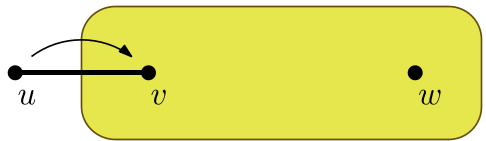 In this model, distance is measured by category set difference: .
Methodology: The Math of Success
The researchers identified two critical requirements for a category system to be "routable":
- Internal Connectivity: Every category (e.g., "The Harvard Alumni Association") must be a connected subgraph. You must be able to reach any member of your group through other members.
- Shattered Property: For any two people, there must be a neighbor who is "closer" to the target in categorical space.
The Construction
The most impressive part of the paper is the proof that any connected graph can be turned into a "Small World" category system. By using Weight-Balanced Binary Trees, the authors show how to embed any graph into a hierarchical structure where the number of categories per node is only .
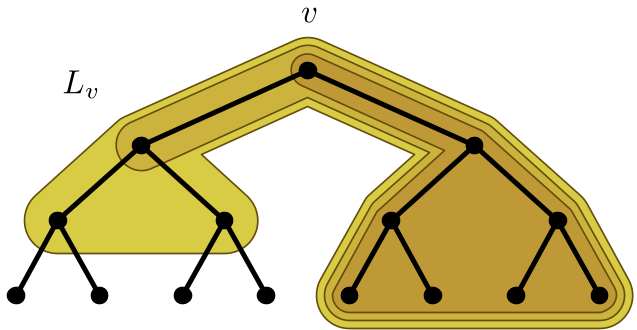 This construction uses recursive partitioning to ensure that nodes can always pivot through ancestors/descendants to find a path.
Why It Matters: Results & Insights
- Efficiency: In a typical "small-world" network where the diameter is logarithmic, each person only needs to remember a squared-logarithmic number of group memberships to guarantee delivery.
- The Impossibility Result: The authors prove that you cannot create a universal category system that works for all graphs. The categories must be tailored to the specific edges of the social network.
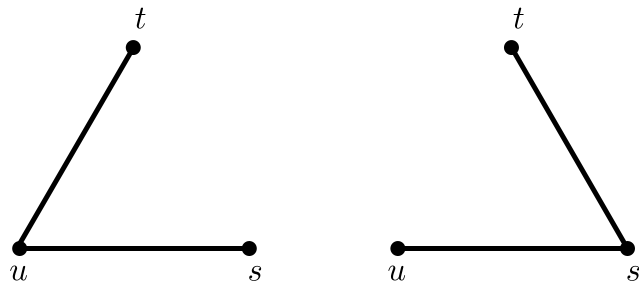 This figure shows that without knowing the graph structure, a fixed category system will eventually fail to route (getting stuck in a local minimum).
Critical Analysis
This work provides a rigorous algorithmic backbone to the "Social Distance" theories of the 1970s. However, it assumes nodes have perfect knowledge of their neighbors' categories. In reality, we often guess which friend might know a lawyer in Boston.
Future Outlook: As we build decentralized networks (like P2P systems or ad-hoc mobile networks), the "Membership Dimension" gives us a limit on how much metadata each node needs to carry to stay functional. The lower the dimension, the more "human-like" and efficient the network becomes.
Summary Takeaway
The small-world phenomenon isn't just a quirk of random edges; it is the result of a low-dimensional categorical mapping of our identities. If you can define yourself through a few specific hierarchies, you make the entire world reachable.