
Beyond Points and Badges: A Theoretical Blueprint for Gamified Marketing
A Theoretical Model of Incorporating Gamification Design into On-line Marketing
This paper proposes a multidisciplinary theoretical framework for integrating gamification into online marketing. It evaluates the impact of game mechanics on user experience (UX) by synthesizing theories from Human-Computer Interaction (HCI), psychology, and communication studies to achieve superior marketing outcomes.
TL;DR
In an era of fragmenting attention, gamification has evolved from a simple "points and badges" gimmick into a sophisticated design strategy. This paper presents a robust theoretical model that bridges the gap between marketing, psychology, and Human-Computer Interaction (HCI), offering a cyclical framework to transform dull online interactions into meaningful, engaging experiences.
The "Pointification" Trap: Why Simple Rewards Fail
Most businesses think they are "gamifying" when they add a leaderboard or a progress bar. However, the authors argue that this misses the core essence of play. Traditional marketing often ignores the Intrinsic Motivation—the internal drive of a user to achieve competence or autonomy. When users are forced to "play" for external rewards alone, they suffer from fatigue. The gap in current research is the lack of an interdisciplinary model that connects how a game mechanic (the code) becomes an aesthetic experience (the feeling).
The Core Mechanism: The MDA and DMC Frameworks
The paper clarifies the taxonomy of gamification by synthesizing several key architectures:
- MDA (Mechanics, Dynamics, Aesthetics): Mechanics are the rules/algorithms, Dynamics are the resulting behaviors, and Aesthetics are the emotional responses (fun, challenge, discovery).
- DMC (Dynamics, Mechanics, Components): Where components (badges, points) are merely tools to serve the higher-level mechanics.
The authors emphasize that Gamification is a Design Strategy, whereas a Game is a Playform. You don't need a "complete game" to gamify; you need a strategic combination of elements that align with user goals.
Methodology: The Multidisciplinary Model
The proposed model is a four-stage recyclable process designed to ensure that the gamification is both usable and psychologically satisfying.
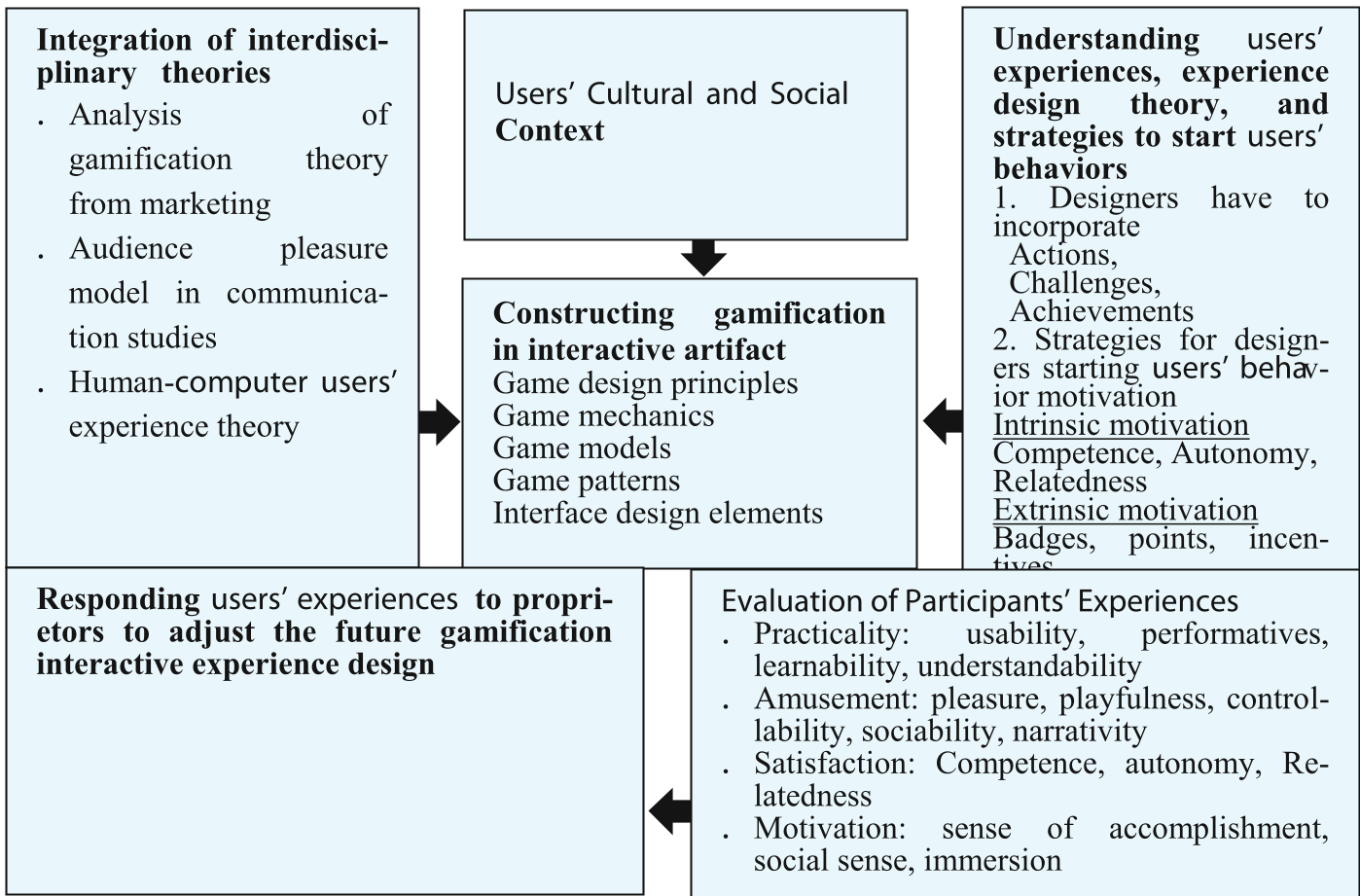
1. Cultural and Social Context
Understand the user's background. What does "winning" mean to them? Without social context, game elements are meaningless.
2. Behavioral Strategy
Designing for both Intrinsic (Autonomy, Relatedness) and Extrinsic (Incentives) motivation.
3. Interactive Artifact Construction
Applying specific game patterns and UI elements to turn theories into a functional interface.
4. Continuous Evaluation
Measuring success across four dimensions:
- Usability: Can they use it?
- Amusement: Is it actually fun (Controllability, Narrativity)?
- Satisfaction: Does it fulfill psychological needs?
- Motivation: Does it create immersion?
Deep Insights: The 4 Types of Media Pleasure
One of the paper's most unique contributions is the application of the Audience Pleasure Model from communication studies:
- Controllability Pleasure: The joy of mastery and interaction.
- Sociability Pleasure: The sense of belonging and intimacy.
- Narrativity Pleasure: Being lost in a story.
- Performance Pleasure: The ability to project an "Ideal Ego" or different identity within the system.
The authors suggest that while most apps focus on Controllability and Sociability, the most powerful (and underutilized) engagement comes from Narrativity and Performance.
Critical Analysis & Conclusion
Takeaway
Gamification success isn't measured by how many badges are issued, but by how effectively the "game" bridges the user's daily life with their inner desires for achievement and connection. This model provides a roadmap for designers to move away from "accidental fun" towards "engineered engagement."
Limitations & Future Work
As a theoretical study, the model serves as a high-level blueprint. The authors note that the next phase involves empirical validation through expert interviews and user surveys to quantify exactly how much "Narrativity" or "Performance" pleasure impacts actual sales conversion rates in online marketing.
Final Thought
For marketers and technical architects, the message is clear: Stop building systems that reward users for showing up; start building systems that empower users to perform.