
From "I" to "We": Deconstructing Collective Action in Online Social Networks
A theoretical model of intentional social action in online social networks
This study develops a theoretical model of intentional social action in Online Social Networks (OSNs), specifically examining "We-Intention" (collective intention) rather than individualistic models. Using an empirical study of 389 Facebook users, the authors demonstrate that collective participation is driven by subjective norms and a multi-dimensional social identity, rather than individual attitudes alone.
TL;DR
Why do we stay on Facebook or LinkedIn? It’s rarely a solo decision. This paper marks a pivotal shift in Information Systems (IS) research—moving away from individualistic adoption models toward a Collective Intention (We-Intention) framework. By surveying 389 Facebook users, the study proves that our "social fabric"—represented by subjective norms and social identity—is what truly drives the intention to participate in digital networks.
The Problem: The Individualistic Bias in Tech Adoption
For decades, the IS community viewed technology use through the lens of the Technology Acceptance Model (TAM). The logic was simple: if I find it useful and I find it easy, I will use it.
However, Web 2.0 changed the game. A social network with only one user is a digital graveyard. The authors argue that existing models are "atomistic" and ignore the reality that using social technologies is an intentional social action. You don't just "intend to use Facebook"; you "intend that we (your friend group) use Facebook together."
Methodology: The Three Pillars of Social Influence
The researchers utilized Kelman’s (1974) framework to analyze three distinct "routes" of social influence that lead to collective intention:
- Compliance (Subjective Norm): The perceived pressure from important others (family/friends) to use the platform.
- Internalization (Group Norm): The degree to which your personal goals and values align with the group's goals.
- Identification (Social Identity): A deep-seated sense of belonging. The authors break this down into:
- Cognitive: Overlap between self-image and group identity.
- Affective: Emotional attachment to the group.
- Evaluative: The sense of worth derived from being a member.
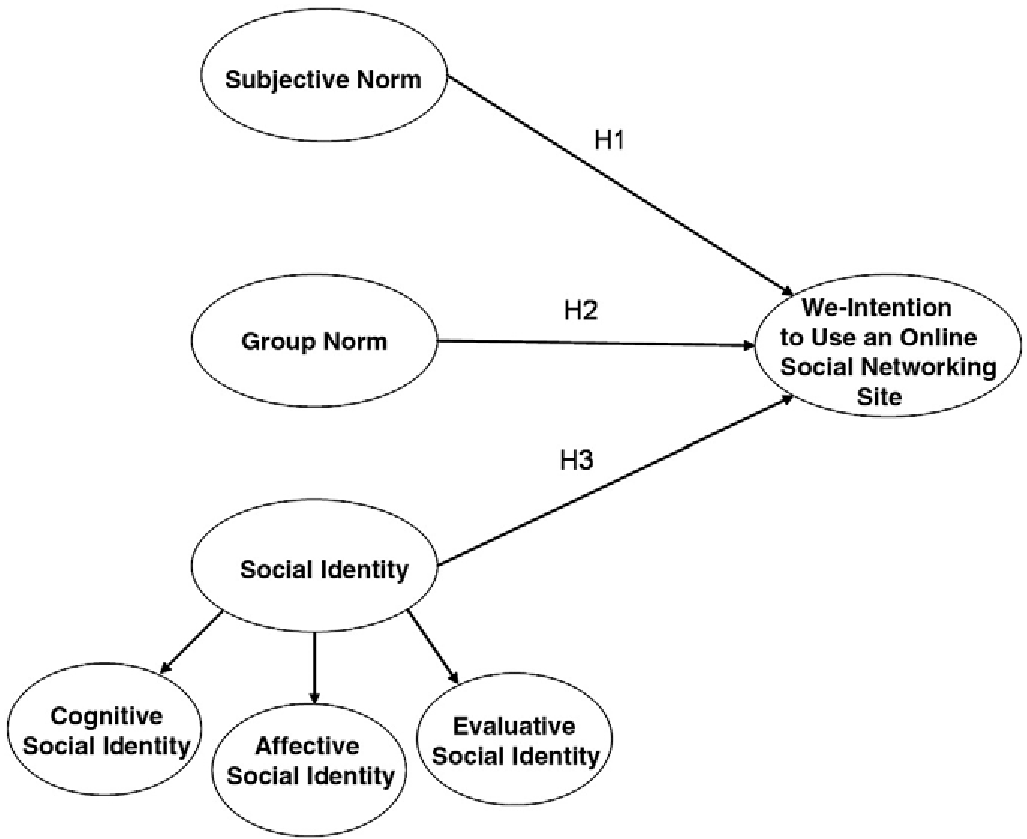 Figure 1: The Research Model illustrating the paths from Social Influence Processes to We-Intention.
Key Findings: Why Norms Matter More Than We Thought
The study’s results using Structural Equation Modeling (SEM) yielded several "aha!" moments:
- Subjective Norms are Persistent: In traditional software (like Word or Excel), social pressure matters only at the start. In OSNs, however, social pressure remains a dominant driver even for experienced users.
- Identiy is Multi-faceted: Social Identity was confirmed as a powerful "second-order" construct. It’s not just "knowing" you belong; it's the emotional and evaluative weight of that belonging that fuels the fire.
- The Group Norm Paradox: Interestingly, the study found no significant link between shared Group Norms and the intention to use Facebook. This suggests that in broad networks, individual belonging and external pressure outweigh specific group goals.
 Table 1: Measurement Validity—showing the high composite reliability (CR) and average variance extracted (AVE) for the "We-Intention" constructs.
Critical Insight: The Managerial Shift
If you are building a social product, this paper suggests you should stop optimizing purely for "Personal Utility" and start optimizing for "Group Identity."
- Marketing Tip: Don't just tell a user what they can do on your app; show them what their circle is doing (leveraging Subjective Norms).
- Community Building: Focus on features that enhance "Affective Identity"—creating emotional bonds between users through shared experiences (like photo sharing or virtual gifting).
Conclusion and Future Outlook
While this study focused on Facebook during its meteoric rise (circa 2008-2010), the core logic remains evergreen. As we move toward the Metaverse and decentralized social layers, the shift from "I-Intention" to "We-Intention" is no longer just a theoretical proposal—it is a requirement for survival in the social economy.
Limitations to Consider: The sample was primarily students (aged 19-23), which may skew the importance of social identity compared to professional networks like LinkedIn. Future research should investigate if these "We-Intentions" hold up in professional or more transactional social environments.