
Social Atoms: Deciphering the Physics of Coherence in Microblogging Networks
Theoretical Study of Self-organized Phase Transitions in Microblogging Social Networks
This paper introduces a sociophysical model to describe phase transitions in microblogging social networks (e.g., Twitter) using a synergetic framework. It maps the evolution of user behavior from a chaotic, uncorrelated state to a coherent, strategy-driven state using the Lorenz system of differential equations.
TL;DR
Researchers have applied the principles of Synergetics and the Lorenz system to Twitter, proving that the emergence of a "unified trend" is a physical second-order phase transition. When a specific threshold of "strategically oriented" users is met, the network shifts from a chaotic state to a coherent one, where a small minority dictates the behavior of the majority.
Background: From Thermodynamics to Twitter
Since the mid-90s, the field of Econophysics has treated market fluctuations as stochastic physical processes. This paper takes it further into Sociophysics, viewing human users as "social atoms." The core insight is that social networks are open systems with continuous information flux, making them perfect candidates for self-organized criticality.
The Problem: Why do Trends Suddenly "Snap" Into Place?
Traditional models often treat social networks as static or purely probabilistic (Poisson distributions). However, real networks show "bursts" of coherence. The authors argue that prior work lacks a generalized framework to explain how a system transitions from "noise" (random personal chatting) to "signal" (a coordinated movement or marketing campaign).
Methodology: The Synergetic Trinity
The authors map social dynamics onto a modified Lorenz system (Equation 1), utilizing three core degrees of freedom:
- Order Parameter (): The correlation between incoming information and the subsequent change in post volume. If , the network is chaotic.
- Conjugate Field (): The "force" of information, derived from mass media or internal network activity.
- Control Parameter (): The number of "strategically oriented" users—those with a specific agenda (business, bots, or activists).
The Critical Architecture
By applying the Le Chatelier principle, the model assumes a negative feedback loop: as the order parameter grows, it resists further growth of the control parameter. However, when the initial number of strategic users () is high enough, a Positive Feedback Loop overrides this resistance, leading to self-organization.
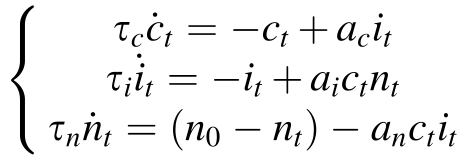 Above: The self-consistent evolution equations for and .
Results: The Geometric Mean Threshold
Using the Adiabatic Approximation (where information changes faster than the overall network state), the authors derived a "Synergetic Potential."
- Chaos: If strategic users are below the critical threshold (), the potential has one minimum at zero (). No one follows the strategy.
- Coherence: Once the number of strategic users exceeds the Geometric Mean of total and critical users (), a new minimum appears.
At this point, the network "decides" on a strategy. Interestingly, the model shows that even if the strategic group is small (), they can spontaneously "impose" their strategy on the massive, randomly acting remainder of the population.
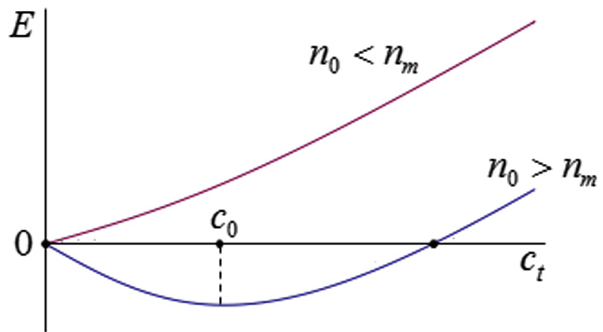 Figure 2: The Synergetic Potential . Note how the minimum shifts away from zero as the ratio increases, signifying the birth of a coherent trend.
Critical Insight & Conclusion
This study provides a rigorous mathematical basis for what we intuitively call "tipping points." In a microblogging context:
- Random Orientation = Unpredictability and "Social Noise."
- Coherent State = Exponential growth of posts and "Social Signal."
The limitation of this work is its reliance on the adiabatic approximation, which assumes information moves instantly. In reality, modern "echo chambers" might introduce delays that could lead to more complex, non-linear oscillations or chaotic attractors rather than a clean phase transition.
Future Outlook: By calculating the of a specific network community, platform moderators (or marketers) could theoretically predict exactly how many "seeds" are required to trigger a self-sustaining viral event.