
IBMM: Scaling Misinformation Blocking with Martingale Theory
3305_A Theoretically Guaranteed Approach to Efficiently Block the Influence of Misinformation in Social Networks.
This paper introduces IBMM (Influence Blocking Maximization using Martingale), a two-step sampling algorithm designed to minimize misinformation spread in social networks under the Competitive Independent Cascade Model (ICM). It achieves a approximation guarantee with near-linear time complexity, significantly outperforming traditional greedy approaches.
TL;DR
The spread of rumors on social platforms can cause real-world panic. The Influence Blocking Maximization (IBM) problem aims to find "savior nodes" to counteract this. While we've had the math to solve this since 2011, it was too slow for big networks. IBMM solves this by using Martingale-based sampling, providing a solution that is both theoretically guaranteed (near-optimal) and fast enough to handle 250k+ nodes in under 4 seconds.
Background: The Scalability Wall
In social network theory, finding the most influential nodes is a classic NP-hard problem. When you introduce a "competitor" (the rumor vs. the savior), the complexity spikes. Traditionally, we used Greedy Algorithms paired with Monte Carlo simulations.
- The Problem: To be accurate, you need tens of thousands of simulations per node.
- The Result: On a medium-sized network like
Email-Eu-All, a standard greedy approach could take hours or even days, making it useless for rapid rumor containment.
Methodology: The Modified RR-Set and Martingale Logic
The authors bypass the "simulation trap" by using Reverse Sampling. Instead of looking forward at where a rumor might go, they look backward from random nodes to see what could have stopped the rumor.
1. Modified RR Set
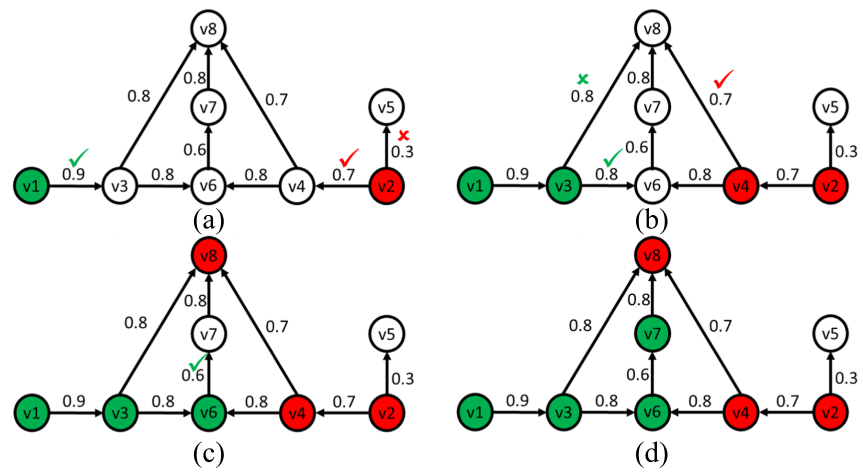
The core innovation is the Modified Reverse Reachable (RR) Set. For a random node , it identifies all potential savior nodes that are "closer" to than the rumor source is. If a savior node can reach through a shorter or equal path than the rumor, it has a chance to "save" that node.
2. Martingale vs. Chernoff Bounds
To guarantee accuracy, you need to know how many samples () to take. Previous methods used Chernoff Bounds, which are statistically "loose," requiring a massive number of samples. By using Martingale Theory, the authors derived a much tighter bound. As shown in the paper's comparison, the Martingale approach () requires significantly fewer samples than the Chernoff approach () to achieve the same confidence level.
Experimental Performance
The researchers tested IBMM against baselines like CELF-Greedy, Random, and Max Degree across several real-world datasets.
- Effectiveness: IBMM's "Saving Ratio" (SR) was virtually identical to the CELF-Greedy algorithm, meaning we lose no "saving power" by switching to the faster method.
- Efficiency: On the
Epinionsdataset, IBMM is orders of magnitude faster.
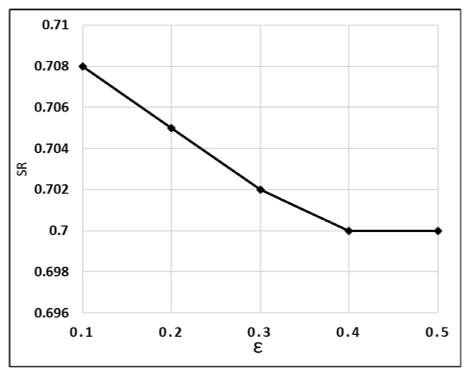
In the figure above, note how IBMM (green lines) maintains low runtime even as the savior budget () increases, while traditional methods struggle.
Critical Insight: Why it Works
The "Secret Sauce" is the Lower Bound Estimation (Algorithm 2). Because you cannot calculate the optimal number of samples without knowing the "true" influence (which you are trying to find), IBMM uses a clever 2-hop neighbor score to estimate a lower bound of the influence. This prevents the algorithm from over-sampling, keeping the runtime near-linear.
Conclusion & Future Directions
IBMM proves that we don't have to choose between mathematical rigor and engineering speed. By refining how we sample the network "backward" and using Martingale theory to stop sampling once we have enough data, we can effectively manage misinformation at scale.
Future work in this area suggests moving beyond the Independent Cascade Model to include Topic-Aware or Location-Aware diffusion, where the savior's influence depends on the subject of the rumor or the physical location of the users.
Author Analysis: This work provides a critical bridge. For practitioners in social media safety, it offers a real-time tool. For academics, it validates the use of Martingale theory in competitive graph dynamics.