
AI Performance x Economic Value: Inductivising Philosophy in Cognitive Systems
Theorizing change in artificial intelligence: inductivising philosophy from economic cognition processes
The paper, "Theorizing change in artificial intelligence: inductivising philosophy from economic cognition processes," proposes a multi-disciplinary framework that integrates AI, cognitive science, and economics. It argues that strong AI systems must incorporate socio-economic-technical value additions and context-specific human-machine interaction, moving beyond simple symbol manipulation to grounded, evolutionary learning.
TL;DR
Artificial Intelligence is at a crossroads where logic and computation meet the messy, value-driven world of human economics. This paper explores how AI can evolve from mere symbolic manipulation to truly "intelligent" systems by grounding its cognitive processes in economic utility, human interaction, and evolutionary learning.
Background: Beyond the Ghost in the Machine
In the early days of AI, intelligence was often treated as a disembodied process—physical symbol systems (PSS) operating in a vacuum. However, as the field matured, the gap between "knowing that" (propositional knowledge) and "knowing how" (practical action) became a bottleneck. The author argues that for AI to fulfill its original promise, it must bridge this gap by incorporating the "Inductive Philosophy" of economic cognition.
Problem & Motivation: The Disembodiment Trap
Why do intelligent programs often fail in real-world scenarios?
- Symbol Grounding: Symbols in a computer don't have intrinsic meaning unless they are connected to the physical or economic world.
- Computational Costs: Real-world reasoning isn't free. Thinking, perceiving, and acting require "costly resources," a concept often ignored by early AI researchers but central to economic theory.
- Static Logic: Traditional AI struggles with the dynamic, unpredictable nature of human preferences and socio-economic shifts.
Methodology: The Interactionist Alternative
The core insight of this paper is the move toward Interactionism. Instead of just "encoding" the world into a database, the system should learn through interaction.
1. The Economic Nexus
The author suggests using the Expected Value of Computation (EVC). This means the AI must decide, in real-time, whether the effort of more data processing is worth the potential economic gain. This mimics human survival and financial strategies.
2. Human-Centered Design
Drawing from the "UTOPIA" project and "Participatory Design," the methodology emphasizes that users shouldn't just be "operators" but part of the feedback loop.
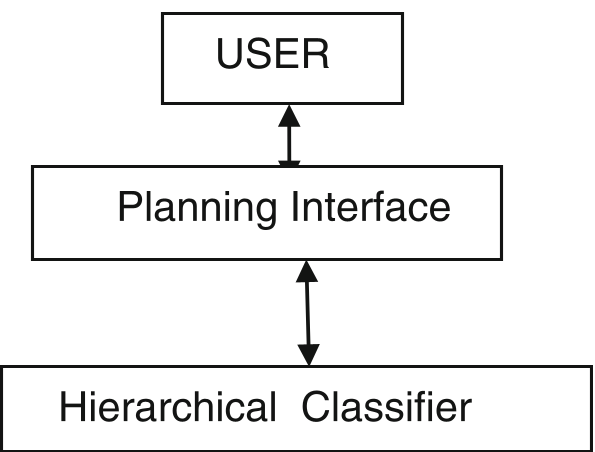 The figure above illustrates a "Plan Selection Problem Solver" using Classification, a prime example of how domain knowledge (Human Capital) is structured to solve asset acquisition problems.
Experiments & Results: AI in the Real Market
The paper cites several "real-world" success stories where this integrated approach has outperformed traditional systems:
- Financial Services: Impactful expert systems like Credex use qualitative risk interval scales to assess credit. By mimicking cognitive psychology, these systems lower mortality expenses and improve pricing accuracy.
- E-Commerce: Agent-based systems that handle fuzzy logic allow for personalized product recommendations that adapt to buyer feedback autonomously.
- Genetic Algorithms: The use of evolutionary "crossover and mutation" algorithms to generate trading strategies shows that AI can find "new equilibrium structures" that traditional economic models miss.
Critical Analysis & Conclusion: The Ethical Horizon
The author leaves us with a provocative takeaway: AI is not just a technological tool; it is a manifestation of human values.
Takeaway
True intelligence emerges when neuronal interaction (Connectionism) meets socio-economic utility. The "third intelligence revolution" is not about faster chips, but about better integration between the strata of biology, commerce, and philosophy.
Limitations
- Responsibility: If a grounded AI makes a mistake (e.g., a false medical diagnosis), who is Liable? The physician, the programmer, or the system itself?
- Bias: Learning modules are prone to systemic bias, especially in behavioral finance.
Future Work
The next step for AI is the development of "socially sustainable" systems that prioritize "Rawlsian Justice"—ensuring that the technological gain is distributed equitably throughout the human-machine network.