
A Theory of Generalization in Deep Learning: Unlocking the Signal Channel
A Theory of Generalization in Deep Learning
The paper introduces a non-asymptotic theory of generalization in deep learning based on the partitioning of the output space by the empirical Neural Tangent Kernel (eNTK). It proposes a "Signal Channel" where signal accumulates through linear drift and a "Reservoir" where noise is trapped in test-invisible dimensions, leading to a practical population-risk training objective that outperforms AdamW in generalization tasks.
TL;DR
Why do deep neural networks generalize even when they have enough capacity to memorize noise? This paper provides a rigorous answer: the Neural Tangent Kernel (NTK) partitions the model's output space. Signal lives in a "fast lane" (the Signal Channel), while noise is trapped in a "parking lot" (the Reservoir) that is invisible to test data. By deriving a practical optimizer gate based on this insight, the authors achieve massive speedups in Grokking and superior performance in DPO fine-tuning.
The Core Intuition: Signal vs. Noise Geography
The paper moves beyond "worst-case" complexity bounds to a path-dependent view of optimization. In the overparameterized regime, the gradient doesn't just "go down"—it's a competition between linear drift (coherent signal) and random walk diffusion (label noise).
1. The Signal Channel and the Reservoir
The authors define the Cumulative Dissipation Gramian ().
- Signal Channel: The range of . These are directions where the training process effectively reduces loss and transmits that change to the test set.
- The Reservoir: The kernel of . These are directions where the model might "memorize" labels, but because the test-train kernel shares the same factors, these directions are algebraically invisible to test predictions.
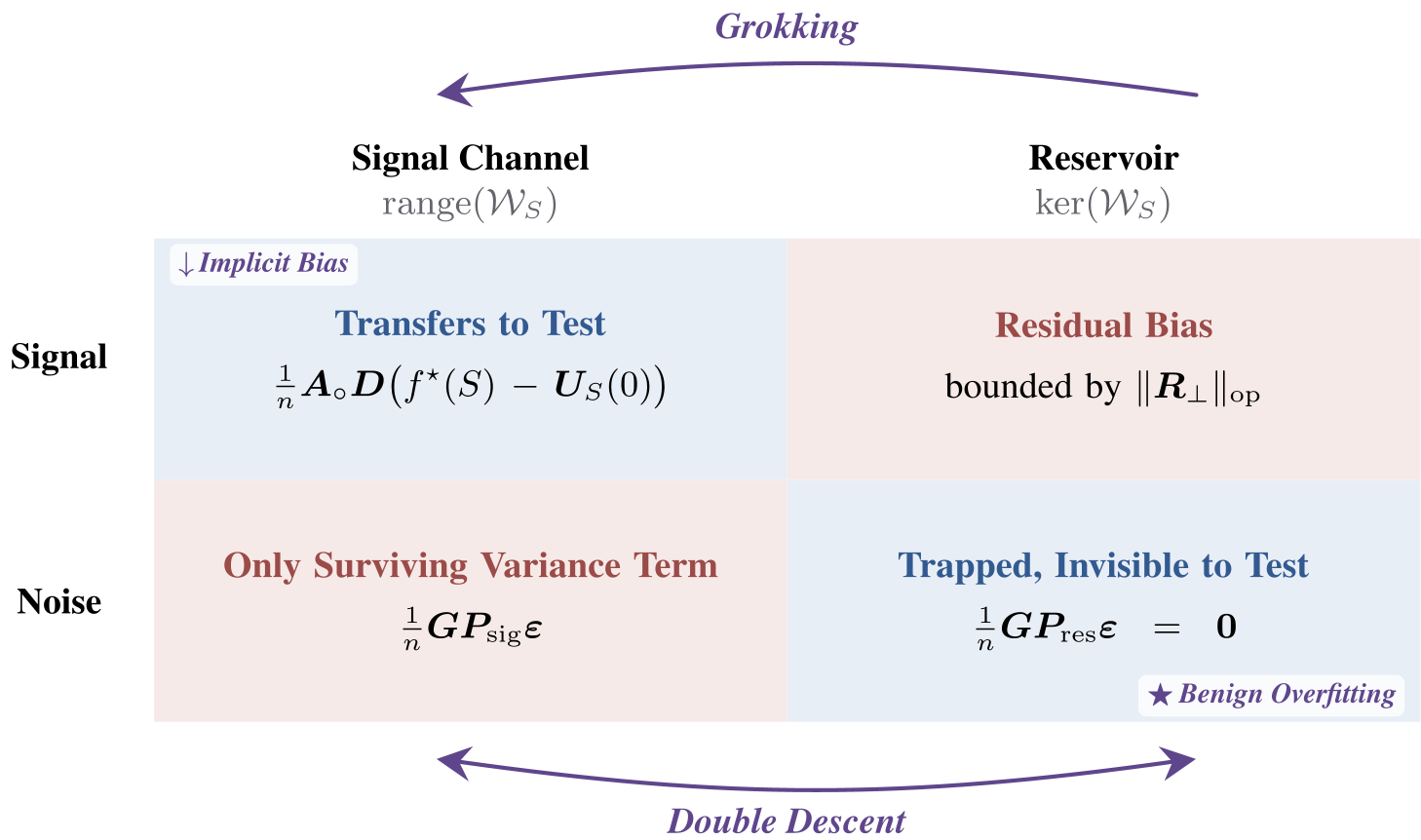 Figure 1: Test error is decomposed into four cells. Generalization succeeds when signal stays in the signal channel and noise is trapped in the reservoir.
Methodology: Training directly on Population Risk
The paper's most impactful contribution is the derivation of a "Population-Safe" rate. Instead of just minimizing Empirical Risk (which includes noise), we want to minimize Population Risk.
The SNR Gate
By analyzing the statistics of minibatches, the authors show that a parameter should only be updated if its "Signal-to-Noise Ratio" is high enough. Specifically, they derive a tight threshold: Where is the mean gradient and is the variance. If a parameter's gradient is mostly noise across the batch, the optimizer simply shuts it off for that step.
Experimental Evidence: From PINNs to LLMs
This isn't just theory; it's a "one-line change to Adam" that delivers SOTA results.
Grokking Accelerated
Grokking—the phenomenon where a model suddenly generalizes long after over-fitting—is explained as signal slowly migrating from the reservoir to the signal channel. The new objective collapses the wait time by roughly 5x.
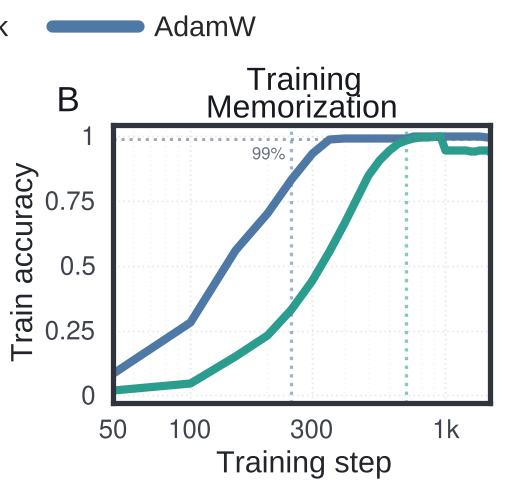 Figure 4: Population-risk training reaches 95% accuracy in 5,950 steps, compared to 29,450 for standard AdamW.
Robust DPO Fine-tuning
In Direct Preference Optimization (DPO), label noise (swapped preferences) often leads to model degradation. The "Population Risk Gate" allows the model to ignore noisy preferences, staying closer to the reference policy while achieving higher accuracy on clean evaluations.
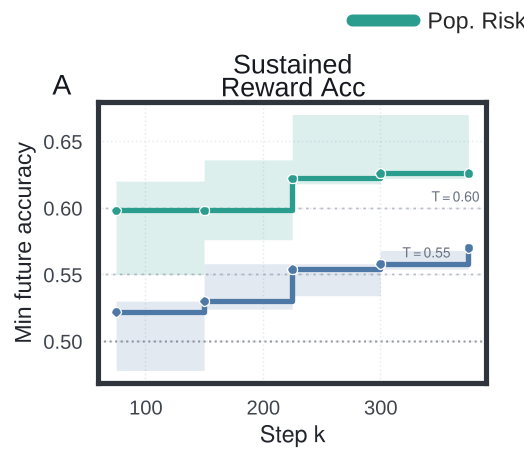 Figure 5: Fine-tuning Qwen2.5-0.5B-Instruct shows sustained reward accuracy and significantly lower drift from the reference policy.
Critical Analysis & Conclusion
The "Why" behind the "How"
The beauty of this theory is its unification of disparate phenomena like Benign Overfitting, Double Descent, and Implicit Bias into one spectral framework. It handles the "full feature learning" regime where the NTK is not frozen, proving that generalization survives even when the kernel evolved significantly (O(1) in operator norm).
Limitations
- Computational Cost: While it's "one extra state vector," computing per-example gradients for the variance estimate can be expensive without efficient
vmapimplementations. - Manifold Assumptions: The Sobolev bounds used for theoretical proofs depend on the data lying on low-dimensional manifolds, which might not perfectly describe high-dimensional unstructured data.
Final Takeaway
This paper marks a transition from viewing deep learning as a "black box" to a predictable physical system where signal and noise are geographically separated in the model's output space. For practitioners, the SNR gate offers a robust alternative to early stopping and standard weight decay.