
Beyond Fact-Finding: The Theoretical Crisis in Early Web 2.0 Social Research
The Use of Theory in Social Studies of Web 2.0
This systematic literature review examines the patterns of theory use across 54 empirical social studies of Web 2.0 applications. The study identifies that while 63% of articles mention theory, the majority use it superficially, with only five studies using theory as a rigorous framework to guide research design and data interpretation.
TL;DR
This meta-analysis reveals a significant "theory gap" in the early social studies of Web 2.0. While researchers were quick to document the explosive growth of platforms like Facebook, very few (less than 10%) used social theories to fundamentally guide their research. The field is characterized by "fact-finding" rather than the "complete research" necessary for academic maturity.
The "Anaemic" State of Digital Social Science
In the late 2000s, Web 2.0 was an umbrella term coined by practitioners, not academics. This origin story resulted in a research landscape where the term was widely used but poorly defined. The authors argue that scientific maturity is marked by the use of theory as a "generalization" that explains facts. Without it, research remains a collection of anecdotes about college students on Facebook.
The core problem identified is a lack of cohesion. Many papers mention a theory in the abstract or literature review but fail to apply it to their methodology or use their data to challenge/refine the theory.
Methodology: Mapping the Theory Landscape
The researchers analyzed papers from two major databases, filtering for peer-reviewed, empirical data that focused on human behavior rather than technical infrastructure.
Note: The selection process filtered 141 initial articles down to 54 core empirical studies to ensure a focus on original research data.
Key Findings by the Numbers:
- Academic Dominance: 100% of authors were affiliated with academic institutions, yet theoretical rigor remained low.
- Social Science Centric: 94.4% of authors came from Social Science backgrounds (Information Science, Psychology, Sociology).
- Platform Bias: Research was disproportionately focused on Facebook (33.3%) and MySpace (22.2%).
The Core Issue: Superficial Theory Use
While 63% of the sampled articles mentioned a theory, the authors distinguish between mentioning and using.
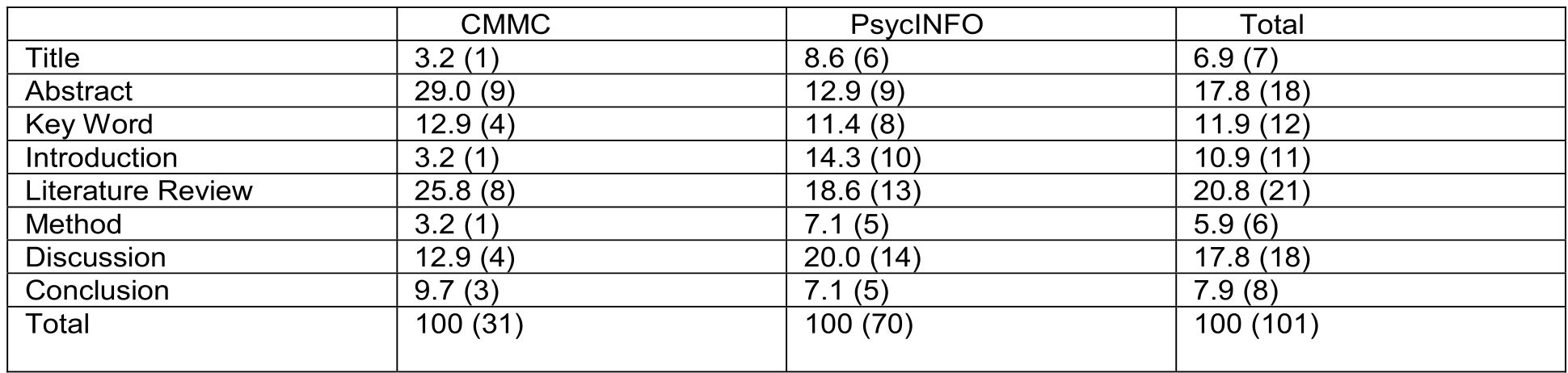
As shown in the data above, theories were most frequently cited in the Literature Review (20.8%) and Abstract (17.8%), but rarely in the Method (5.9%) section. This suggests that theory was often used as "window dressing" rather than a foundational blueprint for the research.
Top Theories Identified:
- Social Network Theory (and Mark Granovetter’s "Weak Ties")
- Social Capital
- Erving Goffman’s Self-Presentation
- Communities of Practice (CoPs)
Critical Insights & Future Outlook
The study concludes that early Web 2.0 research was in a "fact-finding" stage. For a field to advance, it must transition to "complete research" that:
- Explains all relevant facts simply.
- Predicts future social behaviors.
- Refines existing theories (like Weak Tie theory) through the lens of new digital affordances.
Limitations & Observations
The paper notes an over-reliance on "convenience samples" (college students). This limits the generalizability of Web 2.0 theories as older populations began adopting these technologies. Furthermore, the absence of research on emerging tools like Twitter or Wikis in the 2010 sample suggests that academic research often lags behind the "bleeding edge" of social practice.
Conclusion
Theory is not just a scholarly ornament; it is the framework that turns data into knowledge. As we move further into the age of AI and the Metaverse, this 2010 critique serves as a timely reminder: data without theory is just noise, and research without a "Why" remains incomplete.