
Thermal Emotion Classifiers: Revolutionizing Empathy in Human-Robot Interaction
A thermal emotion classifier for improved human-robot interaction
This paper presents a novel thermal emotion classifier designed for Human-Robot Interaction (HRI) using Far Infrared (FIR) thermography. By tracking localized thermal changes in five facial regions, the researchers developed a Support Vector Machine (SVM) classifier capable of distinguishing between happy and angry states with 77.5% accuracy.
TL;DR
Researchers have successfully developed a non-contact thermal emotion classifier that identifies "Happy" vs. "Angry" states with 77.5% accuracy. Unlike standard cameras, this thermal approach ignores cultural/age-related facial expressions and focuses on raw physiological heat signatures, making it a game-changer for socially assistive robots.
Context: Why Heat Matters More Than Smiles
As robots transition from industrial cages to our living rooms and hospitals, they need to read our "vibe." Standard emotion detection (CV-based) often fails because:
- Cultural Variance: A "smile" or "frown" varies across the globe.
- Invasiveness: Wearable heart-rate or skin-conductance sensors are uncomfortable for long-term use.
- Ambiguity: Subtle facial cues are hard to interpret in varying light conditions.
Infrared Thermography (IRT) offers a "cheat code"—it measures the autonomic nervous system's response directly via blood flow changes in the face, which is much harder to mask or fake than a facial expression.
Methodology: The Thermal Map of Emotion
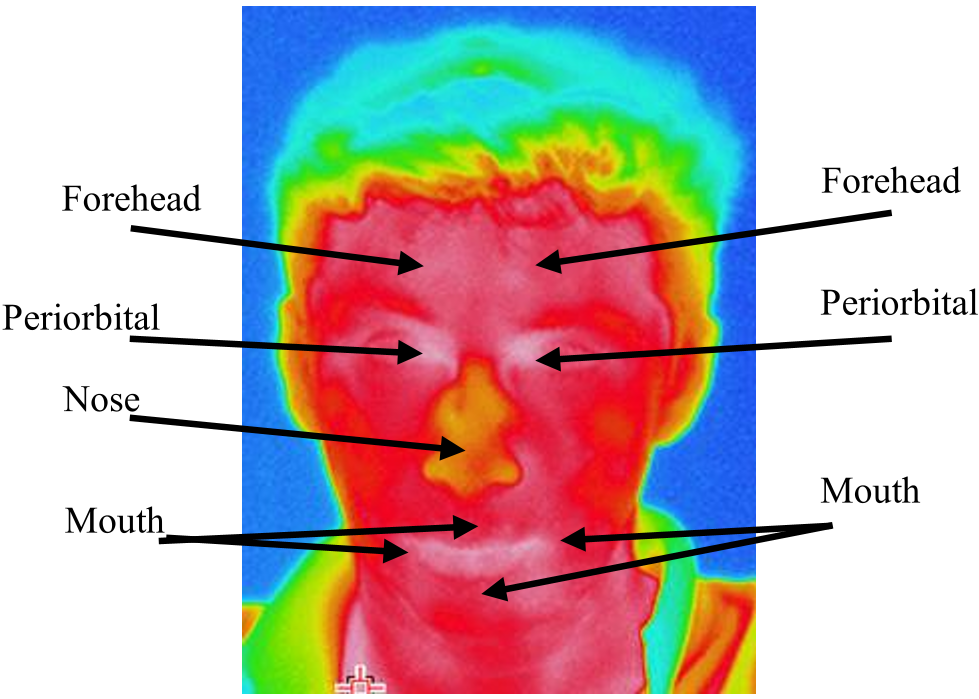
The researchers used a high-resolution Far Infrared (FIR) camera to monitor 10 participants during two distinct scenarios: interacting with a "Keepon" robot and watching evocative video clips.
The Five Regions of Interest (ROIs)
Instead of looking at the whole face, the team focused on:
- Forehead
- Periorbital area (around the eyes)
- Nose Tip (The most sensitive thermal indicator)
- Cheeks
- Mouth
Intuition: The Nose Knows
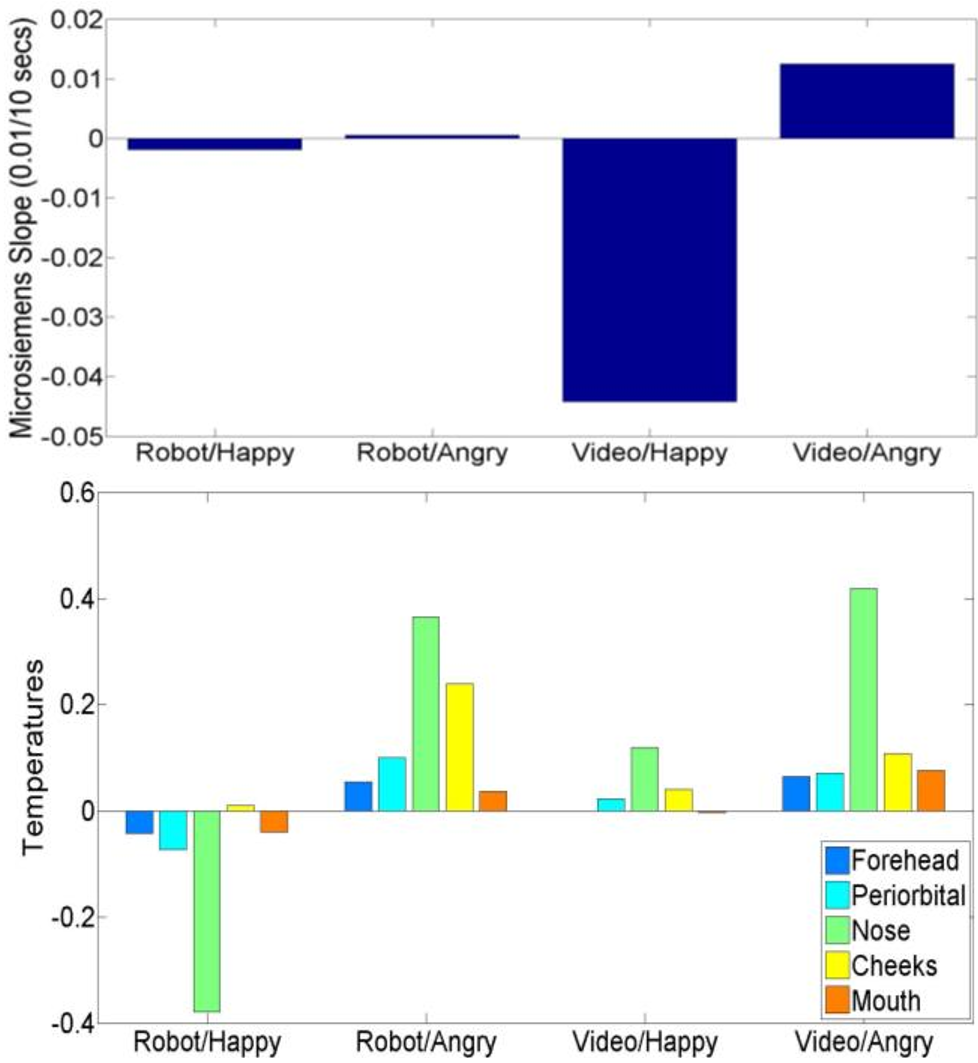
The key finding was that thermal slopes (the rate of change in temperature) were the primary indicators. During "Angry" phases (elicited by a robot intentionally giving wrong trivia answers), facial temperatures—especially the nose—exhibited a sharp upward slope. Conversely, "Happy" states showed flattening or declining temperatures.
Experimental Results & Insights
The study utilized Principal Component Analysis (PCA) to distill the complex thermal data into three main components that explained over 90% of the variance.
Performance Highlights:
- Classification Accuracy: 77.5% using a Support Vector Machine (SVM).
- Correlation: Robot-elicited happiness and anger resulted in thermal trends nearly identical to those elicited by validated video clips, proving that robots are effective "emotional triggers."
- The EDA Paradox: Interestingly, Electrodermal Activity (EDA) did not strongly correlate with thermal changes, suggesting that thermal imaging captures unique physiological signatures that traditional "lie detector" tech might miss.
Critical Analysis & The Path Forward
While the 77.5% accuracy is impressive for a small sample (n=10), the study highlights a few key areas for growth:
- Latency: There is a physiological delay in thermal response compared to instant facial expressions.
- Multi-state classification: The current model is binary (Happy vs. Angry). Future work must tackle "Frustration" or "Sadness" to be truly useful in complex healthcare settings.
Conclusion
This research marks a significant step toward physiologically-aware robots. By "seeing" the heat of frustration or the cooling of relaxation, future robots can adjust their behavior in real-time—backing off when a student is stressed or engaging more when a user is happy—all without the user needing to say a single word.